If you’re researching what is shopify, you’re usually trying to answer one practical question: Is this the right platform to sell online for my business—without overcomplicating the build?
Shopify is one of the most popular ways to launch an online store fast, but it’s not “perfect for everyone.” The real decision comes down to trade-offs: ownership vs convenience, cost over time, checkout flexibility, and how much complexity your business needs.
In this 2026 guide, Shopify is explained in plain language, with a clear framework to decide if it fits your goals—especially if you’re building in the UAE market.
Want a fast Shopify fit check for your UAE store? Message Lucidly on WhatsApp.
Shopify Explained: What It Is (and What It Isn’t)
Before comparing features, it helps to anchor the definition. Most confusion around what is shopify comes from mixing up “platform” with “website,” and “hosting” with “ownership.”
What is Shopify in simple terms?
Here’s the simplest shopify meaning: Shopify is a hosted ecommerce solution that lets you build, run, and manage an online store without having to maintain servers, security patches, or complex infrastructure.
In other words, Shopify is a shopify ecommerce platform where the technical foundation is handled for you, and you focus on products, marketing, and operations.
Before we go deeper, keep this mental model in mind: Shopify is not just a theme or a shopping cart—it’s a complete storefront system that includes product management, payments options, checkout, and integrations.
For a deeper understanding of when Magento is the better choice compared to Shopify, check out [Magento vs Shopify (2026): When Magento Makes Sense and When Shopify Wins]."
In simple terms, Shopify gives you:
A hosted store builder and backend to manage products and orders.
A checkout flow that’s designed to convert on mobile.
A theme system for design and layout control.
An app ecosystem to extend functionality without custom code.
Now let’s clarify what it isn’t, so you don’t choose it for the wrong reasons.
Shopify is not:
A fully custom system built exactly around your internal workflows.
A “cheap once and done” website if you rely heavily on apps.
A self-hosted platform where you control every technical layer.
Shopify platform overview (2026)
To answer what is shopify properly, you need a quick platform overview.
Shopify sits in the “managed convenience” zone: you pay a monthly subscription, the platform handles the infrastructure, and you trade some deep control for speed and reliability.
Before we move into setup and checkout, here’s the core value proposition:
Shopify’s core promise:
Launch faster with fewer technical dependencies.
Maintain stability and security without an in-house DevOps team.
Scale most stores smoothly as catalog and traffic grow.
"After understanding the basics and features of Shopify, the next step is to explore the Top Shopify Development Companies Abu Dhabi to ensure a successful launch for your project."
How Shopify Works (From Store Setup to Checkout)
Once you understand what is shopify, the next intent is usually: How does it actually work day-to-day?
This section is written for shopify for beginners, but it’s also useful if you’re deciding between Shopify and other platforms.
Setup basics for Shopify for beginners
To reduce confusion, think of Shopify setup as building three layers: store foundation, catalog, and operations.
You choose a plan, select a theme, configure products, then connect payments and shipping.
If you need a practical guide to tax setup, read: UAE VAT on Shopify: Practical Setup for Taxes, Invoices, and Compliance.
Before you jump into tools, start with outcome clarity: Do you need a simple D2C store, a brand catalog with strong product pages, or a more complex ecommerce workflow?
Typical setup steps (high level):
Choose a plan (subscriptions) that matches your feature needs.
Connect your domain and configure basic settings (currency, taxes, policies).
Build categories/collections and upload products with clean variants.
Configure shipping rules and returns logic.
Set up key pages: shipping, returns, privacy, and contact/WhatsApp.
If you need a practical guide to delivery setup, read: Shopify Shipping UAE: Aramex Integration, Zones, COD, Tracking, and Returns.
Themes: what you control vs what you don’t
Themes are Shopify’s design layer, and Shopify theme customisation is what helps merchants adapt that layer to real business and conversion goals. They control layout, typography, product page templates, and many conversion elements—especially on mobile.
Before you pick a theme, treat it like choosing a store layout. A beautiful theme that loads slowly or hides key info can reduce conversions fast.
What themes typically control well:
Page layout structure (home, collection, product, cart).
Navigation patterns and menus.
Product page sections and content blocks.
Mobile design patterns and UX flow.
Theme limitations to keep in mind:
Deep structural changes may require developer work.
Some themes rely on heavy scripts that harm performance.
Not every theme is built equally for Core Web Vitals.
Apps: power vs risk
Apps extend Shopify quickly—loyalty, subscriptions, reviews, upsells, bundles, analytics, and more. But apps are also where costs and performance issues often hide.
Before you install ten apps, decide what the store must do on day one vs later. Many “nice-to-have” features can wait until after the first sales data comes in.
Apps are great when you need:
Fast feature deployment without custom development.
Tested solutions for common ecommerce problems (reviews, email capture, shipping logic).
Integrations with services you already use.
Apps become a risk when:
Too many scripts slow the site and hurt conversion.
Monthly app fees stack up and inflate total cost.
Multiple apps conflict and break UI consistency.
Checkout: why it converts (and limits you should know)
Checkout is one of Shopify’s biggest strengths for many merchants. A reliable, mobile-friendly checkout removes friction where most revenue is won or lost.
Before you choose Shopify solely for checkout, understand the trade-off: Shopify’s checkout is optimized and stable, but customization depth can depend on your plan and the boundaries Shopify sets.
Checkout advantages many stores benefit from:
Fast, familiar flow that reduces hesitation.
Strong compatibility with mobile purchasing patterns.
A platform focus on security and stability.
Checkout constraints to evaluate:
Some deep custom flows are harder than on custom platforms.
Certain business logic may require specific apps or plan upgrades.
At this point, shopify explained should feel less abstract: it’s a managed platform that accelerates launch and conversion, but asks you to accept platform rules.
If you are considering flexible payment options for UAE shoppers, read: BNPL on Shopify UAE: Tabby vs Tamara (Setup, Widgets, and Best Practices).
Shopify Pros and Cons (Real-World, Not Marketing)
If your next search is “shopify pros and cons,” your intent is decision-making. You want the truth, not brochure language. So we’ll cover the realistic upsides and the common pain points.
Pros — Why use Shopify
Before listing benefits, match them to business reality: Shopify shines when you want speed, stability, and a proven ecommerce foundation with less technical overhead.
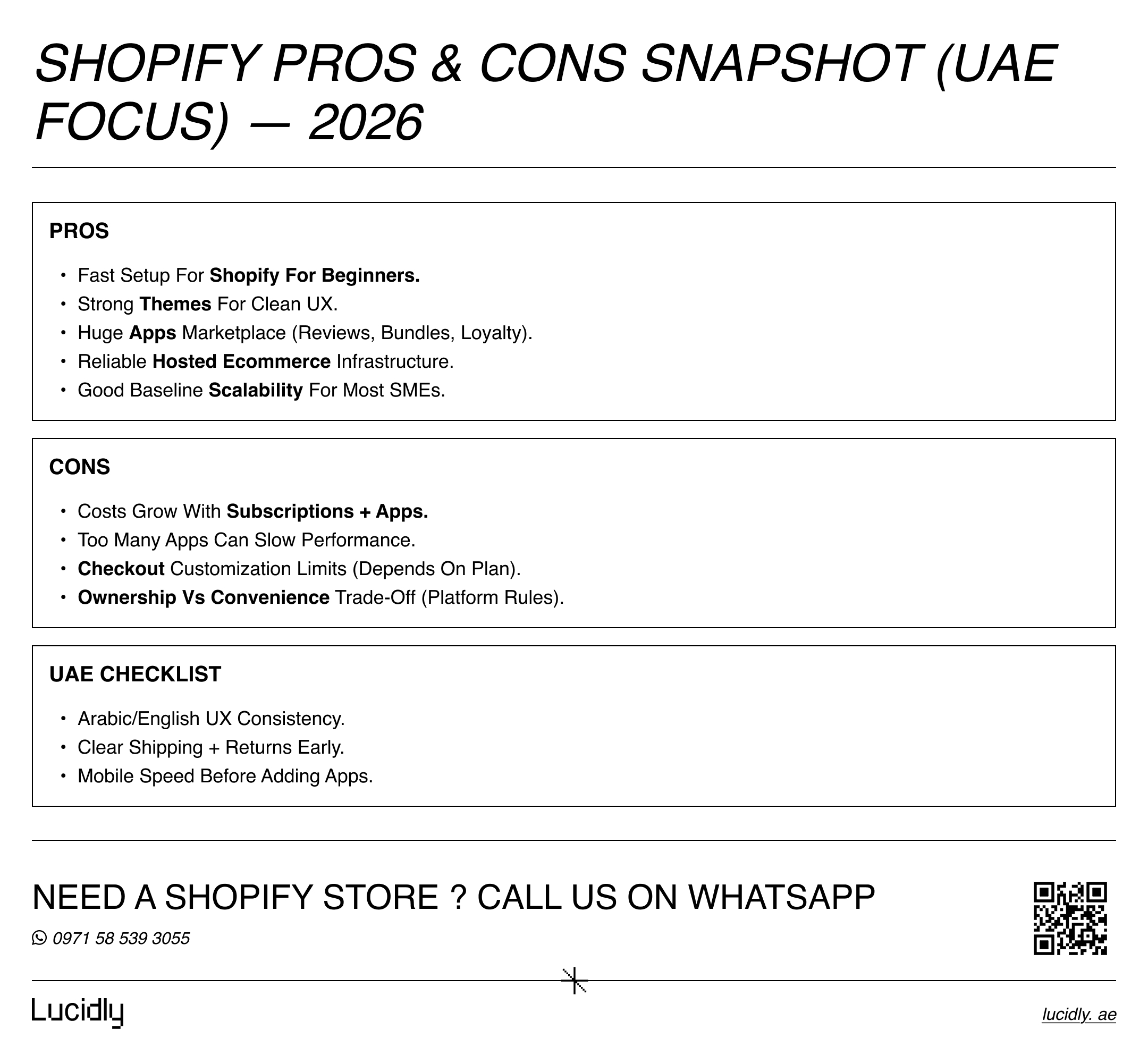
Top Shopify advantages:
Fast launch because hosting, security, and core ecommerce features are built in.
High-quality theme ecosystem that gets you to “good enough” design quickly.
Strong app ecosystem for common growth features and integrations.
Reliable checkout that often performs well on mobile.
Scalability for most small-to-mid brands as traffic and catalog grow.
Cons — What Shopify is bad at
Before you commit, evaluate the friction points. Most Shopify “cons” are not dealbreakers—unless they collide with your business model.
Common Shopify drawbacks:
Total cost can increase as you add apps, upgrades, and paid themes.
Deep customization can be constrained by platform boundaries.
Ownership vs convenience trade-off: you don’t control every layer the way you would on self-hosted systems.
Some complex B2B workflows require more engineering than teams expect.
To re-anchor what is shopify as a choice: Shopify is often the fastest path to a reliable store, but not always the best path to a deeply customized commerce system.
If you need help choosing the right payment setup, read our guide: Payment Gateways Shopify UAE: How to Choose and Integrate.
Is Shopify Worth It in 2026? (Cost, Value, and Trade-Offs)
When people ask is shopify worth it, they’re rarely asking about the subscription alone. They’re asking about total cost vs the speed and reliability they gain.
What you really pay for (beyond the plan)
Before you compare platforms, compare “total system cost.” Shopify is a subscription platform, but many real-world stores pay beyond the plan because of apps, paid themes, and occasional dev work.
Typical cost buckets to consider:
Shopify subscriptions and any plan upgrades you may need.
Themes (free vs paid) and optional design customization.
Apps (monthly fees) for features like reviews, bundles, subscriptions, or advanced reporting.
Development time for branding, UX improvements, and performance tuning.
Ongoing optimization costs as you test and improve conversion.
Ownership vs convenience: choose your constraint
This is the heart of the decision. Some businesses want maximum control and ownership. Others want maximum convenience and speed.
Before you decide, answer this: do you want to “own the system” or “own the outcome”? Shopify tends to optimize for outcome and operational simplicity.
When convenience wins:
You don’t want to manage hosting, updates, and security.
You want a store live quickly and iterated after launch.
Your team is small, and speed matters more than perfect customization.
When ownership wins:
You need deep custom workflows and unique business logic.
You require full control over architecture and data patterns.
You have technical resources to maintain and evolve a system.
A quick “worth it” checklist (yes/no in 30 seconds)
Before we move into who Shopify fits, here’s a fast filter.
Shopify is usually worth it if:
You want to launch quickly and improve through iteration.
Your catalog and operations are fairly standard for ecommerce.
You value stability and a proven checkout experience.
You can manage apps carefully to avoid cost and speed bloat.
Shopify is usually not worth it if:
Your business depends on deep checkout or workflow customization from day one.
You need full ownership and control over the infrastructure and codebase.
Your ecommerce model is extremely complex and not app-friendly.
Shopify is a subscription platform, but many real-world stores pay beyond the plan for apps, themes, and dev work. See Shopify Website Cost UAE (2026) for details.
Who Should Use Shopify (and Who Shouldn’t)
If you’re still thinking about what is shopify, you’re likely close to the decision point. This section turns the platform overview into clear fit categories.
Shopify is right for you if…
Before you choose, picture your first 90 days: you want momentum, not months of building.
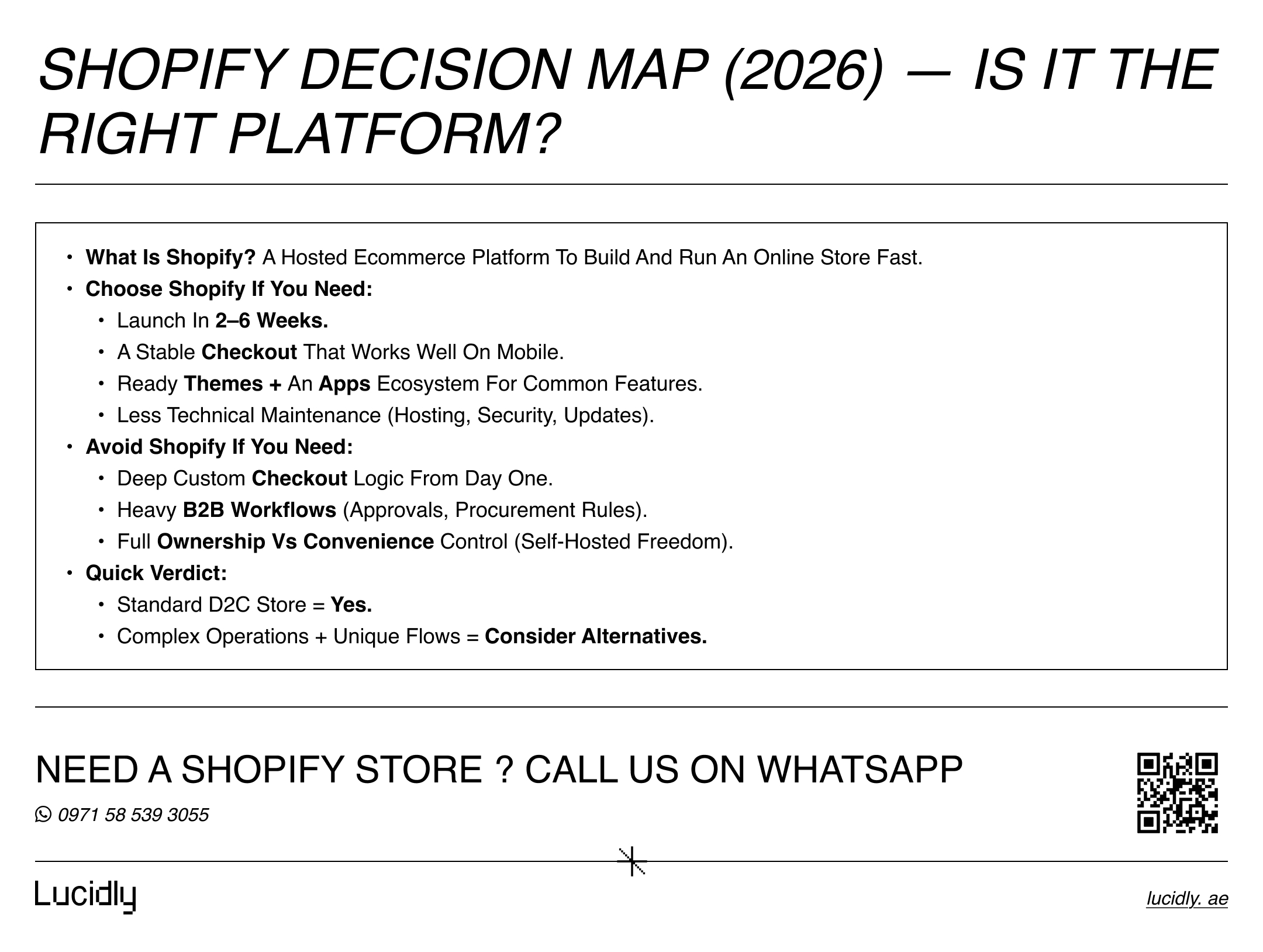
Shopify is a strong fit when:
You’re a startup or SME launching D2C with a clean product catalog.
You want a professional store without needing a large technical team.
You plan to test offers, pricing, and product positioning quickly.
You’re comfortable using themes and a small set of high-quality apps.
You want a platform that supports growth and basic scalability.
Shopify is not ideal if…
Before you force Shopify into a complex model, recognize the signs early.
Shopify may be a poor fit when:
You need custom procurement flows, approvals, or complex B2B logic.
You require heavy ERP integrations with unique processes.
Your checkout must behave in highly specific ways beyond typical ecommerce norms.
You want maximum control and ownership vs convenience.
You have a technical team ready to build and maintain a tailored system.
If you’re new to ecommerce, Shopify for beginners is still one of the clearest “start here” choices—but only if your model fits the platform boundaries.
If Shopify is the right fit for your store, explore Top Shopify Development Companies Sharjah (2026): Best Options Compared to compare local partners and choose the best option for your launch.
Shopify for UAE Stores (2026): What Changes Locally?
For UAE merchants, “platform fit” isn’t only technical—it’s operational. Payments behavior, delivery expectations, and bilingual UX all shape conversion.
Before we answer the UAE question directly, treat the UAE market as mobile-first and trust-sensitive: if your store feels slow, unclear, or inconsistent across Arabic/English, conversion drops.
Is Shopify good for small businesses in the UAE?
In many cases, yes—Shopify can be a strong option for small businesses in the UAE because it reduces technical workload and helps you launch with a stable ecommerce foundation. But you still need to do the local readiness work: policies, delivery clarity, and bilingual experience.
Before you commit, confirm that your store can support UAE expectations without excessive app dependence.
If you are selling in the UAE, read our guide: Shopify Payments UAE: What to Use Instead and How to Set It Up.
Where Shopify often helps UAE SMEs:
Fast launch for seasonal campaigns and new product lines.
Stable hosted ecommerce infrastructure without needing a big tech team.
Themes and apps that can support common conversion features quickly.
A checkout flow that typically performs well on mobile shoppers.
Where UAE stores still need careful planning:
Bilingual UX: Arabic/English switching must feel consistent and trustworthy.
Delivery transparency: rates, timelines, and returns must be clear early.
Performance discipline: too many scripts and apps can slow mobile experience.
If your store needs a smoother bilingual experience, read: Arabic and RTL on Shopify: Language Setup, Bilingual Navigation, and UX Tips.
UAE readiness checklist (before you launch)
Before the store goes live, use this checklist to reduce friction.
UAE launch checks:
Confirm Arabic/English UX doesn’t break layout, tracking, or navigation.
Make shipping and returns policies extremely clear on product and cart pages.
Keep your theme lean and performance-focused before installing many apps.
Test checkout end-to-end on mobile using real payment scenarios.
Set trust signals: contact options, WhatsApp, policies, and brand credibility.
If you want a Shopify store built for speed, trust, and conversion, explore Lucidly’s Shopify Development UAE.
Shopify Alternatives (When Shopify Isn’t the Best Fit)
Sometimes the best decision is “not Shopify.” That doesn’t mean Shopify is bad—it means your model needs different constraints.
Before you choose an alternative, identify the reason: do you need more ownership, more custom logic, or more control over data and infrastructure?
Common alternatives by need:
WooCommerce: stronger ownership and customization, but higher maintenance and hosting responsibility.
Custom build: maximum flexibility, but higher cost, longer timelines, and more ongoing engineering demands.
Other hosted platforms: may fit specific needs, but compare ecosystem depth and integration options carefully.
If your main requirement is speed with a proven foundation, Shopify remains a top contender. If your main requirement is deep customization and ownership, alternatives may fit better.
If Shopify feels like the right fit, this guide to Top Shopify Development Companies Dubai (2026): Best Options Compared can help you choose the right partner for setup, design, and launch.
Decision Framework: Pick Shopify in 5 Minutes
At this stage, you likely understand what is shopify and you want a decision you won’t regret. Use this five-question framework to choose fast.
Before you answer, be honest about your resources and timeline—not just your “ideal” platform.
5 questions to decide fast
Ask these and score each as “low / medium / high”:
Do we need to launch within weeks (not months)?.
Do we require deep customization of checkout and core flows?.
Will monthly app costs stay controlled if we scale features?.
Do we have a technical team to maintain a more complex platform?.
Is our “scalability” about traffic and catalog, or about complex operations?.
If your answers cluster around speed, simplicity, and controlled complexity, Shopify is often the right call. If your answers cluster around deep customization and heavy workflows, Shopify may fight you over time.
This is the practical shopify platform overview in decision form: Shopify is built to make standard ecommerce easier, faster, and more stable.
FAQs
What is Shopify in simple terms?
Shopify is a hosted ecommerce platform that lets you launch and run an online store without managing servers. It includes products, payments, themes, apps, and checkout—trading some control for convenience, stability, and speed.
What are the main pros and cons of Shopify?
Pros: fast launch, reliable hosting/security, strong themes, a huge app ecosystem, and conversion-friendly checkout. Cons: costs can rise with apps, deep customization has limits, and you trade ownership for convenience.
Who should use Shopify and who shouldn’t?
Shopify fits small-to-mid businesses that want to launch quickly and run standard ecommerce. It’s not ideal for businesses needing complex custom workflows, specialized checkout logic, heavy B2B/procurement, or full technical control.
Is Shopify good for small businesses in the UAE?
Often yes—Shopify can speed up launch and provide a stable base. But UAE results depend on bilingual UX, clear shipping/returns, strong mobile performance, and trust signals—keep apps controlled and test checkout on mobile.
"If Shopify fits your store, here’s a shortlist of top development companies UAE and tips to choose the best."
When Shopify Is the Right Ecommerce Platform
If your real goal behind what is shopify is “launch fast, sell reliably, and improve through iteration,” Shopify is often the right ecommerce platform. It’s especially strong for businesses that want a managed, hosted ecommerce foundation with proven themes, apps, and a conversion-focused checkout.
If your business requires maximum ownership, highly customized workflows, or deep checkout customization as the core differentiator, Shopify may not be your best long-term fit. In that case, consider platforms that trade convenience for control.
Want a clearer decision on whether Shopify is the right platform for your UAE store? Message Lucidly on WhatsApp—or use the numbers on our Contact Us page to book a quick Shopify fit audit.
References
Shopify Help Center — Intro to Shopify (Overview). (Shopify Help Center)
Shopify — Plans & Pricing (subscription tiers and included features). (Shopify)
Shopify App Store — Apps marketplace (categories and app ecosystem). (Shopify App Store)
Shopify Changelog — Checkout extensibility on Shopify Plus (Plus checkout customization approach). (changelog.shopify.com)