A website redesign can feel like a “design project.” In reality, it’s a business decision that affects your visibility on Google, your conversion rate, and your credibility—especially in competitive markets like Dubai and the UAE.
If your site is live but results are flat, leads are declining, or the experience feels dated on mobile, you don’t always need a full rebuild. What you need is a clear website redesign strategy: knowing when to redesign, what to change, and how to do it without losing SEO rankings.
This guide will walk you through a practical, step-by-step process to plan a redesign that improves UX, performance, technical SEO, and conversions, while protecting what already works.
Contact Lucidly on WhatsApp for a focused website redesign and technical SEO review—so you can identify gaps and fix them before they impact leads and sales.
The Real Goal of a Redesign (It’s Not “A New Look”)
A successful website redesign strategy doesn’t start with colors and layouts. It starts with outcomes. The goal of redesigning an existing site is to remove friction and create a faster, clearer path from visitor to inquiry, booking, or purchase.
In the UAE market, small differences matter. When two businesses offer similar services, users will choose the website that loads faster, feels more trustworthy, and makes it easier to take action—especially on mobile.
A strong website redesign strategy typically aims to improve:
Conversion rate and lead quality.
Mobile usability and navigation clarity.
Speed and Core Web Vitals performance.
SEO stability and long-term organic growth.
Brand confidence and credibility.
Launching a website often feels like crossing the finish line. In reality, it’s only the starting point.
Learn what web development really does for modern business websites and why a solid foundation makes redesigns faster and more effective.
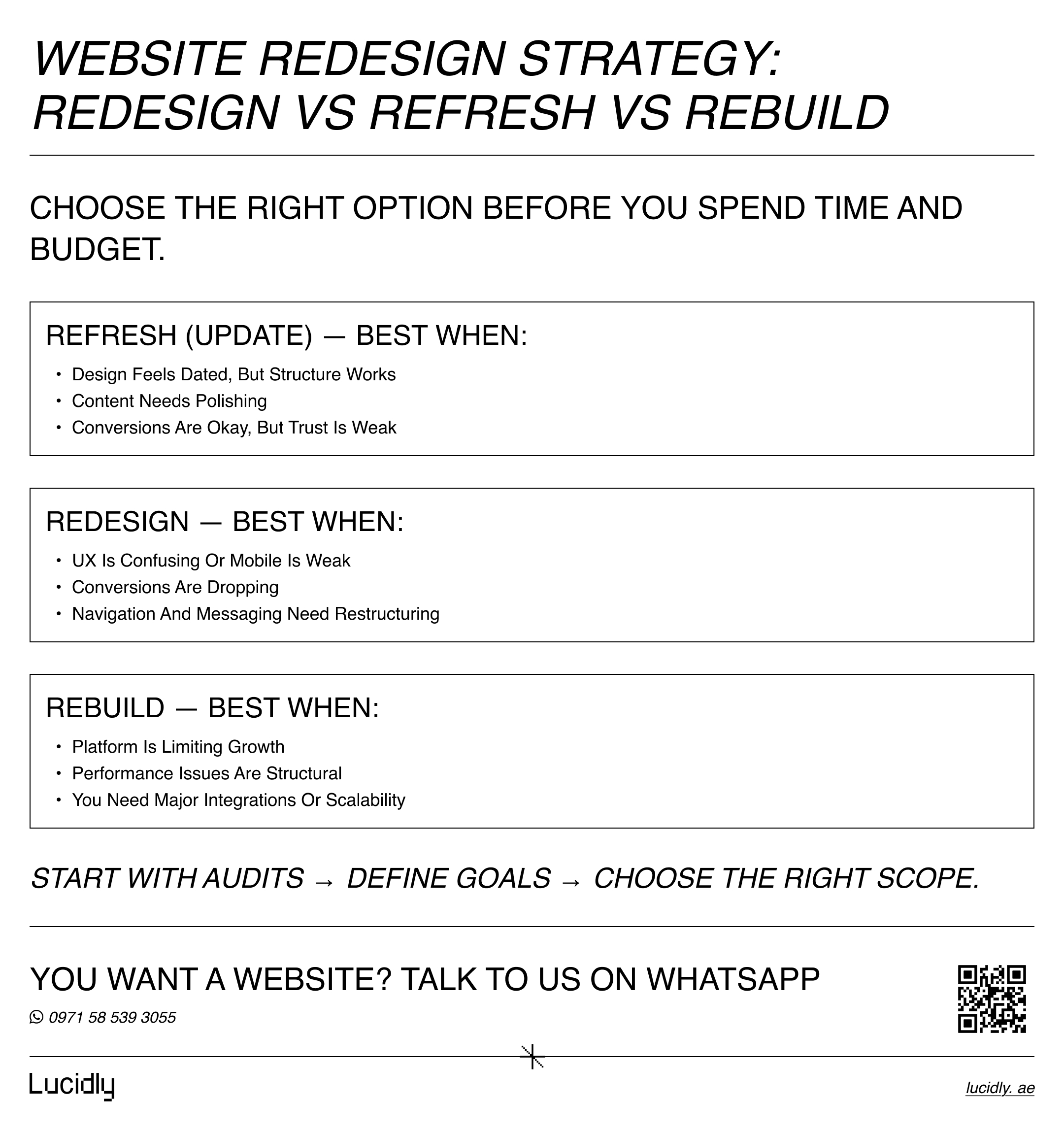
Redesign vs Refresh vs Rebuild (Choose the Right Move)
Before you plan budgets or timelines, you need to define what kind of update you actually need. Many businesses call everything a “redesign,” but the scope can vary dramatically.
A website refresh is a surface-level update. It improves visuals and content without changing the structure.
A redesign is a structured improvement. It often changes layout, messaging, UX flow, and content hierarchy while keeping the platform mostly intact.
A rebuild is a technical shift. It usually involves changing platform, rebuilding templates, or restructuring architecture from the ground up.
A simple way to decide is to ask one question:
Are your problems mostly about appearance and clarity, or are they structural and technical?
If you’re seeing SEO issues, mobile friction, or performance problems, a strategic redesign is usually the right path.
Clear Signs It’s Time to Redesign Your Website
Most redesign decisions should be driven by data, not feelings. A smart website redesign strategy starts by spotting patterns that show your current site is no longer supporting growth.
One common signal is when traffic stays steady but conversions drop. Another is when mobile users bounce quickly because the experience feels slow, unclear, or hard to navigate.
You may need to activate a website redesign strategy if you’re experiencing:
Declining conversions or lower-quality leads.
Weak mobile responsiveness or poor Core Web Vitals.
Slow loading speed despite “good hosting”.
A brand identity that no longer matches your business.
Content that’s difficult to update or scale.
SEO visibility that drops after small site changes.
When these issues appear, redesign isn’t a “nice to have.” It’s a performance fix that protects leads, rankings, and long-term growth.
Before You Redesign: Run These 3 Audits First
A redesign strategy becomes clear once you measure what is working, what is broken, and what needs to be protected.
These three audits will prevent costly mistakes and help you prioritize changes that actually move the needle.
1) Performance & Technical Audit
Speed and stability issues don’t fix themselves with new design. If the foundation is heavy or outdated, you’ll carry the same problems into the new version.
Start by establishing a baseline for:
load speed and Core Web Vitals.
mobile experience and responsiveness.
broken elements, scripts, or plugin conflicts.
hosting limitations and caching/CDN opportunities.
This gives you the “before” snapshot you’ll later use to prove improvement.
2) SEO Audit (Protect What Already Works)
The biggest redesign mistake is accidentally deleting your best-performing pages. Before you change anything, identify the pages, keywords, and URLs that currently drive results.
A practical SEO audit before redesign focuses on:
top landing pages by organic traffic.
pages that rank for valuable keywords.
backlinks pointing to specific URLs.
indexing status, crawl errors, and duplicate content risks.
The goal is simple: redesign without losing the SEO assets you already earned.
3) UX & Conversion Audit
Redesign should reduce friction. That means you need to know where users get stuck today.
A UX-focused audit helps you understand:
where users drop off in key journeys.
which CTAs get ignored.
why forms are abandoned.
which pages create confusion or mistrust.
This is where your redesign strategy becomes practical, not cosmetic.
Speed and stability issues don’t fix themselves with new design. If the foundation is heavy or outdated, you’ll carry the same problems into the new version.
Related reading: how to plan a website from business goals to architecture for smoother UX and scalable design.
The Step-by-Step Website Redesign Strategy (Practical Framework)
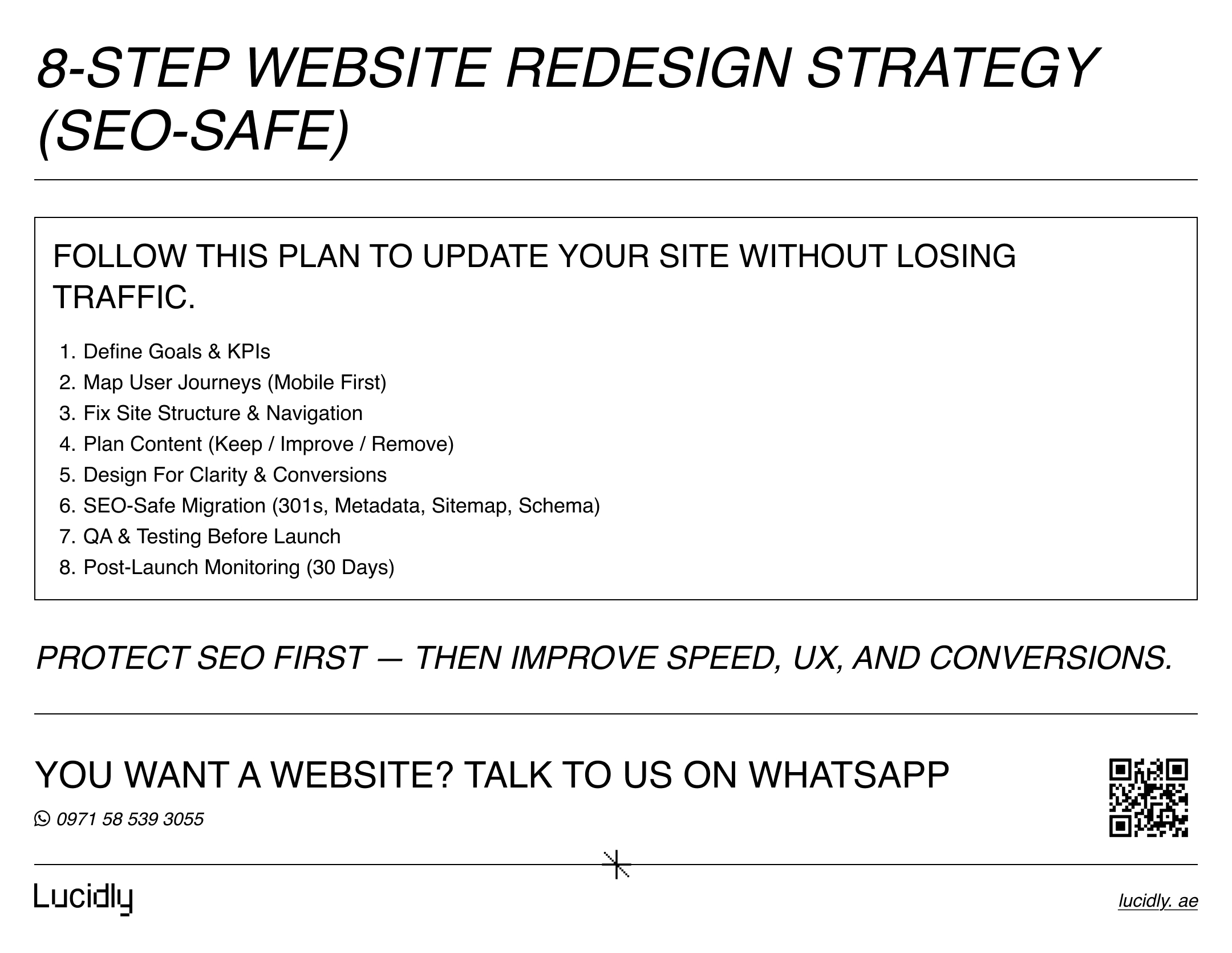
At this point, you have the inputs. Now you need a process that turns those insights into a redesign plan you can execute without chaos.
Step 1 — Define Business Goals and KPIs
A redesign should be measured. Otherwise, you’ll launch a new site and still wonder whether it worked.
Choose a few KPIs tied to growth, such as:
conversion rate from key pages.
number of qualified inquiries.
booked calls or WhatsApp leads.
organic traffic to high-intent pages.
site speed improvements.
Step 2 — Map User Journeys (Mobile First)
In the UAE, most journeys begin on mobile. Your redesign strategy should focus on the fastest path to action.
Map the key flows you want users to complete, such as:
service page → proof → contact.
homepage → key offer → WhatsApp.
product page → checkout → confirmation.
If you can shorten the journey, you can increase conversions.
Step 3 — Fix Site Structure and Navigation
A redesign is the perfect time to improve information architecture. Many websites fail because users can’t find the next step.
Your structure should make it obvious:
what you do.
who it’s for.
why you’re credible.
how to contact you.
Good navigation also supports internal linking, which helps SEO.
Step 4 — Build a Content Plan (Keep, Improve, Remove)
Content is often the hidden reason redesigns fail. People redesign pages but keep weak messaging.
Create a content inventory and decide:
which pages must remain (SEO winners).
which pages need rewriting (low conversion).
which pages should be merged or removed.
which new pages you need for growth.
This is where your website update becomes strategic.
Step 5 — Design for Clarity, Not Creativity
Strong design supports scannability, trust, and action. In competitive markets, clarity beats clever.
Focus the design on:
clear above-the-fold messaging.
visible CTAs (contact, form, WhatsApp).
trust elements (testimonials, clients, certifications).
clean layouts that load fast on mobile.
Step 6 — SEO-Safe Implementation
This step is what separates a good redesign from a traffic disaster.
Plan for:
redirect mapping for URL changes.
metadata preservation where relevant.
sitemap updates and indexing checks.
schema validation and structured data consistency.
internal linking updates to match the new structure.
A redesign should protect rankings first, then improve them.
Step 7 — QA & Testing Before Launch
A polished redesign can still fail if the basics break. QA should be treated as part of the strategy, not an afterthought.
Test the site on real devices and verify:
forms and lead tracking.
checkout flow (if applicable).
page speed and performance after build.
404 errors and redirects.
analytics events and conversion tracking.
Step 8 — Post-Launch Monitoring (First 30 Days)
The first month after launch is where real issues appear. Monitoring helps you fix them before they impact SEO or revenue.
Track:
indexing and crawl errors.
keyword stability and organic traffic.
conversion rate and lead volume.
speed and uptime alerts..
Redesign isn’t complete at launch. It’s complete when performance stabilizes.
The first month after launch is where real issues appear. Monitoring helps you fix them before they impact SEO or revenue.
For ongoing upkeep, see our website maintenance and support guide to keep your redesign performing long-term in the UAE market.
SEO During a Redesign (How to Avoid Traffic Loss)
If you want to redesign without losing traffic, your website redesign strategy must treat SEO as a core requirement—not a final checklist. The goal is to protect rankings while improving the site’s structure, speed, and user experience.
Traffic loss during a redesign usually happens when teams change key elements without an SEO migration plan.
Common causes include:
Changing URLs without proper 301 redirects.
Deleting pages that already rank and drive traffic.
Breaking internal links and navigation paths.
Mistakes in robots.txt, canonicals, or noindex tags.
Launching without an updated sitemap and clean site structure.
The safest approach is to keep high-performing pages intact unless you have a clear reason to restructure them. If URLs must change, map redirects carefully and update internal links so Google can follow a consistent path.
Done correctly, a website redesign strategy can actually improve SEO by strengthening content structure, boosting Core Web Vitals, and reducing technical errors that hold rankings back.
Redesign for the UAE Market: What Users Expect
A redesign that works in the UAE focuses on what users actually value: speed, trust, and convenience.
Mobile-first experience is essential. So is credibility. Most users want proof quickly, not paragraphs.
In practical terms, UAE-focused redesigns often benefit from:
faster pages and lighter design for mobile.
clear service positioning and stronger messaging.
trust blocks close to CTAs.
WhatsApp and fast contact options.
location intent where appropriate (Dubai, Abu Dhabi, UAE).
bilingual planning if your audience uses EN/AR.
Your website should feel local in expectations, even if the style is global.
How Long Does a Website Redesign Take? (Realistic Timelines)
Timelines depend on content readiness, approvals, and scope clarity more than design complexity.
Smaller sites can move faster when content is ready and decisions are quick. Larger sites take longer because UX, templates, and stakeholder approvals add layers.
The biggest delays are usually caused by:
unclear scope and last-minute additions.
content not prepared early.
delayed feedback cycles.
lack of SEO migration planning.
A clear strategy reduces delays more than any tool.
How Much Does a Website Redesign Cost in the UAE? (What Drives Price)
Website redesign cost in the UAE varies because “redesign” can mean very different scopes.
Costs are typically driven by:
number of templates and page types.
platform complexity and integrations.
SEO migration requirements (redirects, structure, schema).
content strategy and copywriting needs.
performance work (speed, Core Web Vitals).
The best comparison is not price. It’s deliverables: what will actually improve, and how it will be measured.
The Website Redesign Checklist
A redesign project runs smoother when you can quickly confirm the fundamentals are in place. This checklist is designed to keep your website redesign strategy focused, measurable, and low-risk—before, during, and after launch.
Use it to validate that the essentials are covered before you go live.
Make sure you have:
A clear goal and KPIs for the redesign.
A list of top pages and keywords to protect.
A content inventory with keep / improve / remove decisions.
A new sitemap and navigation plan.
Redirect mapping for any URL changes.
Tracking and analytics events properly set up.
Forms and contact paths fully tested.
Speed checks completed after the build.
A 30-day post-launch monitoring plan.
If any of these are missing, your website redesign strategy becomes higher risk than it needs to be—and fixing issues after launch is always more expensive.
Common Redesign Mistakes (and How to Avoid Them)
Most redesign failures look good visually but perform worse.
The most common issues include redesigning without data, ignoring SEO migration, launching without QA, removing high-performing pages, and adding heavy animations that slow the site.
A better approach is simple: redesign for clarity and performance, then validate with measurement.
When to Work With a Professional Redesign Partner (UAE)
If your site depends on organic traffic, integrates with tools like CRM or payment systems, or represents a premium brand, professional support can prevent expensive mistakes.
A strong partner should provide:
a clear redesign process and deliverables.
a technical SEO migration plan.
performance and speed optimization approach.
QA and post-launch monitoring.
transparent reporting and timelines.
In the UAE market, the best advantage is reliability and execution quality.
Frequently Asked Questions
When should I redesign my website?
You should redesign when your site no longer supports growth—especially if conversions drop, mobile experience is weak, speed is poor, or your brand and content no longer reflect your business.
What’s the difference between a website refresh and redesign?
A refresh updates visuals and content without major structure changes. A redesign improves UX, structure, and messaging to increase performance and conversions.
Will a redesign hurt my SEO rankings?
It can, if SEO is ignored. With proper planning—especially redirects, structure, and indexing checks—you can protect rankings and often improve them after launch.
How long does a website redesign take?
Timing depends on scope, content readiness, and approvals. A clear plan and prepared content usually reduce delays significantly.
How much does a website redesign cost in the UAE?
Cost depends on complexity, number of templates, integrations, and SEO migration needs. The best way to evaluate cost is to compare deliverables and expected outcomes, not visuals alone.
What should I prepare before starting a redesign?
Prepare performance and SEO baselines, content inventory, user journey goals, and a clear plan for redirects and tracking. This reduces risk and speeds up delivery.
Redesign Is a Growth Lever—If Done Right
A website redesign is not about looking modern. It’s about making your website easier to trust, faster to use, and better at converting—especially on mobile.
In a competitive UAE market, a strong web development and website redesign strategy helps you protect SEO visibility, improve user experience, and unlock growth without disruption. When the process is planned correctly, you don’t just launch a new design—you launch a better-performing website.
Contact us — or message Lucidly on WhatsApp for a focused website redesign strategy and technical review—so you can identify speed, security, and SEO gaps before they impact leads and sales.
References
Google Search Central — Site moves with URL changes (redirects & migrations)
Google Search Central — Core Web Vitals and Search