web design vs web development is one of the most misunderstood comparisons in digital projects. Many businesses assume they are the same service, but they solve different problems.
Design shapes the look, structure, and user experience of a website, while development builds the code, functionality, and technical performance behind it.
Understanding this difference matters because it affects budget, timelines, team structure, and the final quality of the website you launch, manage, and grow over time.
If you are planning a website project and need expert guidance, Message Lucidly on WhatsApp.
Web Design vs Web Development: The Core Difference
Quick Comparison: Web Design vs Web Development
Aspect | Web Design | Web Development |
Main focus | Visual experience and usability | Technical build and performance |
Core goal | Make the website clear, attractive, and easy to use | Make the website functional, stable, and scalable |
Key skills | UI, UX, layout, wireframes, branding | Coding, databases, integrations, functionality |
Main output | Mockups, page designs, design systems | Working pages, features, logic, CMS setup |
Common concerns | Clarity, trust, flow, readability | Speed, responsiveness, security, reliability |
Business value | Better engagement and conversion flow | Better usability and technical execution |
A Closer Look at the Difference Between Web Design and Web Development
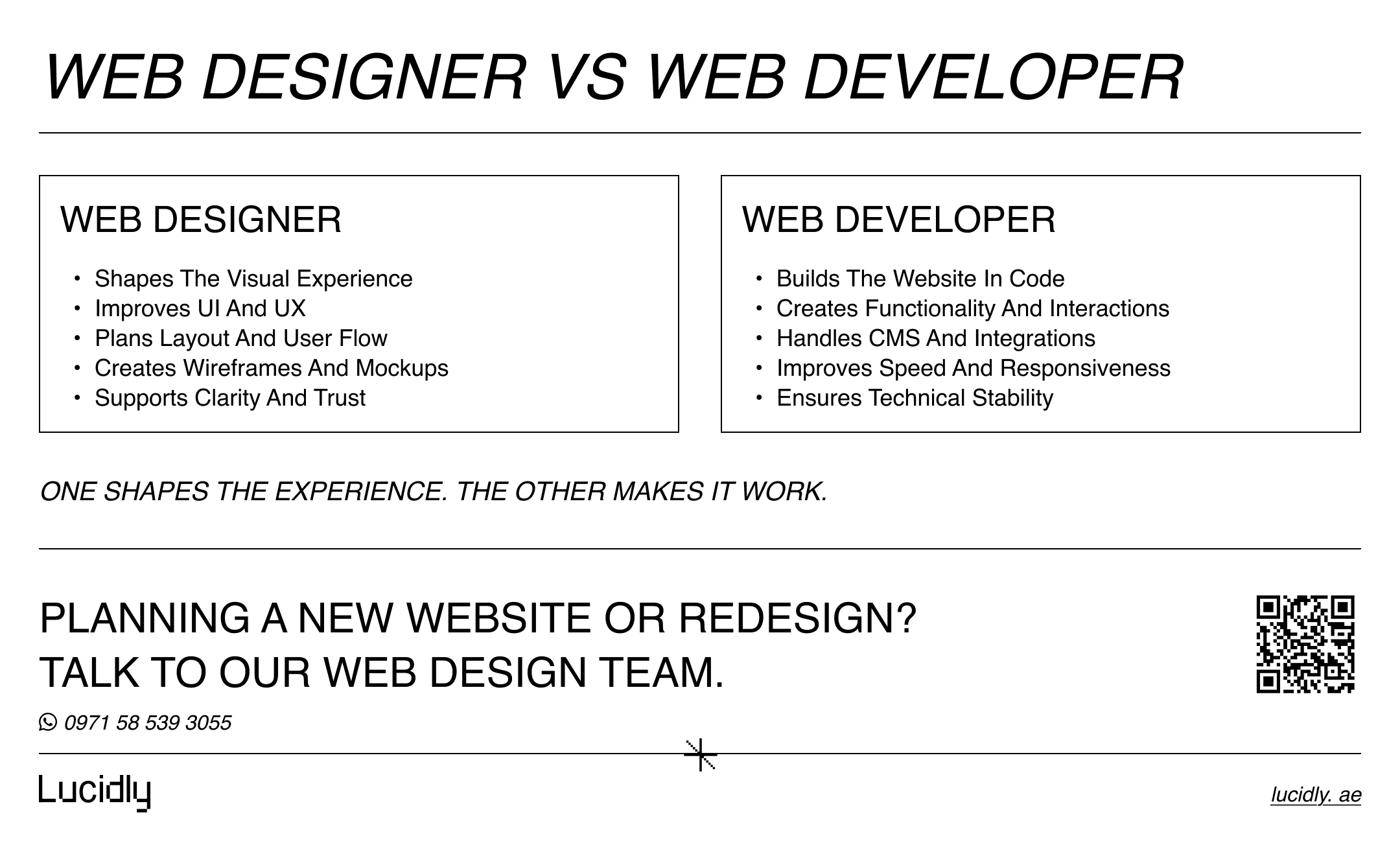
The comparison between web designer vs web developer is useful because it shows how responsibilities differ inside real projects.
A web designer typically focuses on:
page structure.
visual hierarchy.
interface clarity.
user journeys.
branding consistency.
CTA placement.
wireframes and mockups.
UX refinement.
A web developer typically focuses on:
building the frontend and backend.
writing and maintaining code.
implementing forms, features, and dynamic elements.
integrating third-party tools.
improving speed and responsiveness.
handling CMS or ecommerce setup.
ensuring technical stability.
This is the most practical explanation of the difference between web design and web development. One shapes the experience. The other builds the working system that delivers it.
Still, good projects are not built in silos. The best results happen when design and development work together early.
Designers need awareness of technical limits, and developers benefit from understanding the intended UX, priorities, and content flow.
Why this difference matters
This comparison makes the design and development difference much clearer. A designer decides how the experience should be presented.
A developer ensures that experience actually works in real conditions across devices, browsers, and user actions.
Why This Difference Matters for Businesses
This difference matters because businesses are not just investing in a website. They are investing in outcomes. When web design and web development are confused, it can lead to:
hiring the wrong type of team.
defining the wrong project scope.
underestimating the actual work required.
weaker planning, budgeting, and timelines.
Understanding the difference early helps businesses make better decisions and achieve stronger results.
Do You Need Web Design, Web Development, or Both?
For most businesses, the practical question is not just design vs development website thinking in theory. It is this: what is actually limiting results right now?
If the site looks dated, feels confusing, or fails to build trust, design may be the bigger priority.
If the site is slow, broken, hard to manage, or missing key features, development may be the bigger issue. If the website has both clarity problems and technical weaknesses, then both disciplines need attention.
If you are considering platform-based solutions, you can explore when WordPress is the right choice in WordPress Web Design Dubai: When It’s the Right Choice for Your Business.
What Your Business Probably Needs
Situation | You likely need | Why |
Your website looks outdated or unclear | Web design | The issue is presentation, trust, and structure |
Users visit but do not convert | Design and UX review | Messaging, layout, and user journeys may be weak |
Your site is slow or unstable | Web development | Technical issues affect performance and usability |
You need booking, ecommerce, or custom tools | Web development | New functionality requires coding and integrations |
Your site works but feels confusing | Web design first | Wireframes, UX, and content structure may need improvement |
You are launching a new business site | Both | Strong websites need design direction and technical execution |
This is where website design vs development becomes a business decision rather than a terminology question.
Businesses exploring web design services are often not looking for aesthetics alone.
They usually need a website that helps users trust, understand, and navigate with ease. Development then ensures that experience works smoothly through reliable functionality, better performance, and technical stability.
Frontend Design vs Development: Where Confusion Often Happens
The phrase frontend design vs development causes confusion because both sides affect what users see on screen. That overlap makes people assume they are the same job, but they are not.
Frontend design usually focuses on:
At this stage, the emphasis is on how the interface should look and feel to users.
visual communication.
consistency across the interface.
clarity and spacing.
typography and element relationships.
interaction logic and user perception.
Frontend development usually focuses on:
This side is responsible for turning the approved interface into a working frontend experience.
translating approved designs into code.
making the interface responsive across screen sizes.
ensuring browser compatibility.
building interactive components.
connecting interface elements to real content or system logic.
For example, a designer may define:
These are typically the parts of the interface that are planned visually before development begins.
a hero banner.
a CTA section.
a card layout.
mobile menu behavior.
A frontend developer then:
builds those components.
ensures they respond correctly.
connects them to real content or functionality where needed.
This is why the design and development difference still matters, even in the same visible part of a website. Users may only see one screen, but multiple disciplines shape that result.
Website Design vs Development in Real Business Situations
The comparison of website design vs development becomes clearer when viewed through common business scenarios.
"In Dubai, UI/UX design plays a key role in improving website performance, contributing to better leads and sales through effective website design strategies."
A business launching a new brand website often needs design first because:
In this situation, the priority is usually to define structure, clarity, and trust before the build starts.
messaging needs to be clarified.
page priorities need to be structured.
trust signals need to be established before the build begins.
A business with an existing website may need design improvements when:
Here, the problem is often not technical failure but weak presentation or user flow.
conversion performance is weak.
UX feels confusing.
layout and content hierarchy do not guide users clearly.
A business may need development more urgently when:
In these cases, the main issue is usually technical functionality rather than visual direction.
checkout issues affect ecommerce performance.
category pages load slowly.
filters or interactive features are broken.
technical friction is limiting usability.
In all of these cases, responsive web design vs web development is really about diagnosis. The key question is whether the website is being held back by:
poor flow.
weak presentation.
unclear calls to action.
missing features.
broken interactions.
technical limitations.
The answer helps define the right scope of work and whether the business needs a design-focused partner, a full-service team, or a web development company for more technical requirements.
Which Comes First in Web Design vs Web Development?
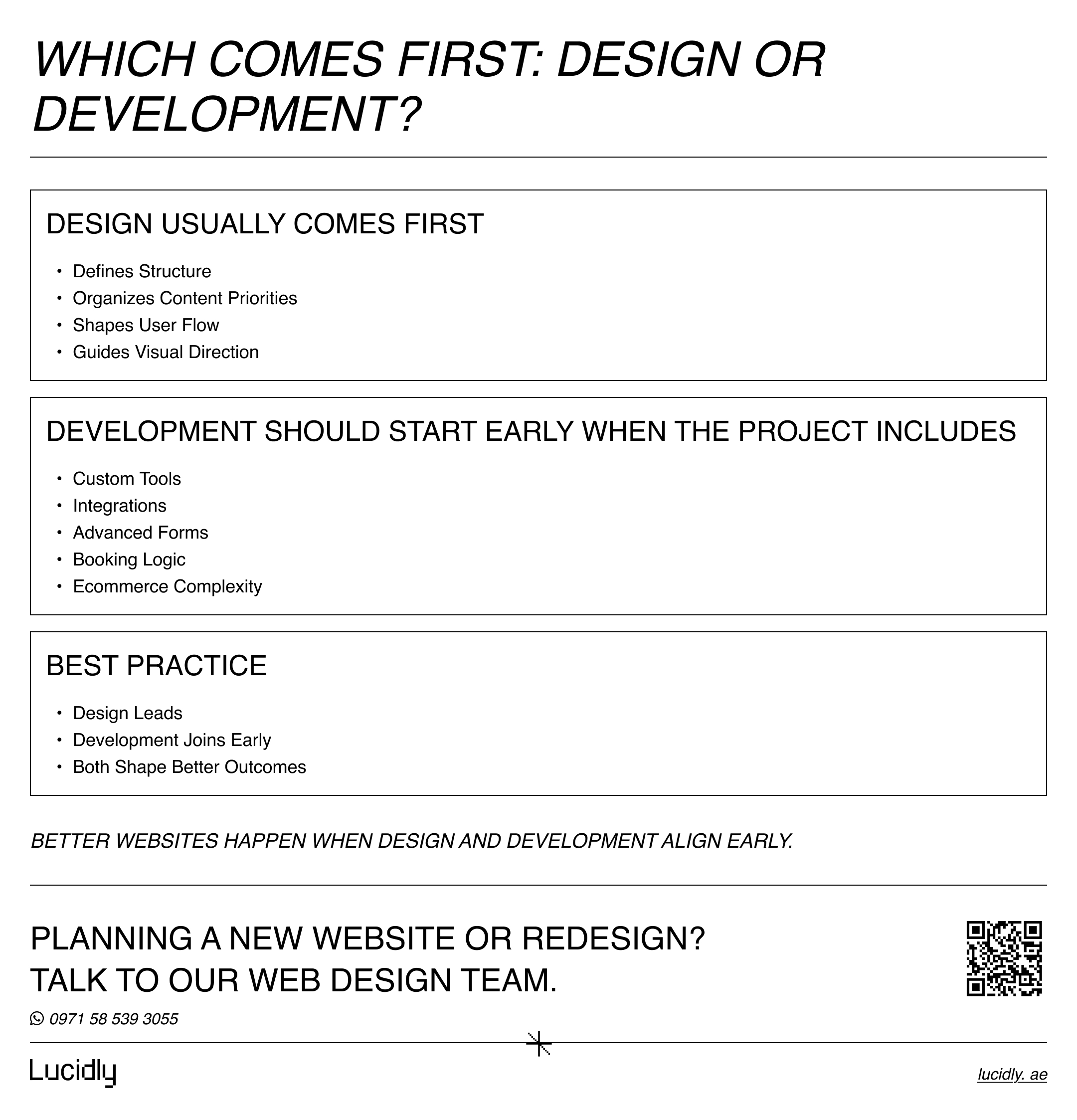
In most web design vs web development projects, design usually comes first because it is more efficient to define structure, content priorities, and user flow before the build begins. However, development should be involved early when the project includes more technical requirements.
Design usually comes first because:
At this stage, the goal is to shape the website clearly before any technical build begins.
page structure needs to be defined.
content priorities need to be organized.
user flow should be clear before coding starts.
visual direction helps guide the build process.
Development should start early when the project includes:
In these situations, technical input is important from the beginning to avoid unrealistic design decisions.
custom tools.
third-party integrations.
advanced forms.
account areas.
booking logic.
ecommerce complexity.
Why this order matters in web design vs web development
A clear sequence helps the project move more efficiently from planning into execution.
it reduces wasted revisions.
it prevents disconnected decisions.
it improves coordination between teams.
it creates a more practical handoff from design to development.
This is another reason why the difference between web design and web development matters. It affects not only who does what, but also when each role should shape the project.
Why This Difference Matters Before Hiring an Agency or Team
If a business does not understand web design vs web development, it becomes much harder to compare website companies in the UAE properly.
Some agencies are strong in visual design but limited in custom development.
Others are technically capable but weaker in UX thinking, content structure, or interface clarity. Some teams can handle both well, but only when the scope is clear from the start.
Before hiring, businesses should understand whether they need:
design only
development only
a redesign with backend improvements
a full strategy, design, and build process
This matters because design vs development website decisions can affect the difference between web design cost and web development cost, along with timelines, deliverables, and post-launch expectations.
A website is rarely just a homepage mockup or just a code deployment. It is a combination of experience design and technical execution.
FAQ
What is the difference between web design and web development?
The difference between web design and web development is that web design focuses on visual experience, structure, UI, UX, and user flow, while web development focuses on coding, functionality, performance, and technical implementation.
Do I need both a designer and a developer?
In many professional website projects, yes. Design helps shape layout, trust, and user journeys, while development builds the actual site and its features. Smaller projects may use one team for both, but both skill sets still need to be covered.
Which comes first: design or development?
Design usually comes first because it defines the structure and intended experience before build begins. However, development input should come in early when the project includes complex functionality or custom technical requirements.
Can one team handle both?
Yes, one team can handle both if it genuinely has strong capabilities in design and development. The important point is not whether the services come from one provider or two, but whether both areas are handled with enough depth.
web design vs web development is not just a terminology issue. It affects project scope, budget, team decisions, and overall website quality.
Design shapes the user experience through UI, UX, layout, and structure, while development turns that vision into a functional and reliable website.
When businesses understand the difference between web design and web development, they make better decisions and build websites that support real business goals.
Need help choosing between design, development, or both? Message Lucidly on WhatsApp or use the phone numbers on the Contact Us page.
References
MDN Web Docs. Learn Web Development.
Nielsen Norman Group. About User Experience.
Interaction Design Foundation. UX vs UI: What’s the Difference?