shopify vat uae is not just about turning on a tax rate inside the admin and assuming everything is done.
For UAE stores, the practical work includes accurate tax collection, clear invoices, the right pricing display, proper handling of the VAT number, and understanding whether billing VAT applies to Shopify fees.
A clean setup reduces confusion, supports smoother operations, improves customer trust, and helps merchants avoid common issues that appear later in checkout, invoice workflows, and day-to-day compliance.
Need a smoother Shopify VAT setup in the UAE? Message Lucidly on WhatsApp.
Why shopify vat uae setup matters for UAE stores
Getting VAT right in Shopify affects more than accounting.
It shapes how customers see prices, how tax appears at checkout, and how clearly the business documents each sale. That is why shopify vat uae should be treated as an operational setup, not just a finance task.
VAT affects customer clarity and trust
When VAT is configured properly, the customer journey feels predictable.
Shoppers can understand whether prices already include tax, whether VAT is added later, and whether the final amount makes sense.
Poor tax setup often leads to avoidable issues.
Unclear product pricing.
Unexpected tax at checkout.
Mismatched totals between pages.
More support questions after purchase.
VAT also affects internal workflows
Behind the storefront, tax settings influence reporting, invoice generation, and communication with finance teams.
Many stores discover problems only after orders start coming in, which is why shopify vat uae should be reviewed before launch and after major store changes.
For practical teams, the goal is simple: the storefront, checkout, and invoice flow should all reflect the same tax logic.
If you are still evaluating Shopify as a platform, read our guide: What Is Shopify? Pros, Cons, and When It’s the Right Ecommerce Platform (2026 Guide).
How do I set up shopify vat uae correctly?
The first practical step is to stop thinking about VAT as only a 5% switch. In real stores, the result depends on how tax rules, products, shipping, and price display work together.
A strong shopify vat uae setup begins with structure, not assumptions.
Set the standard tax logic carefully
Most UAE merchants start with the standard VAT treatment expected in the market. But enabling the rate alone is not enough.
The configuration should match how the store actually sells, how prices are shown, and how the checkout behaves.
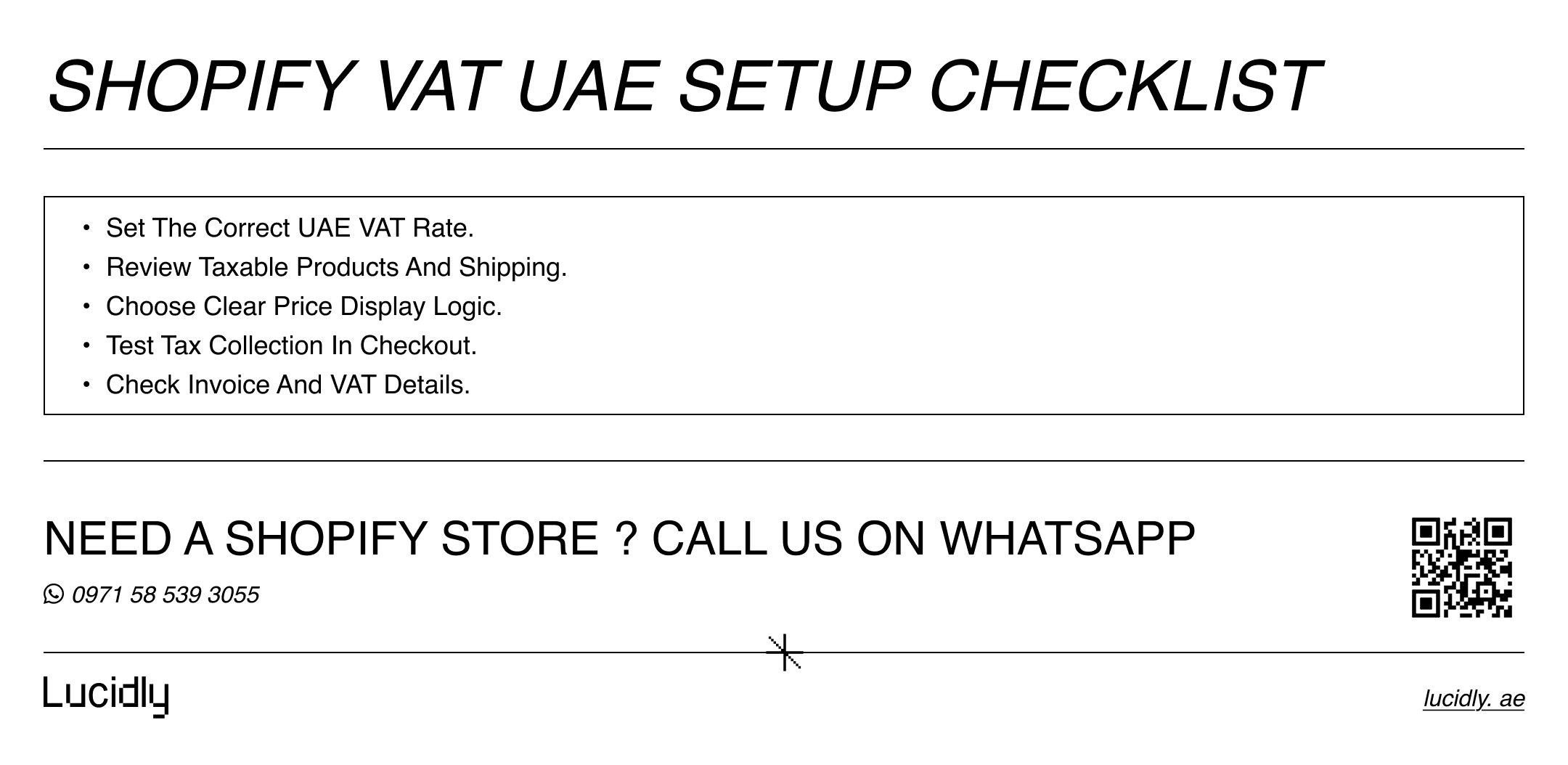
Before considering the setup complete, review the basics.
The correct UAE tax rate is active.
Taxable products are included correctly.
Shipping treatment has been reviewed.
Duplicate or conflicting tax rules are not present.
Review products and shipping together
A store can look correct at account level and still behave incorrectly on the storefront. In many cases, the issue is not the VAT rate itself but how the product settings or shipping settings interact with tax rules.
This matters because customers do not see your tax settings. They see the final price, the cart total, and the checkout summary. If those do not align, the store feels unreliable.
If you also need the right delivery setup, read: Shopify Shipping UAE: Aramex Integration, Zones, COD, Tracking, and Returns.
Test the setup with real scenarios
Once the tax logic is in place, test it like a customer would. Add products to cart, move through checkout, and confirm how tax appears at each stage. For shopify vat uae, testing is one of the fastest ways to catch problems before they affect real orders.
A proper review should check the following areas.
Product page pricing.
Cart calculations.
Checkout tax lines.
Order confirmation totals.
shopify vat uae for prices, checkout, and tax collection
After the tax rate is configured, the next question is how VAT appears to customers.
This is where many stores create confusion without realizing it. Even when tax collection is technically correct, the buying experience can still feel unclear.
Decide on tax-inclusive pricing with intention
One of the most important decisions in shopify vat uae is whether the store should use tax-inclusive pricing. This affects how prices are perceived across product pages, collections, cart, and checkout.
The decision should support both clarity and consistency. If the storefront suggests one pricing logic and checkout shows another, trust drops quickly.
When reviewing pricing logic, focus on the practical customer experience.
Is the displayed product price easy to understand.
Does the cart match that expectation.
Does checkout confirm the same pricing logic.
Does the final amount feel predictable.
Make tax collection visible and understandable
Tax collection should not feel hidden or surprising. Customers should be able to understand how VAT is applied without needing to guess whether the price changed unexpectedly.
This is why VAT on Shopify UAE should always be reviewed in context, not only inside the tax settings page. The important question is not just whether VAT is collected, but whether it is presented clearly.
Keep display consistent across the storefront
Consistency matters more than complexity. If product pages, cart, and checkout do not reflect the same logic, even a correct tax setup can create friction.
For that reason, shopify vat uae should always be checked after theme edits, pricing changes, or app installations that affect totals, labels, or order summaries.
Do I need to show VAT on invoices?
For many merchants, this is one of the most important practical questions. The answer is not only about generating a document.
It is about making sure the invoice presents tax details clearly enough for customer understanding and internal records.
Invoices should present tax clearly
A useful invoice should reflect the transaction in a way that is easy to read. That usually means showing the taxable amount, VAT amount, and total in a clear structure.
Before finalizing the invoice flow, review whether it includes the essential details.
Amount before VAT.
VAT amount.
Total after VAT.
Business details.
VAT number.
Shopify order documents and invoice workflows are not always identical
Merchants sometimes assume Shopify will automatically produce the exact invoice format they need.
In practice, invoice workflows often need review, adjustments, or added tools depending on how the store operates.
This is where invoices become more than an afterthought. If the store needs a specific format, clearer tax presentation, or a more structured output, that should be considered early rather than after orders begin.
The VAT number should be treated seriously
The VAT number is not a decorative line on a document. Where required, it plays a real role in tax clarity and invoice completeness.
Stores should make sure the right business information appears in the right places and that invoice presentation supports clean documentation.
For many merchants, this is a key part of making shopify vat uae practical rather than merely activated.
Will Shopify charge VAT on billing?
This question creates confusion because merchants often mix two separate topics: the tax they collect from customers in the store, and the VAT treatment of Shopify’s own charges to the merchant.
Billing VAT is different from store tax collection
billing VAT usually refers to VAT that may apply to Shopify subscription fees or related platform charges billed to the merchant.
This is separate from the tax collected from customers on orders inside the store.
That difference should stay clear from the beginning.
Customer order tax is part of store sales.
Billing VAT relates to Shopify’s charges.
The invoice context is different.
The reporting context may also differ.
Review billing information carefully
A merchant can have clean tax collection inside the store and still have questions about billing VAT on the account side.
That is why billing details should be reviewed separately rather than assumed to follow the same setup.
This distinction matters because uae tax shopify questions often involve both areas, but they should not be treated as one system.
Your VAT number may matter for billing records
In some situations, the VAT number connected to business billing information can influence how tax details are recorded or reviewed on Shopify charges.
At minimum, merchants should confirm that billing information is complete and aligned with business records.
A practical shopify vat uae review always separates store-side tax logic from platform billing VAT.
Common shopify vat uae setup mistakes
Most VAT problems do not come from one major failure. They usually come from several small assumptions that were never tested properly. In the UAE market, these mistakes can affect customer confidence as much as internal compliance workflows.
Applying 5% VAT without checking price logic
Many merchants enable shopify 5% vat uae and assume the work is finished. But if the store has not decided whether pricing should be tax-inclusive, the customer experience can still feel confusing.
The issue is rarely the rate alone. The issue is whether the pricing logic matches the customer-facing experience.
Treating invoices as a late-stage detail
Some stores focus on tax collection first and think about invoices later.
That often creates avoidable problems once customers need clearer documentation or internal teams need cleaner records.
A strong setup reviews invoice output early, not after launch.
Confusing billing VAT with sales tax
This is one of the most common mistakes in shopify vat uae.
Merchants sometimes believe that VAT charged by Shopify on billing is the same as VAT being collected from customers on store orders. These are separate areas and should be reviewed separately.
Ignoring changes caused by apps or themes
Tax behavior can shift after a new app, theme customization, or checkout-related change. That is why VAT should be rechecked after major store updates.
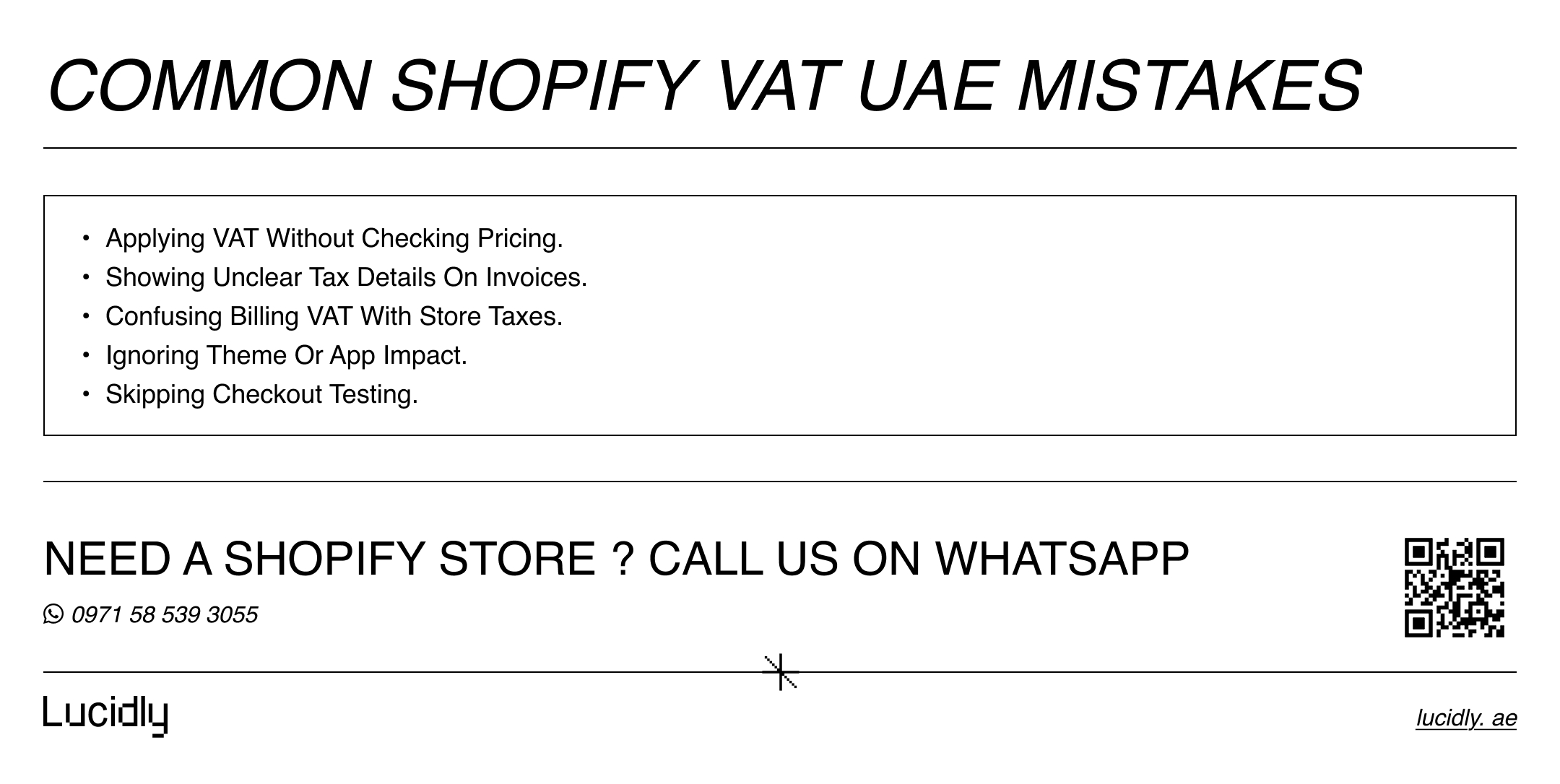
The most useful review points are usually the following.
Product price display.
Cart summaries.
Checkout totals.
Invoice formatting.
Tax-related app behavior.
Practical checklist for shopify vat uae
A checklist helps merchants review the setup without overcomplicating it. This is especially useful before launch, after a redesign, or after changing tax logic, pricing structure, or invoice tools.
Core setup checklist
Before considering the setup complete, work through these points carefully.
Confirm the Shopify VAT setup is active.
Check whether the standard UAE tax rate is applied correctly.
Test tax collection through real checkout flows.
Review whether tax-inclusive pricing is intentional.
Confirm invoices show tax clearly.
Check that the VAT number appears where needed.
Review billing VAT separately from store sales tax.
Use testing as part of routine review
A setup may look correct in settings and still behave incorrectly in practice. That is why shopify vat uae should be tested after meaningful changes.
A quick review after updates is often enough to catch pricing, tax display, or invoice issues before customers do.
For stores with frequent theme or operational changes, this should become a routine check rather than a one-time setup task.
When to get help with vat settings shopify uae
Not every store needs complex tax support, but some situations justify a closer review.
If the storefront, checkout, invoices, and billing records do not feel aligned, the issue is usually not just technical. It is operational.
A review helps when the setup feels inconsistent
Some stores technically collect tax but still create confusion. In those cases, the problem often sits between settings, theme presentation, invoice structure, and pricing logic.
This is where vat settings shopify uae becomes important as a full-store review, not only a dashboard adjustment.
Support is useful when several moving parts are involved
Merchants often need practical help when tax settings touch multiple areas at once. That includes storefront pricing, invoice requirements, checkout behavior, and billing records.
Common signs that a review would help include the following.
Tax display feels inconsistent.
Invoices are unclear.
The VAT number is missing or misplaced.
Billing VAT is being confused with sales tax.
Tax collection does not match storefront expectations.
When these issues appear together, vat settings shopify uae should be treated as a structured operational fix.
Need a cleaner Shopify VAT setup in the UAE? Explore Lucidly’s Shopify development services in the UAE for practical support with tax settings, invoices, pricing display, and billing VAT.
FAQ
This section answers the most common practical questions clearly and directly.
How do I set VAT in Shopify for the UAE?
Start by reviewing the tax settings, confirming the expected rate, checking products and shipping, and testing the storefront and checkout with real scenarios. A reliable Shopify VAT setup should cover pricing display, tax collection, and invoice clarity together.
Do I need to show VAT on invoices?
In practice, yes, invoices should clearly reflect tax details, transaction totals, and relevant business information. The VAT number may also need to appear depending on the invoice workflow and business requirements.
Will Shopify charge VAT on billing?
billing VAT can apply to Shopify’s own charges to the merchant, and this is different from the tax collected from customers on store orders. It should be reviewed separately from normal sales tax setup.
If you also need the right payment setup, read: Shopify Payments UAE: What to Use Instead and How to Set It Up.
What are the common VAT setup mistakes?
The most common issues include enabling shopify 5% vat uae without reviewing pricing logic, treating invoices as a late step, confusing billing VAT with customer-side tax collection, and failing to test the store after theme or app changes.
shopify vat uae should be approached as a practical business setup, not a single checkbox inside Shopify.
A reliable result depends on accurate tax collection, clear invoices, the right use of tax-inclusive pricing, proper handling of the VAT number, and a clear distinction between customer-side taxes and billing VAT.
When those parts work together, UAE stores create a smoother checkout experience, clearer records, and fewer avoidable tax problems in daily operations.
Need help with Shopify VAT in the UAE? Message Lucidly on WhatsApp or use the contact numbers on our Contact Us page for expert support with tax setup, invoices, VAT numbers, and billing VAT.
References
Federal Tax Authority (UAE) — Tax Invoices. Covers tax invoice requirements and related VAT guidance in the UAE.
Shopify Help Center — Taxes. Explains that tax setup, filing, and remittance responsibility sits with the merchant unless using eligible automated tools.