UAE ecommerce in 2026 is less about “what looks best” and more about what launches fast, stays stable, and scales without hidden costs.
This guide answers the question behind every platform debate—shopify vs woocommerce uae—by comparing real-world ownership, fees, maintenance, and scalability.
You’ll get a quick decision picker, a practical comparison table, and UAE-specific guidance on payments, shipping, and post-launch support. If you’re choosing the best ecommerce platform UAE for your business stage, start here.
If you want a quick UAE-specific recommendation based on your budget and timeline, message Lucidly on WhatsApp for a practical platform assessment before you commit.
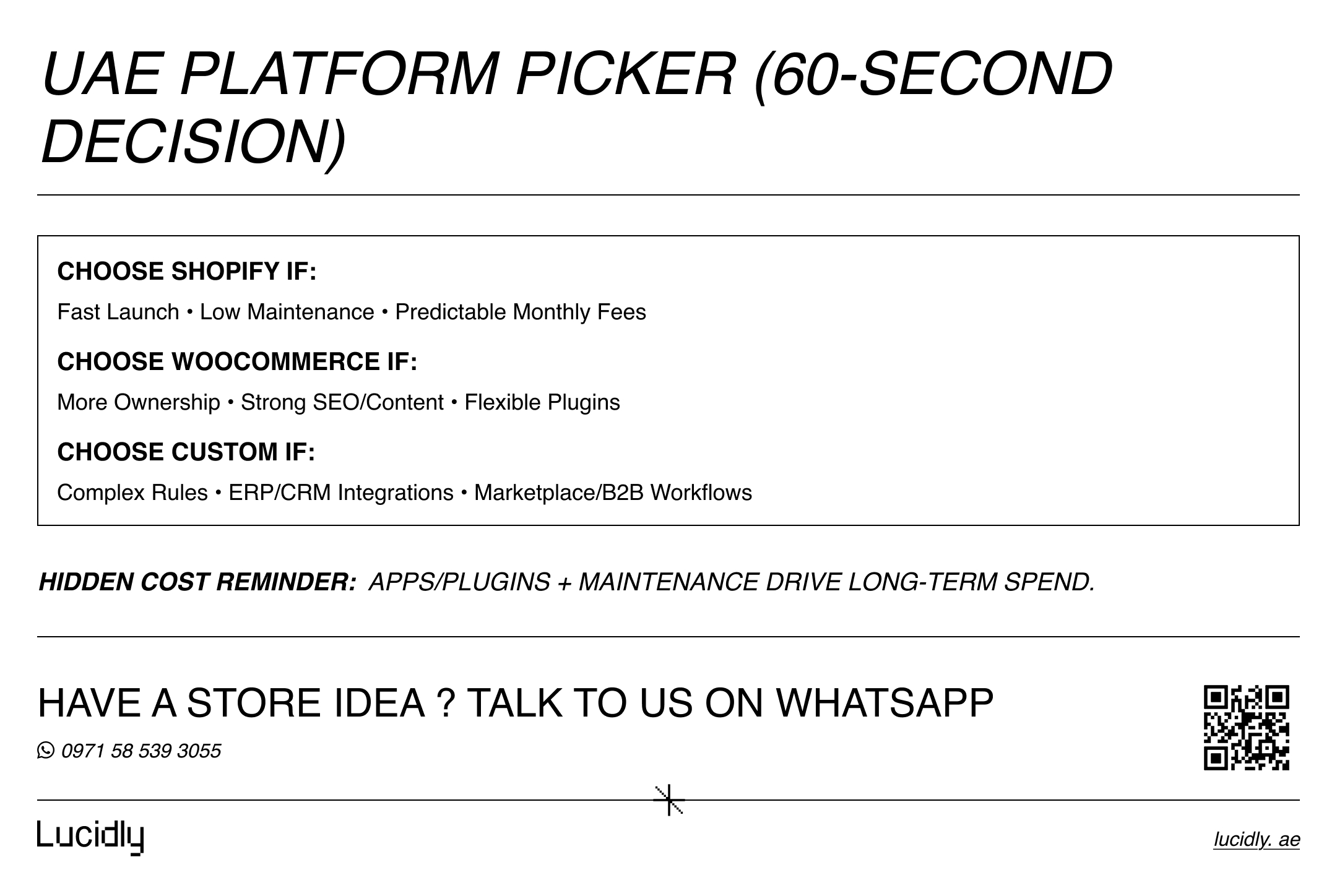
Quick Picker — Choose Your UAE Ecommerce Platform in 60 Seconds
Before we dive into details, use this fast filter. Most platform regret comes from choosing based on design demos instead of business stage, ownership needs, and ongoing costs.
Choose Shopify if…
Shopify is a hosted platform (hosted vs self hosted ecommerce), so it’s built for speed and simplicity.
You need a fast launch with minimal technical overhead
You prefer predictable monthly fees and managed hosting
You want app-based features without custom development early
Your catalog and pricing logic are straightforward
You want a clean setup path for payments and shipping integrations
Choose WooCommerce if…
WooCommerce is self-hosted (WordPress-based), so you get more control—especially over content and SEO.
You want stronger ownership control over site and content
SEO and content marketing are central to your growth plan
You need flexible customization without building from scratch
You can budget for maintenance and a good hosting setup
You want a WordPress ecosystem for content + commerce (shopify vs wordpress uae)
For a checklist of essential pages, functions, and integrations for UAE stores, see Ecommerce Website Features Checklist.
Choose Custom ecommerce if…
Custom becomes relevant when your business rules are the product.
You have advanced workflows (B2B pricing, roles, approvals)
You need ERP-level integrations and automation
You’re building a marketplace or multi-vendor platform
Your checkout, pricing, or fulfillment logic is highly specific
You can fund ongoing maintenance and feature iteration
For a complete guide to building a successful online store in the UAE, explore our guide on Ecommerce Website Development in the UAE.
7 Key Differences: Shopify vs WooCommerce UAE
Here’s a quick summary of the shopify vs woocommerce uae decision. These seven differences highlight what impacts launch speed, ownership, ongoing costs, and scalability.
Hosting: Shopify hosted, Woo self-hosted → affects speed and workload
Ownership: Woo gives more control → better for long-term flexibility
Monthly fees: Shopify plans vs Woo hosting/tools → cost shape differs
Transaction fees: depends on setup → compare carefully in UAE
Apps/plugins: Shopify apps vs WP plugins → ongoing costs vary
Maintenance: Shopify managed vs Woo requires updates/security
Scalability: Shopify operationally smooth; Woo scales with good hosting
Ecommerce Platform Comparison UAE (2026) — Shopify vs WooCommerce vs Custom
To make an informed choice, you need a side-by-side ecommerce platform comparison UAE teams actually use. If you’re evaluating shopify vs woocommerce uae, this table keeps the discussion grounded in ownership, monthly fees, transaction fees, apps and plugins, maintenance, and scalability.
Factor | Shopify (Hosted) | WooCommerce (Self-Hosted) | Custom Ecommerce |
Best for | SMEs, fast launches | SEO-led stores, control | Complex models, enterprise |
Time to launch | Fast | Medium | Slowest |
Ownership | Limited code control | High ownership control | Full ownership |
Monthly fees | Yes (plan-based) | Hosting + tools | Infrastructure + team |
Transaction fees | Possible (varies) | Gateway-dependent | Gateway-dependent |
Apps and plugins | Apps marketplace | Plugins ecosystem | Built features |
Maintenance | Low (managed) | Medium–High | High |
Scalability | Strong for most SMEs | Strong with good setup | Highest (if built well) |
If your priority is predictable operations and fast launches, hosted vs self hosted ecommerce becomes the first deciding factor—not the theme or homepage design.
Shopify in the UAE — Best For Fast Launches
Shopify is popular in the UAE because it reduces technical burden. When you want speed, stable hosting, and a clear path to go-live, Shopify offers a practical baseline.
Pros for UAE stores
Before listing features, remember why Shopify wins: fewer moving parts. You’re paying for reliability.
Hosted infrastructure, security, and updates handled for you
Fast setup for storefront, products, and checkout
App ecosystem for common needs (reviews, bundles, email, etc.)
Easier launch operations for SMEs with small teams
Lower maintenance burden compared to self-hosted options
Cons and limits
To choose wisely, compare shopify vs custom ecommerce in terms of flexibility and long-term constraints.
Advanced customization often depends on apps (ongoing monthly fees)
Some business logic becomes expensive if it requires multiple apps
You may face extra transaction fees depending on setup and gateway choices
Complex B2B workflows can be harder without specialized builds
Best use cases
Shopify is often the best ecommerce platform UAE SMEs can choose when the goal is speed, clarity, and stable operations—especially for DTC brands and standard catalogs.
WooCommerce (WordPress) in the UAE — Best For Ownership + SEO Control
WooCommerce shines when content and SEO are core growth channels. If you’re comparing shopify vs wordpress uae as part of a broader shopify vs woocommerce uae decision, the key difference is control: WooCommerce gives you deeper ownership and flexibility, but it comes with more responsibility.
Why WooCommerce wins for content + SEO
WooCommerce fits brands that want to publish, rank, and convert—within one ecosystem.
Strong content structure possibilities (categories, guides, internal linking)
Flexible SEO control for products, categories, and editorial pages
Easier to build a content-led acquisition engine
What you must budget for
Before you pick it, make sure you’re ready for self-hosted reality.
Hosting quality (directly impacts speed and stability)
Security hardening and updates (maintenance)
Plugin management (apps and plugins can conflict)
Developer support for fixes and performance improvements
Best use cases
For many UAE businesses evaluating the best ecommerce platform UAE offers, WooCommerce works well for SMEs and growth brands that want ownership, content strength, and flexible customization—without going fully custom.
For a detailed guide on must-have ecommerce pages, features, and integrations, check out our Ecommerce Website Features Checklist.
Custom Ecommerce in the UAE — When “Off-the-Shelf” Isn’t Enough
Custom platforms are not “better” by default—they’re justified when your workflows cannot fit Shopify or WooCommerce without bending the business.
When to choose custom ecommerce
This is where woocommerce vs custom ecommerce becomes real: if rules are complex, custom can reduce long-term friction.
B2B pricing tiers, customer roles, and approvals
Quote-to-order flows, VAT invoicing logic, or procurement steps
Deep ERP/CRM integration with automated inventory and accounting rules
Multi-vendor marketplace needs with commissions and vendor dashboards
What it really costs
Custom is rarely a one-time build. It’s a product.
Larger upfront build cost and longer timeline
Higher ongoing maintenance and monitoring needs
Continuous iteration (features, UX, integrations)
Risks and how to reduce them
Avoid overspending by launching in phases: build the essential purchase flow first, then add advanced workflows after validation.
Hidden Costs in the UAE — What You’ll Pay After Launch
Many “platform comparison” articles ignore the long tail.
In real UAE projects, hidden costs often decide whether your platform still makes sense six months after launch—especially when comparing shopify vs woocommerce uae or considering shopify vs custom ecommerce.
To understand detailed pricing for different UAE ecommerce platforms, check Ecommerce Website Cost in the UAE (2026).
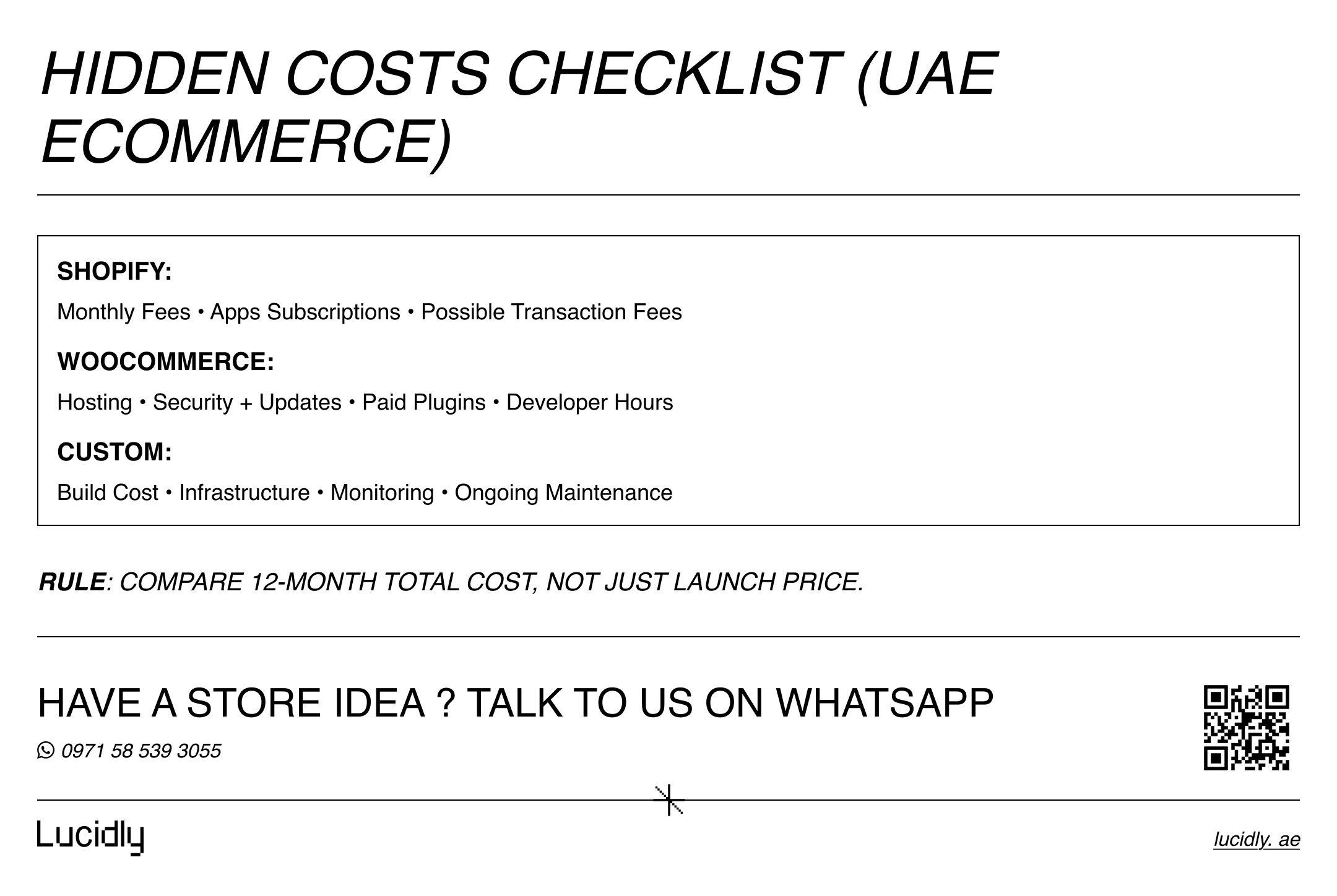
Shopify cost model
Before choosing Shopify, understand how the “simple” setup can grow in cost over time. The main drivers are monthly fees, transaction fees, and recurring apps and plugins.
Monthly fees for the plan (monthly fees)
Apps and plugins via subscriptions (apps and plugins)
Possible transaction fees depending on payment setup (transaction fees)
Costs rise as more features become app-driven (maintenance + cost control impact)
WooCommerce cost model
WooCommerce can be cost-effective, but only with disciplined upkeep. In a hosted vs self hosted ecommerce comparison, WooCommerce typically shifts spend toward hosting and ongoing maintenance.
Hosting + backups + security tools (maintenance baseline)
Premium plugins and renewals (apps and plugins)
Developer hours for fixes and performance improvements (maintenance)
Maintenance becomes a real monthly line item (ownership comes with responsibility)
Custom cost model
Custom can offer the strongest scalability, but it requires ongoing investment. This is the real trade-off in woocommerce vs custom ecommerce: you gain tailored workflows, but you must fund long-term operations.
Infrastructure costs plus monitoring (scalability support)
Maintenance and security updates (maintenance)
Feature work as the business evolves (continuous iteration)
A roadmap mindset—not “project and done”
If you’re trying to choose the best ecommerce platform UAE businesses rely on long term, compare ownership and maintenance as seriously as design—because that’s where the real cost difference shows up.
Explore Lucidly’s Ecommerce Solutions in the UAE to see how we build performance-first stores with strong SEO foundations and reliable post-launch support.
Which Platform Scales Best in the UAE?
Scaling depends on your operating model. The question isn’t just traffic—it’s complexity. If you’re evaluating shopify vs woocommerce uae, scalability is tied to ownership, maintenance, and how features are added through apps and plugins.
Scaling with Shopify
Shopify scales smoothly for most SMEs, especially when catalogs and workflows stay standard. Complexity often arrives through apps and plugins, so keep monthly fees, potential transaction fees, and cost control in mind.
Scaling with WooCommerce
WooCommerce can scale strongly with the right hosting and performance strategy, but you must commit to ongoing maintenance and disciplined plugin management—especially if long-term ownership and flexibility are priorities.
Scaling with Custom
Custom ecommerce is the most scalable in flexibility, but it’s also the most demanding in maintenance and ongoing investment. Choose it when your requirements justify full ownership and long-term scalability work.
Real UAE Scenarios — What Should You Choose?
Choosing between shopify or woocommerce often becomes obvious when you map it to a real scenario.
SME launching a first store
Choose Shopify or a lean WooCommerce build. Prioritize fast launches, practical features, and cost control.
Brand scaling catalog + paid ads
Shopify works well for stability; WooCommerce works well if SEO content is a major pillar. The right answer depends on your internal capabilities.
B2B wholesale with roles and rules
Custom is often justified when pricing tiers, approvals, and integrations define your sales process.
Marketplace or multi-vendor platform
Custom is typically the cleanest path for vendor logic, commissions, and dashboards.
UAE Platform Checklist — Ask These 10 Questions Before You Commit
Before you decide, use this checklist to protect scope and budget.
Who owns the data, code, and admin access (ownership)?
What are the monthly fees including apps and plugins?
Are there transaction fees, and under what conditions?
What is the expected maintenance cost per month?
What features are “phase 1” vs “phase 2”?
How will speed and performance be measured?
How will integrations be tested (payments, shipping, tracking)?
What does post-launch support include?
What’s the scaling plan for 12 months?
What’s the exit plan if you migrate later?
FAQs
Is Shopify better than WooCommerce in the UAE?
It depends on ownership and operations. Shopify is easier to run and maintain, while WooCommerce offers stronger control and flexibility—especially for content-led growth.
When should I choose custom ecommerce?
Choose custom when your workflows require it: B2B rules, deep integrations, marketplace logic, or unique pricing/checkout requirements.
Which platform scales best?
Custom scales best in flexibility, Shopify scales best in operational simplicity, and WooCommerce scales well with strong hosting and maintenance discipline.
What are the hidden costs?
Monthly fees, transaction fees, apps and plugins subscriptions, hosting upgrades, developer hours, and ongoing maintenance are the biggest hidden costs—especially after launch.
If you’re building lean and want clarity, Shopify often wins for fast launches and low maintenance. If you want stronger ownership and SEO control, WooCommerce is a powerful choice with the right setup.
If your requirements are complex and integration-heavy, custom is the long-term solution—when budget and governance support it. For anyone searching shopify vs woocommerce uae, the right platform isn’t the fanciest—it’s the one you can run, maintain, and scale confidently.
Want a performance-first store with strong SEO and reliable support? Contact Lucidly—or message Lucidly on WhatsApp for a quick assessment.
Referencesب
Shopify Help Center — Pricing plans & billing overview
https://help.shopify.com/en/manual/intro-to-shopify/pricing-plans/pricing-overviewبWordPress.org — WooCommerce plugin (open-source overview)
https://wordpress.org/plugins/woocommerce/WooCommerce — WooCommerce vs Shopify (official comparison)
https://woocommerce.com/posts/woocommerce-vs-shopify/