Choosing between Shopify vs Salla is one of the most important decisions for ecommerce businesses in the GCC.
Both platforms can support online selling, but they are built for different business priorities. Salla is often attractive for Saudi-first merchants who want a simpler local setup, while Shopify is usually the stronger choice for brands that need deeper customization, broader integrations, and more room to scale across the GCC or beyond.
This guide explains the real differences so you can choose the right platform for 2026.
Need expert guidance on store setup, customization, and long-term growth? Message Lucidly on WhatsApp.
Shopify vs Salla: What Really Matters for GCC Businesses in 2026
When businesses compare Shopify vs Salla, they often focus on price or popularity first. In practice, the better choice depends on market focus, operational needs, growth plans, and how much flexibility the business will need over time.
For merchants in Saudi Arabia, the UAE, Kuwait, Qatar, and the wider GCC, this is not just a launch decision. It is a platform decision that affects payments, store management, customer experience, marketing workflows, and future expansion.
At a high level, Shopify is a global ecommerce platform built for flexibility and scale. Salla is a regional platform with a strong local fit, especially for merchants who want a straightforward launch in Saudi Arabia.
If you're new to Shopify, check What Is Shopify? Pros, Cons, and When It’s the Right Ecommerce Platform (2026 Guide) to see when it fits your business.
That is why the Shopify vs Salla ecommerce platform decision is really about choosing between local simplicity and long-term flexibility.
Quick Platform Overview
A simple overview helps clarify where each platform tends to fit best.
Shopify ecommerce platform
Global platform with strong international capabilities.
Large apps ecosystem and advanced integrations.
Better for brands that need customization and scalability.
Strong fit for businesses planning multi-market growth.
Salla ecommerce platform
Built with strong local relevance for Saudi merchants.
Easier onboarding for smaller teams.
Good fit for businesses wanting a simpler operating model.
More limited in advanced customization compared with Shopify.
Salla vs Shopify Comparison: Core Differences at a Glance
A useful Salla vs Shopify comparison should focus on the areas that affect real store performance, not just what appears in the dashboard. For most GCC merchants, the most important factors are setup speed, design control, app ecosystem, payment flexibility, SEO control, and scalability.
Area | Shopify | Salla |
Market orientation | Global and regional expansion | Saudi-first and local-focused |
Store setup | Moderate learning curve | Easier and faster |
Design flexibility | High | More limited |
Apps and integrations | Extensive Shopify apps ecosystem | Smaller app ecosystem |
Payments | Broad gateway support | Strong local relevance |
SEO control | More advanced | More basic |
Scalability | Strong for growing brands | Better for simpler growth paths |
Developer flexibility | High | Lower |
This is where many merchants asking Salla or Shopify find the real trade-off. Salla can feel easier at the beginning, but Shopify usually gives businesses more room to grow without changing platforms later.
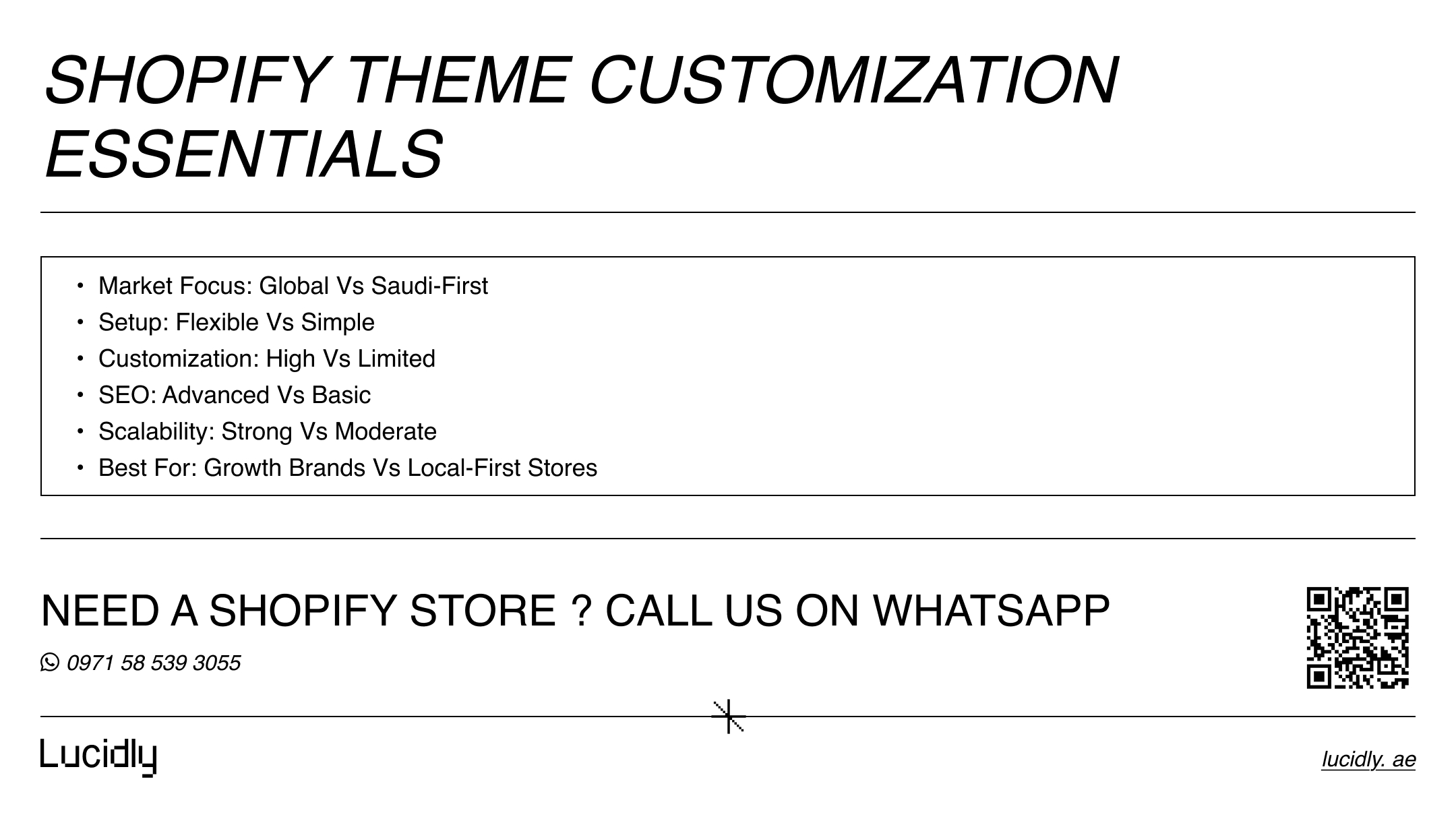
Shopify vs Salla Saudi Arabia: Which Platform Fits the Local Market?
Choosing between Shopify vs Salla Saudi Arabia is not only about features. It is about how well each platform fits local market conditions, buyer expectations, and future plans.
In Saudi Arabia, payment preferences, Arabic storefront experience, logistics workflows, and ease of daily store management all shape which platform feels more practical.
For businesses focused mainly on KSA, Salla often feels naturally aligned with the local market.
For brands with broader ambitions, Shopify often becomes more appealing over time.
For tax setup, see VAT on Shopify UAE: Practical Setup for Taxes, Invoices, and Compliance.
Why Salla Feels More Native in Saudi Arabia
For businesses focused primarily on the Saudi market, Salla often feels like the more natural starting point.
Faster Salla store setup Saudi Arabia.
Easier for merchants with less technical involvement.
Familiar to many local sellers.
Better suited to businesses focused only on Saudi Arabia in the near term.
Why Shopify Appeals to Growth-Focused Brands
For brands thinking beyond a simple local launch, Shopify usually becomes more attractive because of its flexibility and broader growth potential.
Better support for UAE and GCC expansion.
Stronger customization and design control.
More advanced integrations, apps, and automation.
Better fit for brands investing in conversion and tailored storefront experiences.
To choose the right partner, explore Top Shopify Development Companies Dubai (2026): Best Options Compared.
What Businesses Should Consider Before Choosing
Before deciding between Shopify or Salla KSA, merchants should look beyond launch and think about where the business is likely to be in the next 12 to 24 months.
Will the store remain focused only on Saudi Arabia?
Will you need more advanced tools or integrations later?
Is GCC expansion part of the growth plan?
Is ease of launch more important than long-term flexibility?
That is why many businesses searching Shopify vs Salla Saudi Arabia are not really choosing between a good platform and a bad one. They are choosing between local simplicity and broader growth potential.
Shopify vs Salla Features: What You Actually Get
The Shopify vs Salla features comparison should focus on what merchants can actually use to improve performance, not just how long a feature list looks on a pricing page.
Shopify offers a more mature feature environment overall.
The Shopify ecommerce features that matter most to GCC brands usually include theme customization, a stronger apps ecosystem, better integrations, and more control over the storefront experience. This makes it easier to build a more tailored online store.
Salla, by contrast, focuses more on ease of use and accessibility. Many businesses appreciate the simpler Salla store builder experience because it reduces friction at launch. The Salla ecommerce features are often enough for merchants who want the essentials without added complexity.
To understand design flexibility, check Shopify Theme Customisation: Liquid, Sections, and Conversion Focused Development.
Shopify Features That Matter in Practice
For growth-focused brands, Shopify’s strengths usually appear in flexibility and ecosystem depth.
Access to a broad Shopify apps ecosystem.
Stronger Shopify customization options.
Better support for tailored user experiences.
More flexibility for complex product catalogs.
Better support for multi-channel selling.
Stronger long-term development potential.
Salla Features That Matter in Practice
For merchants prioritizing simplicity, Salla’s value comes from ease and local usability.
Easier entry for smaller merchants.
Simpler store management.
Stronger local familiarity for Saudi businesses.
Faster launch path for teams with fewer technical needs.
For brands comparing Salla platform vs Shopify, the real question is whether the business needs simplicity now or flexibility later.
Shopify vs Salla Pricing: Cost vs Real Value
The Shopify vs Salla pricing conversation should not stop at monthly subscription fees. The more important question is how much value each platform provides as the store grows and operations become more demanding.
Cost factor | Shopify | Salla |
Entry cost | Can feel higher | Often easier for small merchants |
Add-ons and apps | May increase total spend | More limited extra tooling |
Custom development | More available, but may cost more | Lower complexity, but fewer options |
Long-term value | Strong for scaling brands | Better for simpler operations |
Salla may look more economical for early-stage merchants, especially those with straightforward needs.
Shopify may look more expensive at first, but for businesses that need stronger infrastructure, deeper integrations, and more flexibility, the long-term value can be significantly better.
So when merchants search Shopify vs Salla pricing, they should compare total business value, not only subscription cost.
For a full cost breakdown, see Shopify Website Cost UAE (2026): Plans, Apps, Development, and Ongoing Fees.
Shopify or Salla for Online Store: Which One Fits Your Business Type?
The answer to Shopify or Salla for online store depends mainly on business model, team structure, and growth direction.
Choose Salla if:
Salla is often the better fit when simplicity and local focus matter most.
Your business is mainly focused on Saudi Arabia.
You want a faster launch.
Your team is small or non-technical.
You do not need deep customization.
You are comfortable with a more standardized setup.
Choose Shopify if:
Shopify is usually the stronger choice when flexibility and expansion matter more.
You plan GCC or international growth.
Your store is design-focused or conversion-focused.
You expect to need custom theme work.
You rely on external apps and integrations.
You are building for long-term scale.
That is why Shopify or Salla for online store should not be answered with one universal winner. The right choice depends on how simple or how ambitious the business is.
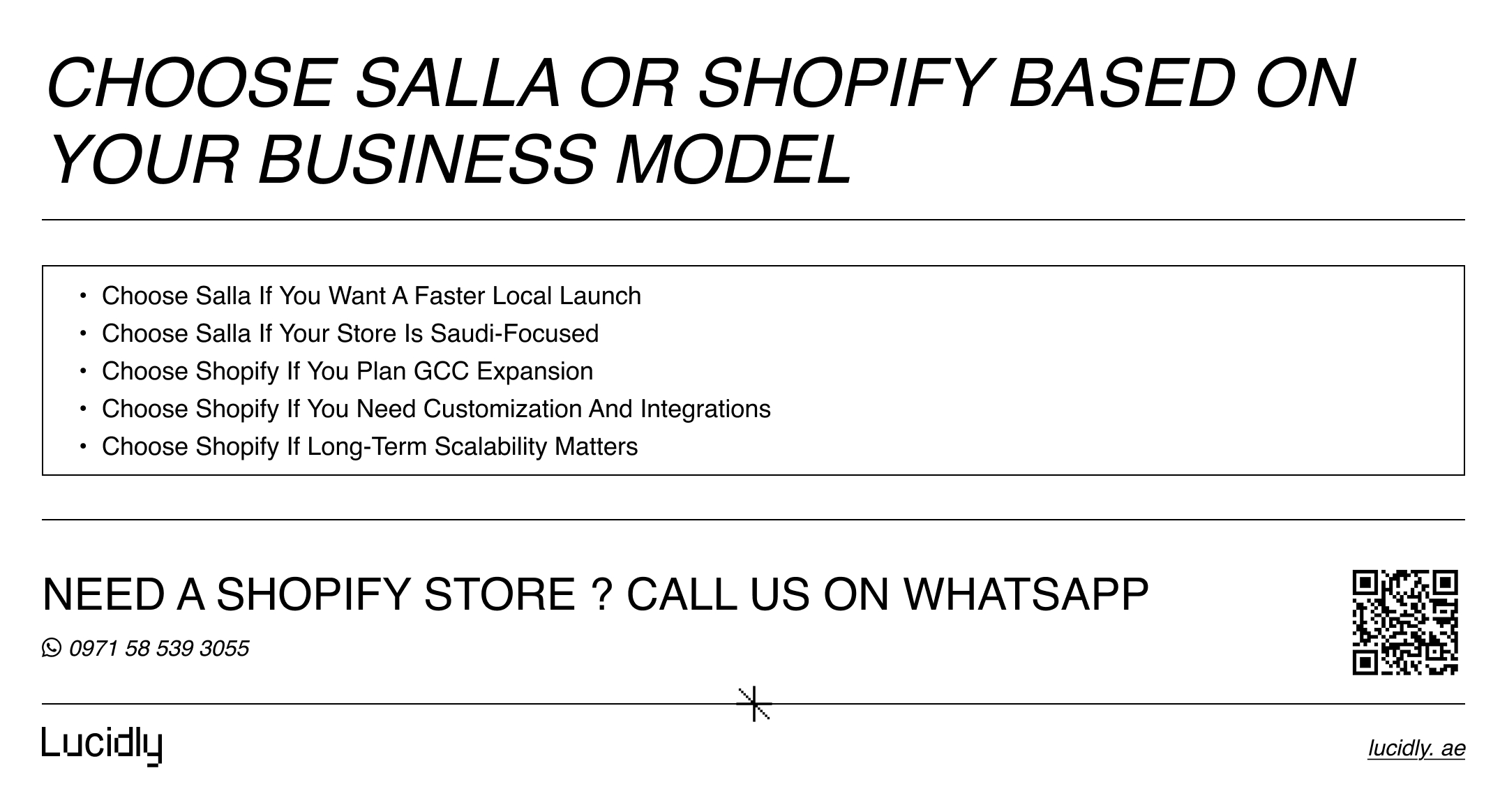
Shopify vs Salla SEO Capabilities: Which Platform Gives You More Organic Growth Potential?
For brands investing in search visibility, collections, category pages, and content, Shopify vs Salla SEO capabilities can become a major deciding factor.
Shopify generally offers stronger SEO flexibility.
It gives merchants and developers more room to improve structure, content strategy, technical setup, and broader optimization efforts.
This makes it a better fit for brands that want SEO to become a serious growth channel in the GCC.
Salla can support basic SEO requirements, but it is usually better suited to merchants with a simpler organic strategy.
For Arabic UX and SEO, read Arabic and RTL on Shopify: Language Setup, Bilingual Navigation, and UX Tips.
Shopify SEO Strengths
For businesses that care about long-term visibility, Shopify offers more room for advanced work.
Better support for advanced optimization
Stronger integration potential with SEO tools
More flexibility in store architecture and content planning
Better long-term potential for content-led growth
Salla SEO Strengths
Salla can still be workable for merchants with lighter SEO needs.
Simpler starting point
Manageable for businesses with basic SEO requirements
Suitable for merchants not relying heavily on advanced organic growth
For brands that care about ranking depth, structure, and future optimization, Shopify vs Salla often leans clearly toward Shopify.
Shopify vs Salla Scalability: What Happens When the Business Grows?
As your ecommerce business grows, the platform you choose starts to play a bigger role in performance, flexibility, and long-term success.
Both platforms may seem sufficient at launch.
The difference becomes clearer as the business grows in traffic, products, and operational complexity.
Shopify is usually better for scaling businesses in the GCC.
It offers stronger integrations, broader customization, and more operational flexibility.
It is a better fit for brands planning multi-market growth or advanced ecommerce workflows.
Salla can work well for smaller and mid-sized businesses with simpler needs.
Its limitations become more noticeable as the business becomes more complex.
For many merchants, the real choice is between easier launch now and stronger long-term scalability later.
Explore Lucidly’s Shopify development services in the UAE if you need help choosing the right Shopify setup, improving your storefront, or building for long-term growth in the GCC.
Best Ecommerce Platform Saudi Arabia: Final Verdict for GCC Businesses
The best ecommerce platform Saudi Arabia is not the same for every merchant.
Salla is often the better fit for businesses that want a local-first experience, simpler setup, and a practical path to launching in Saudi Arabia without heavy technical needs.
Shopify is often the better fit for brands that want more than launch convenience.
It is usually the stronger option for businesses that care about customization, expansion, conversion optimization, advanced SEO, and cross-border growth.
So, if you want a concise conclusion to the compare Shopify and Salla decision:
Choose Salla for simpler local commerce
Choose Shopify for stronger long-term growth potential in the GCC
In many cases, the best platform for online store GCC businesses is the one that matches not only today’s needs, but tomorrow’s complexity.
FAQ
Is Salla better than Shopify?
Salla is better for some businesses, especially merchants that want a simpler Saudi-focused setup with less technical complexity.
Shopify is usually better for businesses that need more customization, stronger integrations, and better long-term scalability.
Which platform is more popular in Saudi Arabia, Salla or Shopify?
Salla has strong familiarity in Saudi Arabia because of its local focus. Shopify is also widely used, especially by brands that want a more flexible platform or plan to grow across the GCC and beyond.
Is Shopify available in Saudi Arabia?
Yes, Shopify is available in Saudi Arabia and is used by many merchants in the market. Businesses in KSA often choose Shopify when they want more customization, stronger ecosystem access, and better expansion options.
Can you migrate a store from Salla to Shopify?
Yes, a store can be migrated from Salla to Shopify. The process usually involves transferring products, customers, orders, and content, while rebuilding key storefront elements and checking apps, payments, and SEO structure.
Which platform is better for scaling ecommerce businesses in GCC?
Shopify is generally better for scaling ecommerce businesses in the GCC because it offers stronger customization, a larger integrations ecosystem, and more flexibility as the business grows in complexity.
Does Salla support international ecommerce?
Salla can support international selling to a degree, but it is generally more locally oriented. Shopify is usually the stronger choice for businesses planning broader regional or international expansion.
Is Shopify more customizable than Salla?
Yes, Shopify is significantly more customizable than Salla. It gives merchants and developers more control over theme development, apps, integrations, storefront behavior, and advanced workflows.
What are the payment options available in Shopify and Salla?
Both platforms support ecommerce payments, but the structure differs. Salla is often attractive for local relevance in Saudi Arabia, while Shopify usually offers broader flexibility and compatibility with a wider range of regional and international payment integrations.
The real decision in Shopify vs Salla is not about choosing the platform with the better name. It is about choosing the platform that best supports your business model, market focus, and growth path.
If your business is local-first, relatively simple, and focused on quick setup in Saudi Arabia, Salla may be the better fit.
If your business needs stronger design flexibility, a broader apps ecosystem, better SEO potential, and more room to scale across the GCC, Shopify is usually the better long-term choice.
Need help deciding between Shopify and Salla or building a Shopify store tailored for growth in the GCC? Message Lucidly on WhatsApp or use the contact numbers on our Contact Us page.
References
To support the comparisons and insights in this guide, the following official resources and platform documentation can be reviewed:
Shopify Official Website — https://www.shopify.com
Shopify Help Center — https://help.shopify.com
Shopify Features Overview — https://www.shopify.com/features
Salla Official Website — https://salla.sa