shopify shipping uae is not just about adding a delivery fee at checkout. For UAE-based stores, shipping shapes conversion, trust, fulfillment speed, and the overall customer experience after purchase.
A strong setup usually depends on the right shipping zones, practical carrier rates, reliable delivery operations, clear tracking emails, manageable COD rules, and simple return workflows.
In this guide, you will learn how to build a shipping setup that works in real conditions for Shopify stores in the UAE without adding unnecessary complexity.
Need a smoother Shopify shipping setup in the UAE? Message Lucidly on WhatsApp.
Why Shipping Setup Matters for Shopify Stores in the UAE
Shipping is one of the fastest ways to improve or damage the buying experience. Customers in the UAE expect fast delivery, clear pricing, flexible payment options, and accurate updates after checkout.
When the setup is weak, the result is often abandoned carts, more support questions, and more failed deliveries.
This is why shopify shipping uae should be treated as part of store performance, not as a minor technical step.
A well-structured shipping setup helps the store stay easier to manage while giving customers a smoother experience from checkout to delivery.
If you are still evaluating Shopify as a platform, read our guide: What Is Shopify? Pros, Cons, and When It’s the Right Ecommerce Platform (2026 Guide).
Shopify Shipping UAE Basics: What Needs to Be Configured First
Before choosing a courier or turning on delivery features, the store needs a clean operational base.
Start with products, locations, and shipping profiles
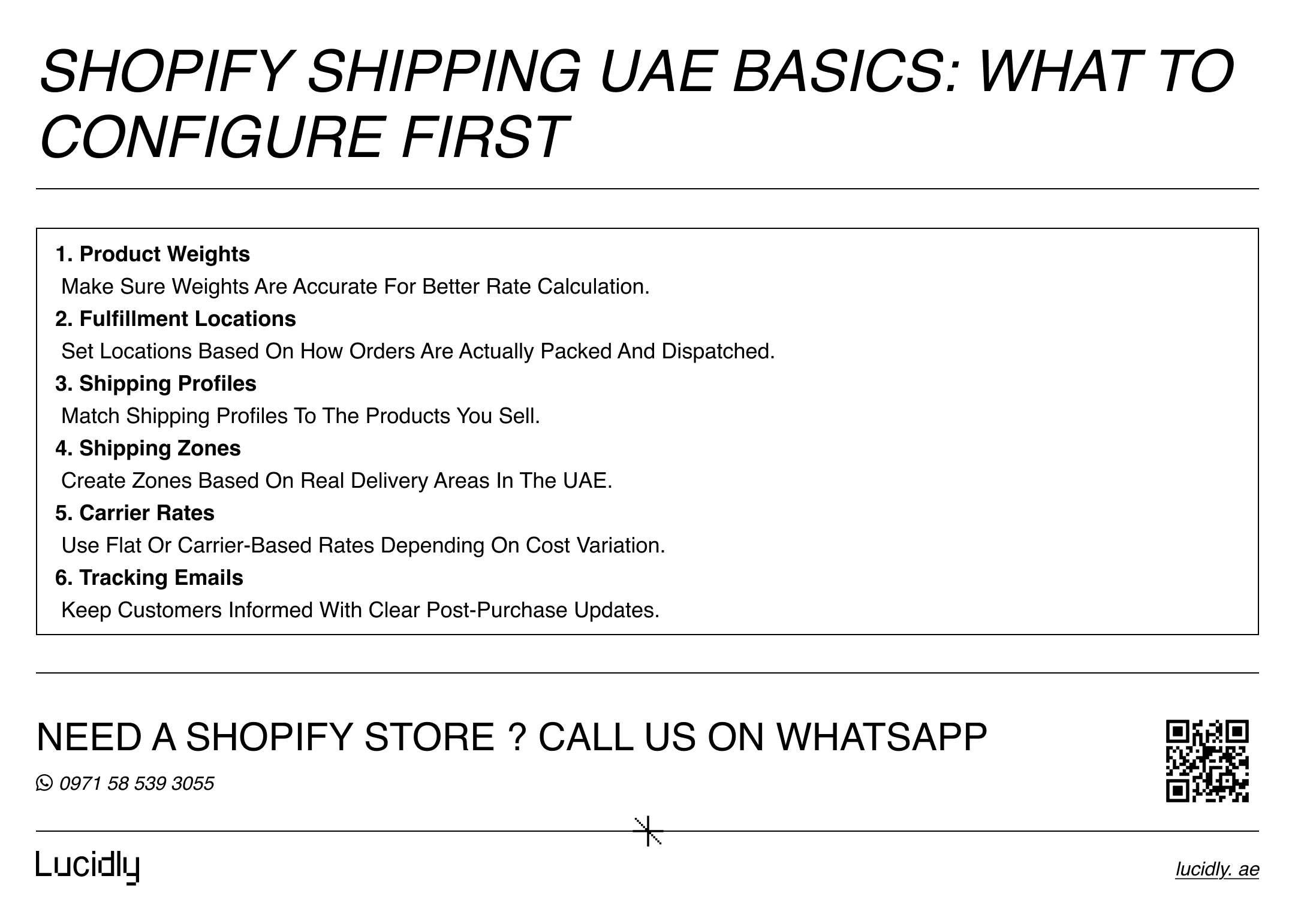
A practical shipping setup starts with the right operational basics inside Shopify. Before adding courier tools or advanced delivery rules, the store needs a clean structure that reflects how orders are actually prepared and fulfilled. A reliable shipping setup shopify uae begins with operational accuracy, not with apps alone.
Focus first on:
accurate product weights
fulfillment locations that reflect real dispatch operations
shipping profiles that match the products being sold
If these basics are not set correctly, the rest of the workflow becomes harder to control. Even a strong courier setup will not fix rate errors, fulfillment confusion, or delivery delays caused by poor product and location settings.
For tax setup and compliance in the UAE, read: UAE VAT on Shopify: Practical Setup for Taxes, Invoices, and Compliance.
Understand shipping zones and carrier rates
Shipping zones define where you deliver and how shipping rules apply by destination. For UAE stores, this usually means creating a structure that reflects the actual service areas of the business instead of overcomplicating the setup.
Carrier rates can be useful when the store needs more dynamic pricing based on destination, weight, or courier logic. In other cases, flat rates may be easier to manage and communicate.
A good delivery setup shopify uae usually balances simplicity and control. If the rate structure is too complex, the team struggles to manage it. If it is too broad, pricing may become inaccurate.
Labels, pickup scheduling, and tracking emails
Shipping operations do not end at checkout. Once the order is confirmed, the store still needs a clean process for labels, pickup scheduling, and customer communication.
Labels should be generated in a way that reduces manual work. Pickup scheduling should fit the actual dispatch process. Tracking emails should be timely and easy to understand.
These details are often overlooked, but they play an important role in ecommerce shipping shopify uae because they affect both internal efficiency and customer confidence.
Can Aramex Integrate with Shopify?
Yes, Aramex can work well for many UAE Shopify stores, especially when the store needs a known logistics partner with local and regional reach.
How Aramex fits Shopify stores in the UAE
Aramex is a common option for stores that want a recognizable carrier with established operations in the region. Depending on the business model, it may support local delivery, wider regional shipping, and workflows that align with COD and order tracking needs.
For growing brands, that can make it a practical part of a broader shopify delivery uae strategy.
Aramex Shopify integration options
There is more than one way to approach aramex shopify integration. The right setup depends on how the store actually operates, how much control the team needs, and how advanced the fulfillment workflow is. Some businesses only need a simple connection, while others need a setup that supports more operational complexity.
Common integration options include:
an app-based setup for simpler store requirements
middleware for more flexibility between systems
a custom solution for stores that need tighter control over workflows and automation
In many cases, a simple store may only need a straightforward aramex shopify app setup. A more complex business may need a system that connects shipping, order processing, and internal operations more tightly.
What to check before using the Aramex Shopify app
Before going live with any Aramex connection, it is worth checking a few practical points:
whether rates are accurate for the areas you serve
whether your shipping zones reflect actual delivery coverage
whether labels can be generated efficiently
whether pickup scheduling fits your dispatch process
whether tracking updates reach customers clearly
whether COD rules can be handled properly
whether return workflows are manageable
This review matters because aramex shopify integration should support the business model, not just technically connect the courier to the store.
How do I set up shipping zones and rates in the UAE?
Shipping zones and rates should reflect how the business truly delivers, not how the map looks in theory.
How to structure shipping zones inside the UAE
Many stores do well with a simple zone structure. For example, one setup may separate Dubai, Abu Dhabi, Sharjah, and the rest of the UAE. Another may use only two or three groups depending on fulfillment speed and delivery cost.
The best structure depends on your operational reality. If delivery times or charges vary meaningfully by destination, the zones should reflect that. If not, a simpler structure is usually better.
This is where shopify shipping uae needs practical thinking. The goal is not to create the most detailed system. The goal is to create one that is easy to manage and clear to the customer.
When to use fixed rates vs carrier rates
Fixed rates work well when the business wants predictability. They are easier to explain and easier to manage. Carrier rates make more sense when shipping costs vary significantly by destination, parcel size, or service method.
Neither is automatically better. The better choice depends on whether pricing accuracy or operational simplicity matters more in your case.
A practical rule is this: use flat pricing when it keeps the experience cleaner and use carrier rates when cost variation is too large to ignore.
Common mistakes in shipping setup Shopify UAE
A few mistakes appear often in shipping setup shopify uae:
creating too many shipping zones without real operational value
charging the same rate everywhere when delivery cost clearly differs
failing to test checkout with real addresses
using shipping rules that do not match actual courier coverage
ignoring how the delivery setup affects COD and returns
A strong delivery setup shopify uae should be tested from both the store side and the customer side before launch.
Should I Offer COD and How Do I Manage It?
COD remains relevant in the UAE for many stores, but it should be managed with discipline.
Why COD still matters in the UAE
Some customers still prefer cash on delivery because it feels familiar and lower risk. For certain product categories or audiences, COD can help remove hesitation and improve conversion.
That said, COD is not automatically the right choice for every store. It adds operational pressure and can increase failed delivery costs.
The operational risks of COD
COD often comes with extra challenges. Orders may be refused at the door. Confirmation steps may become necessary. Internal teams may spend more time managing dispatch and failed attempts.
This is why COD should be part of the overall shopify shipping uae strategy, not treated as a standalone option. It affects delivery efficiency, courier coordination, and customer communication.
Smart ways to manage COD on Shopify
COD is easier to manage when the rules are clear. Many stores improve performance by limiting COD to selected areas, charging a small COD fee where appropriate, and confirming orders before dispatch.
The goal is not to remove flexibility for customers. The goal is to reduce waste and improve order quality.
For many businesses, COD works best when it is selectively offered rather than universally enabled.
Tracking, Notifications, and the Post-Purchase Experience
Customers do not judge delivery only by speed. They also judge it by visibility. In any effective shopify shipping uae setup, tracking and notifications play a major role in building trust after checkout.
Why tracking emails matter
Tracking emails reduce uncertainty after checkout. Customers want to know that the order has been processed, shipped, and updated properly. When these updates are missing or confusing, trust drops quickly.
This is why tracking emails are a core part of shopify delivery uae. They reduce support pressure and make the post-purchase journey feel more professional.
What customers should see after checkout
Customers should receive updates that are easy to understand. They should be able to see order progress, shipment status, and a usable tracking path without confusion.
Good communication here does more than inform. It reassures.
How tracking reduces support load
One of the most practical benefits of better tracking is lower support volume. If customers can easily follow delivery progress, they are less likely to ask where the order is or when it will arrive.
For a store handling regular order volume, this can save significant time and reduce friction across the customer service workflow.
How Do I Handle Returns Efficiently?
Returns should be designed as a controlled process, not as an afterthought.
Build a clear returns policy Shopify UAE
A good returns policy shopify uae should clearly explain the return window, product condition requirements, refund or exchange options, and who is responsible for return-related shipping costs.
Customers do not want long policy language. They want clarity. If the rules are hard to understand, the store ends up dealing with more confusion and more manual resolution work.
Create simple return workflows
A return policy alone is not enough. The store also needs workable return workflows. That includes how customers request a return, how approvals are handled, how the item is collected or shipped back, and how the refund or exchange is processed.
Clear return workflows make the business easier to manage and improve the customer experience during a sensitive part of the journey.
How returns affect the overall delivery setup Shopify UAE
Returns are part of the broader delivery setup shopify uae because they affect logistics, cost control, and customer satisfaction. A store may have strong outbound shipping but still create a poor overall experience if returns are slow or unclear.
This is why returns should be built into the shipping strategy from the start, especially for stores that expect repeat customers and long-term growth.
A Practical Shopify Shipping Setup for UAE Stores
A practical setup usually looks simple from the outside, but it is built with intention underneath.
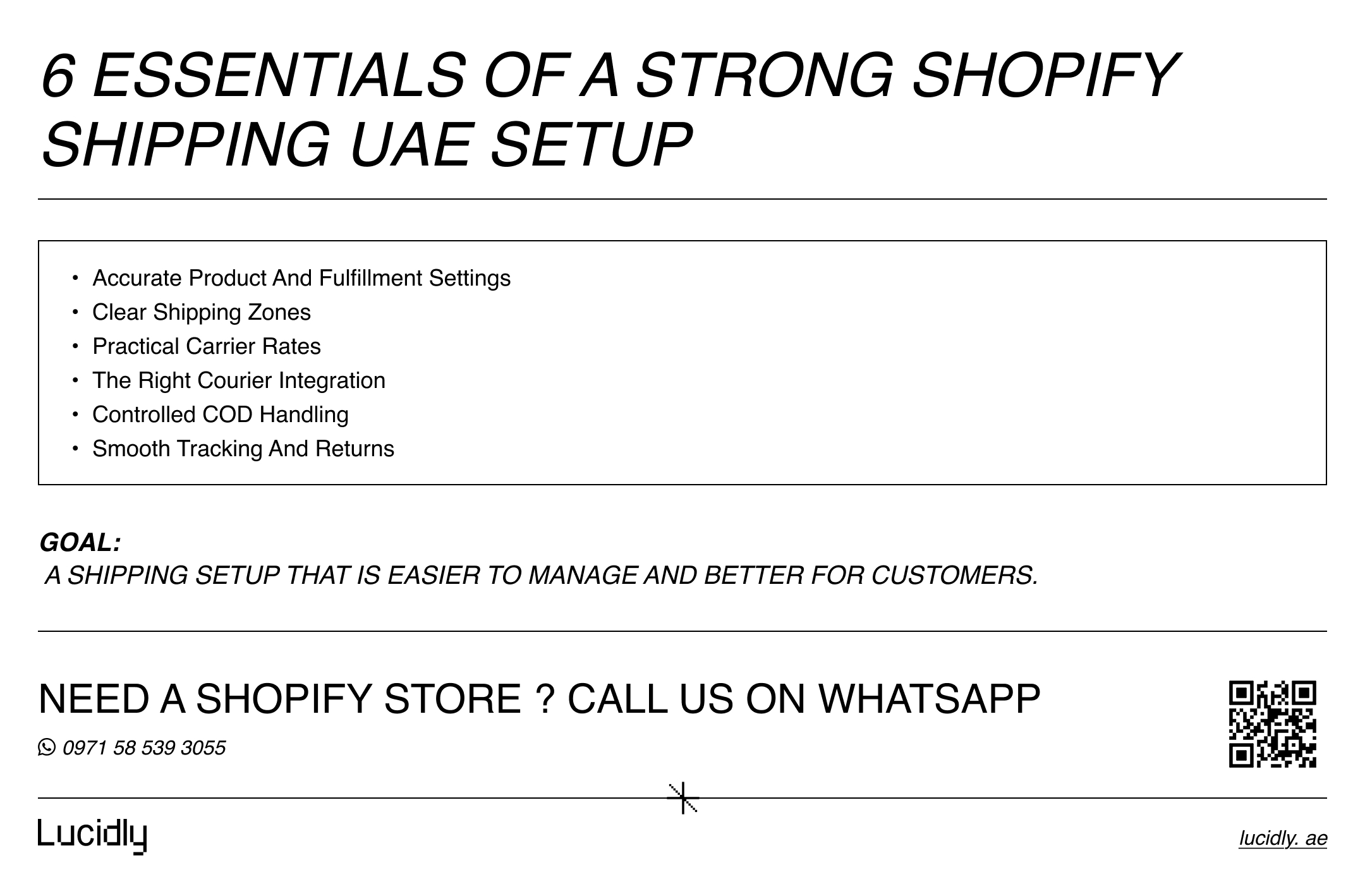
In practice, a strong shopify shipping uae setup usually depends on six essentials:
accurate product and fulfillment settings
clear shipping zones
practical carrier rates
the right courier integration
controlled COD handlin
a smooth process for tracking and returns
When these elements work together, the store becomes easier to manage, and the delivery experience becomes more consistent for customers.
For many businesses, this means defining clear shipping zones, choosing the right balance between flat pricing and carrier rates, connecting a courier such as Aramex where it adds operational value, generating labels efficiently, keeping pickup scheduling organized, sending useful tracking emails, controlling COD carefully, and keeping return workflows straightforward.
That is what makes shopify shipping uae effective in practice. Not complexity. Not feature overload. Just a setup that supports how the store actually works.
Need a better shipping setup for your store? Explore Lucidly’s Shopify development services in the UAE.
FAQ
How do I set up shipping zones and rates in the UAE?
Start by grouping delivery areas based on real operational differences such as cost, speed, or service coverage. Then apply rates in a way that keeps the logic easy to manage. Many stores perform better with a clear, simple zone structure rather than a highly detailed one.
Can Aramex integrate with Shopify?
Yes. Aramex shopify integration can be handled through app-based, middleware, or custom approaches depending on the store’s needs. The best method depends on how much automation and control the business requires.
Should I offer COD and how do I manage it?
COD can still work well in the UAE, but it should be controlled carefully. Many stores manage it more effectively by limiting it to selected areas, confirming orders before dispatch, and keeping rules clear around failed delivery attempts.
If you also need the right payment setup, read: Payment Gateways for Shopify UAE: How to Choose and Integrate.
How do I handle returns efficiently?
Efficient returns start with a clear policy and a simple operational process. Customers should know the conditions, timeline, and next step, while the store should have an internal workflow for approval, collection, inspection, and resolution.
A successful shopify shipping uae setup is not about adding every delivery feature available.
It is about building a system that fits the way the store actually operates. When shipping zones, carrier rates, Aramex integration, COD rules, tracking, and returns work together, the result is a smoother customer experience and a store that is easier to manage as it grows.
Need help with Shopify shipping in the UAE? Message Lucidly on WhatsApp or use the contact numbers on our Contact Us page for expert support with Aramex, COD, tracking, and returns.