Setting up shopify arabic rtl is not only about translating a few storefront labels.
For many merchants, especially those serving mixed audiences in the Gulf, the real challenge is making Arabic feel native across navigation, product browsing, and checkout.
A strong setup depends on the right shopify arabic language configuration, a reliable rtl shopify theme, and UX decisions that keep both Arabic and English users comfortable from entry to purchase.
Message Lucidly on WhatsApp for help with your Shopify Arabic and RTL setup.
Can Shopify support Arabic and RTL?
Yes, Shopify can support Arabic and right-to-left layouts, but the result depends on implementation quality.
Shopify supports multiple languages and allows merchants to manage translations across core storefront content.
That makes it possible to build an Arabic Shopify store or even a bilingual experience.
However, native multilingual capability does not automatically guarantee a polished RTL Shopify experience.
Arabic support can still feel incomplete if the theme does not handle alignment, icon direction, spacing, or typography properly.
In practice, successful shopify arabic rtl setups depend on both language configuration and front-end execution.
If you are still evaluating Shopify as a platform, read our guide: What Is Shopify? Pros, Cons, and When It’s the Right Ecommerce Platform (2026 Guide).
How to set up Shopify Arabic RTL correctly?
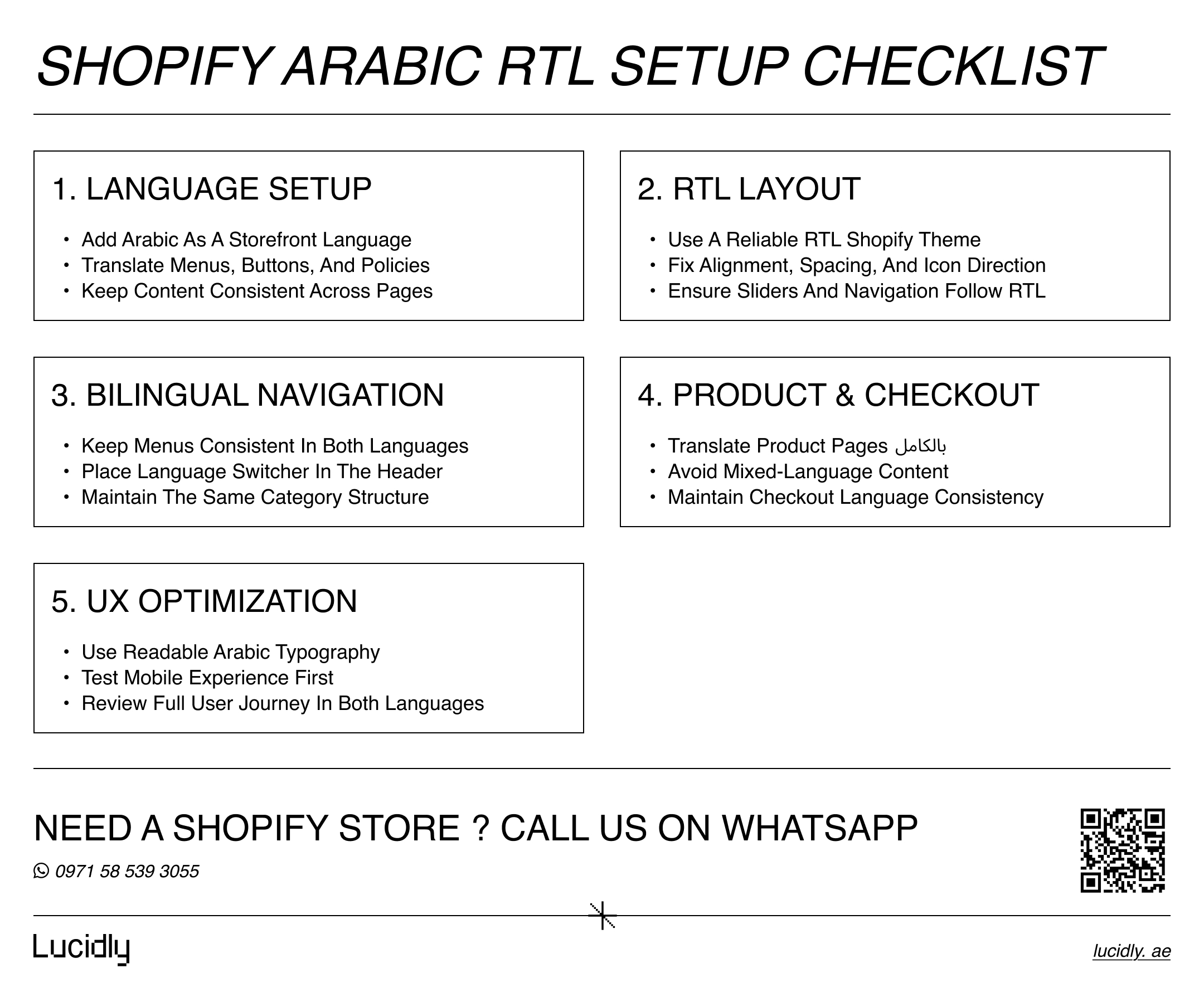
Setting up Arabic on Shopify starts with adding Arabic as a storefront language, then reviewing how translated content appears across the full customer journey.
A strong setup should make the store feel complete in Arabic, not partially translated.
Add Arabic as an available storefront language.
Translate more than the homepage, including collection names, buttons, policy pages, notifications, filters, and key interface labels.
Review product pages carefully, especially variant labels, size options, tabs, and product details.
Check cart and post-purchase flows to make sure the experience stays clear and consistent.
Maintain strong checkout language consistency so customers do not move from Arabic pages into mixed or default English system text.
Make sure the final shopify arabic rtl experience feels complete across the whole store, not only in visible sections.
For tax setup and compliance in the UAE, read: UAE VAT on Shopify: Practical Setup for Taxes, Invoices, and Compliance.
Do I need a special RTL theme?
Not always, but you do need a theme that can handle RTL properly. A good rtl shopify theme should mirror page structure naturally, not just shift text alignment.
This includes header layout, dropdown direction, sliders, breadcrumbs, account icons, filters, and form fields.
A weak theme may technically display Arabic while still breaking the RTL layout.
Common issues include arrows pointing the wrong way, menus opening awkwardly, inconsistent spacing, or banners that feel visually unbalanced.
This is where typography also matters. Arabic text needs a font, size, and spacing system that supports readability rather than forcing Arabic into a layout originally designed only for English.
For many merchants, the best route is not a “special Arabic theme,” but a well-built theme that can be adapted into a solid RTL Shopify experience.
How to build a bilingual Shopify store without confusing users
A successful bilingual shopify store uae setup should make language choice obvious and browsing logic consistent.
Users should be able to switch language easily from a visible location in the header, not hunt for it in the footer.
The biggest mistake in a bilingual store is creating two different navigation experiences. Menus should stay structurally parallel across languages so users do not feel they entered a different store.
Category order, promotional pages, and product discovery paths should remain familiar in both versions.
Content parity matters too. If the Arabic side lacks key collection pages or product information, the experience feels secondary.
A strong Arabic ecommerce Shopify setup treats Arabic and English as equal storefront paths.
That is especially important for a bilingual shopify store uae, where shoppers may switch languages based on habit, device, or family preference.
Looking to build a smoother Arabic Shopify experience? Explore Lucidly’s Shopify development services in the UAE.
What RTL UX issues reduce conversion?
Most conversion problems in shopify arabic rtl stores do not come from translation alone. They come from friction in the user experience.
Broken visual flow
When the RTL layout is inconsistent, users hesitate. The page may feel unfamiliar, unstable, or harder to scan.
Weak Arabic typography
Poor Arabic typography can make even translated pages feel uncomfortable to read. That affects trust and increases effort during browsing.
Confusing navigation
If menus are cluttered, misaligned, or inconsistent between Arabic and English, product discovery becomes slower and less intuitive.
Incomplete product experience
On product pages, mixed-language labels, English-only attributes, or awkward option selectors make the store feel unfinished.
Inconsistent checkout language
Weak checkout language consistency affects confidence at the most sensitive stage of the journey. When the checkout suddenly shifts language, users may hesitate before completing payment.
Practical UX tips for a better Arabic Shopify store
Improving usability does not always require a full rebuild. Often, a few focused fixes make the biggest difference.
Test mobile first
Many users will visit the store on mobile before desktop. That means spacing, text wrapping, filters, and menu behavior should be checked on smaller screens first.
Review direction-sensitive elements
Make sure arrows, sliders, icons, and interface cues follow the language direction correctly.
Use Arabic-friendly typography
Choose fonts that remain clear in Arabic and test line height, weight, and spacing across product and collection templates.
Audit the full journey in both languages
Review search, navigation, cart, and product pages in Arabic and English. The best way to catch issues in shopify arabic rtl is to test the store as a real shopper, not only from the admin side.
FAQs
Can Shopify support Arabic and RTL?
Yes. Shopify can support Arabic and multilingual storefronts, but the quality of RTL depends heavily on the theme and execution.
Do I need a special RTL theme?
Not necessarily. You need a theme that handles RTL structure, alignment, and Arabic readability well, whether natively or through customization.
If you need deeper theme-level improvements, read: Shopify Theme Customisation: Liquid, Sections, and Conversion Focused Development.
How do I set up a bilingual Shopify store?
Add Arabic as a store language, complete the translations, align navigation across both languages, and test the full user journey for consistency.
What RTL UX issues reduce conversion?
The main issues are broken layout flow, weak typography, confusing menus, incomplete product translation, and inconsistent checkout language.
A good shopify arabic rtl setup is not about translating text line by line. It is about building a storefront that feels natural in Arabic, clear in both languages, and friction-free from browsing to checkout.
When language setup, navigation, and UX are handled properly, the result is a more credible and more usable Arabic Shopify store.
Need expert help with Arabic language setup, RTL layout, or bilingual UX on Shopify? Message Lucidly on WhatsApp or use the contact numbers on our Contact Us page.
References
Shopify Help Center. Localization and translation. Available at: https://help.shopify.com/en/manual/international/localization-and-translation
Shopify Help Center. Translate & Adapt app. Available at: https://help.shopify.com/en/manual/international/translate-adapt-app
W3C. Right-to-left text and layout guidelines. Available at: https://www.w3.org/International/tutorials/bidi-xhtml/