Search engines care about content, but they can only rank what they can reliably crawl, understand, and trust.
That’s why seo friendly website development matters: when your site is technically sound—fast, well-structured, and easy to interpret—your content is discovered faster, indexed more accurately, and evaluated more fairly.
This guide breaks down how to make your website SEO-friendly from a development perspective, with clear explanations, real-world examples, and practical checklists tailored for modern websites and competitive markets like the UAE.
Message Lucidly on WhatsApp for a focused SEO and UX review.
What “SEO-Friendly Website Development” Really Means
Before diving into tools and tactics, it’s important to align on definitions. Many teams confuse SEO-friendly development with adding meta tags or installing plugins. That’s only a small part of the picture.
SEO-friendly website development means building a site that allows search engines to:
Crawl pages efficiently
Index the right URLs
Understand content structure and intent
Evaluate performance, usability, and trust signals
In short, your codebase should help search engines do their job — not fight them.
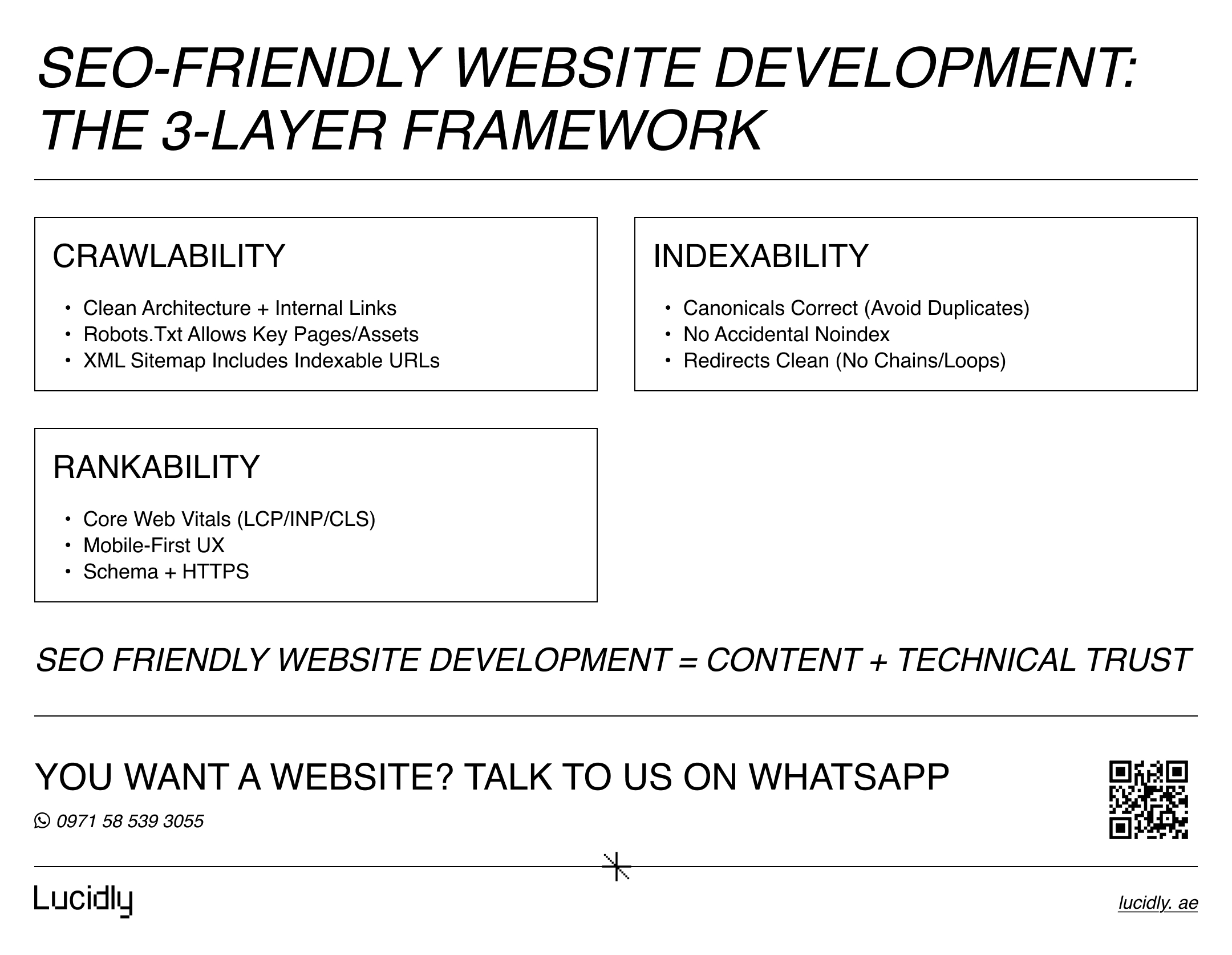
This involves three technical pillars: crawlability, indexability, and rankability.
SEO-friendly results depend on how a site is built. If you’re exploring professional development options, this guide on web development services for modern business websites explains how structure, performance, and functionality drive visibility.
Crawlability, Indexability, and Rankability
Every SEO outcome starts with these three steps, and developers influence all of them.
Crawlability refers to whether search engine bots can access your pages at all. Poor internal linking, blocked resources, or misconfigured robots.txt files often break this step.
Indexability determines whether crawled pages are stored in Google’s index. Canonical errors, duplicate content, or noindex tags can silently remove pages from search results.
Rankability is the final layer. Page speed, Core Web Vitals, mobile usability, structured data, and clean HTML all affect how competitive your indexed pages can be.
Strong seo friendly website development ensures all three layers work together — consistently.
Site Architecture That Search Engines Understand
A search-friendly site structure doesn’t happen by accident. It’s designed.
When developers plan architecture early, SEO becomes scalable instead of reactive.
Clean URL Structure and Logical Hierarchy
URLs should be readable, predictable, and hierarchy-based.
Avoid long query strings, session IDs, or unnecessary parameters.
Good structure:
/services/web-development/
/blog/seo-friendly-website-development/
Bad structure:
/page?id=742&cat=12
Clean URLs support seo friendly website development by improving crawl efficiency and user trust at the same time.
Internal Linking from a Technical Perspective
Internal links are not just for navigation — they are discovery paths for crawlers.
Key rules:
No orphan pages
Important pages reachable within 3 clicks
Contextual links inside content, not just menus
Developers should ensure internal links are crawlable HTML links, not JS-only interactions.
Search-friendly architecture starts with planning. This guide on professional website planning and site architecture shows how strategy, layout, and navigation decisions affect crawlability and conversions.
Controlling Indexing: Robots, Sitemaps, and Canonicals
Once structure is solid, indexing control becomes critical — especially for large or multilingual websites.
This is where many technically strong sites accidentally sabotage their own SEO.
robots.txt and Crawl Directives
Your robots.txt file should block only what truly shouldn’t be crawled — admin areas, test environments, or internal search pages.
Never block:
CSS or JS needed for rendering
Important content sections
Language directories by mistake
Misconfigured robots files are one of the fastest ways to break seo friendly website development.
XML Sitemaps and Canonical URLs
XML sitemaps help search engines prioritize what matters. They should include:
Canonical URLs only
Updated timestamps
Indexable pages with value
Canonicals must always point to the preferred version of a page — especially on ecommerce sites or filtered category pages.
If you want the official baseline, Google’s crawling and indexing documentation explains how to control discovery, crawling, and indexing for your content.
Performance, Core Web Vitals, and SEO
In competitive regions like the UAE, performance is no longer optional. Google measures real user experience at scale.
A fast site is not just good UX — it’s foundational to seo friendly website development.
Core Web Vitals Developers Must Optimize
Focus on:
LCP: Optimize images, hero sections, and server response
INP: Reduce heavy JavaScript and long tasks
CLS: Prevent layout shifts from fonts, ads, or dynamic content
Speed impacts both rankings and revenue. This guide on website performance optimization for higher conversions explains why load time is one of the highest-ROI development upgrades.
Practical Performance Checklist
Use modern image formats (WebP / AVIF)
Lazy-load below-the-fold images
Minify and defer JavaScript
Implement CDN and caching layers
Preload critical fonts
Performance optimization is one of the highest ROI investments in SEO-friendly development.
Your platform choice affects SEO control and long-term scalability. If you’re deciding how to build, this comparison of custom websites vs WordPress vs builders for business growth breaks down which option fits your goals.
Mobile-First Development (Not Just Responsive Design)
Google indexes mobile versions first. That means mobile performance and usability directly influence rankings.
True seo friendly website development treats mobile as the primary experience — not a scaled-down desktop version.
Key developer checks:
Touch-friendly spacing
Readable font sizes
No intrusive interstitials
Mobile-optimized loading behavior
A responsive layout alone is not enough if mobile users struggle to interact with the site.
On-Page SEO Elements Developers Control
While content teams write copy, developers control how it’s delivered to search engines.
HTML Semantics and Headings
Use proper heading hierarchy:
One H1 per page
Logical H2 → H3 flow
Semantic HTML elements
This helps search engines understand content structure and relevance.
Meta Titles, Images, and Structured Data
Developers should:
Ensure titles and meta descriptions are crawlable
Implement proper image alt attributes
Add structured data (Schema) for articles, FAQs, organizations, and local businesses
Structured data strengthens seo friendly website development by improving understanding and eligibility for rich results.
Bilingual and UAE-Focused SEO Development
Websites targeting the UAE often require Arabic and English versions. This introduces technical complexity.
Key considerations:
Correct hreflang implementation
Clear URL strategy (/ar/ and /en/)
No duplicate content between languages
Arabic SEO requires intent-aware translation, not direct word-for-word copying.
Handled correctly, bilingual architecture becomes a major ranking advantage.
Security, Accessibility, and Trust Signals
For UAE-focused websites, accessibility isn’t optional—align your implementation with the UAE’s National Digital Accessibility Policy to meet modern digital service expectations.
Google increasingly rewards trustworthy, accessible websites.
Developers should ensure:
HTTPS across all pages
No mixed content errors
Clean redirect chains
Proper 404 handling
Basic accessibility compliance (labels, contrast, keyboard navigation)
These signals support both rankings and conversions.
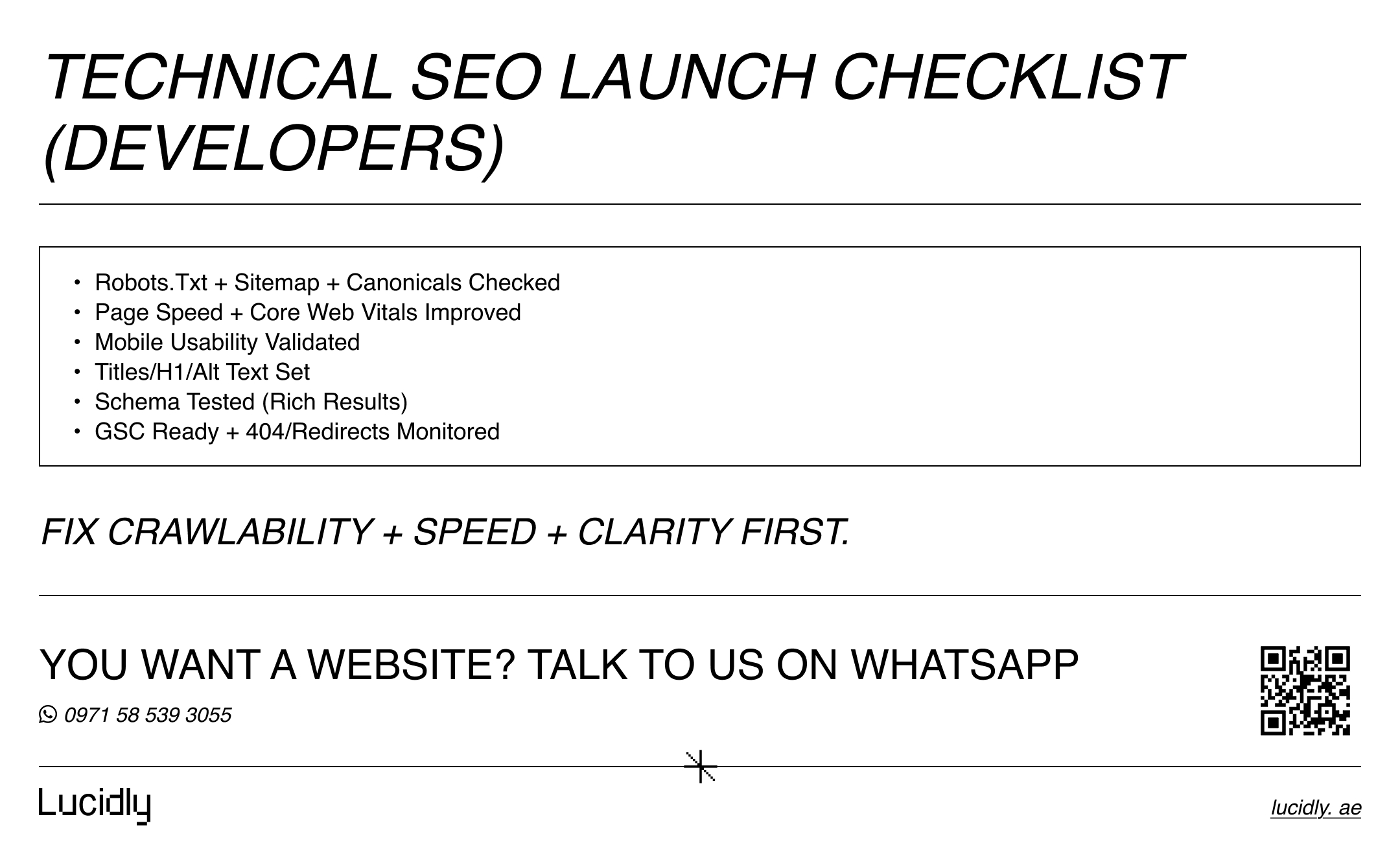
Pre-Launch Technical SEO Checklist
Before launch, validate:
Crawl access
Indexing rules
Core Web Vitals
Mobile usability
Canonicals and sitemaps
Structured data validation
This checklist prevents costly SEO regressions after deployment.
Monitoring After Launch
SEO-friendly development doesn’t end at launch.
Use:
Google Search Console for coverage and performance
Core Web Vitals reports
Crawl error monitoring
Continuous monitoring protects your rankings over time.
Common Developer Mistakes That Hurt Rankings
Blocking important resources
JavaScript-only navigation without fallbacks
Duplicate pages for cities or services
Heavy images on mobile
Incorrect canonical tags
Avoiding these mistakes is just as important as implementing best practices.
Ready to Build a High-Performance Website?
Turn strategy into results with Lucidly’s custom web development solutions — built for speed, SEO, and business growth.
👉 Book Your Web Development Consultation
FAQ
What is SEO-friendly website development?
It’s the practice of building websites that search engines can easily crawl, index, understand, and rank through clean architecture, performance optimization, and semantic code.
Do developers really impact SEO?
Yes. Technical decisions directly affect crawlability, speed, and usability — all core ranking factors.
Is page speed critical for SEO in the UAE?
Absolutely. Mobile performance and Core Web Vitals are especially important in competitive UAE markets.
Do I need structured data for SEO?
Structured data improves understanding and eligibility for rich results, strengthening overall SEO performance.
How often should technical SEO be reviewed?
After every major release and at least quarterly for stable sites.
SEO doesn’t start with keywords — it starts with code.
When developers and SEO work together from day one, seo friendly website development becomes a growth engine instead of a limitation.
Build for users. Build for performance. Build for clarity, Search engines will follow.
Contact us — or message Lucidly on WhatsApp for a clear web development, technical SEO + performance review—so you can prioritise the highest-impact fixes for crawlability, speed, and mobile UX before investing in redesigns or new features.
References
This article is informed by Google Search Central documentation, web.dev guidelines, and leading technical SEO resources including Ahrefs, Moz, and Semrush.