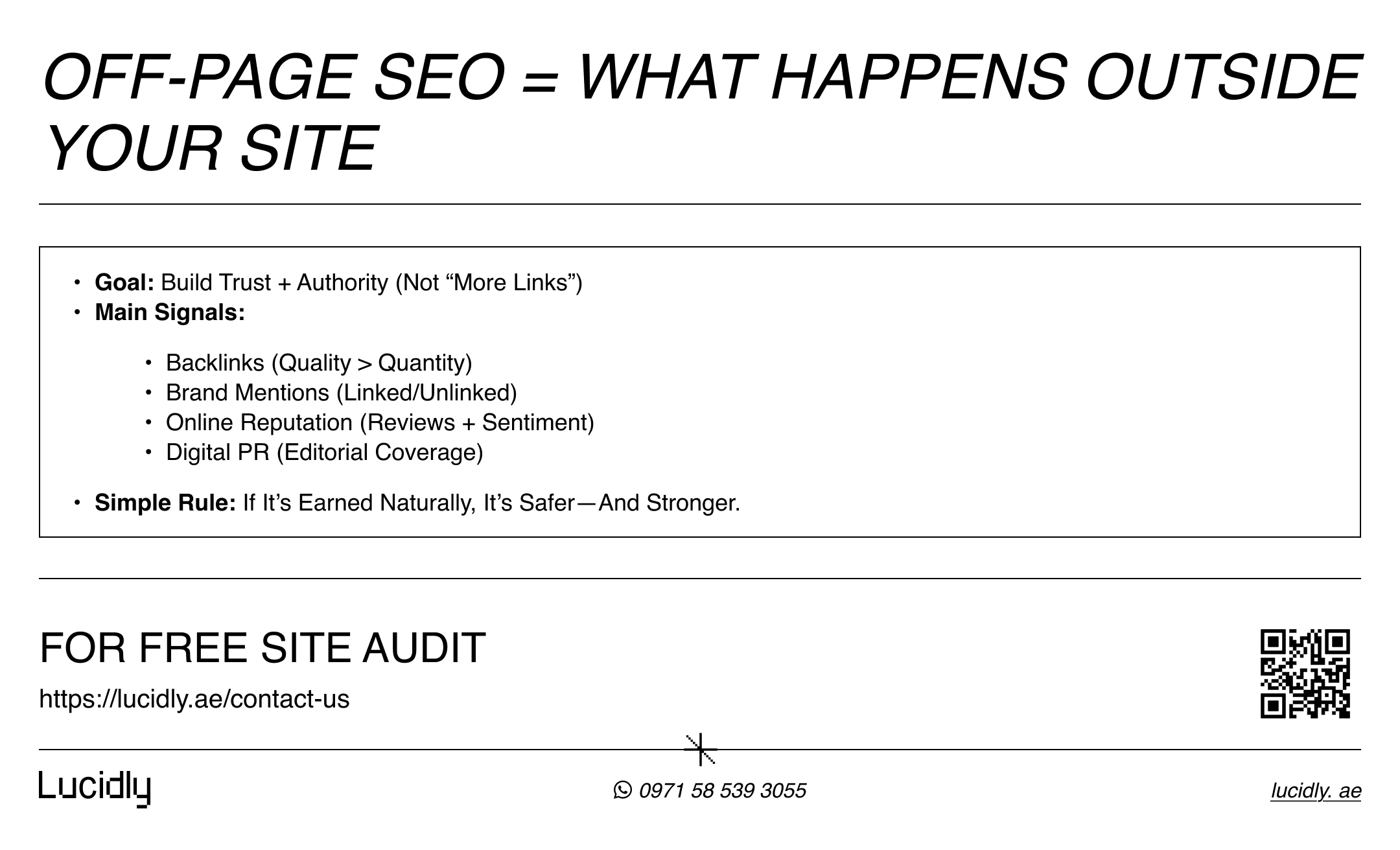
Off-page SEO is everything that happens beyond your website to build trust, credibility, and visibility—so search engines and real people feel confident choosing you.
While on-page SEO helps Google understand your content and technical SEO helps it crawl and index your pages, off-page SEO helps prove your site is worth ranking.
Backlinks remain a key signal, but authority today also comes from brand mentions, online reputation, and digital PR that earns genuine editorial coverage.
In 2026, the goal isn’t “get more links”—it’s to earn relevant, high-quality links in the right context, using safe off-page SEO techniques that support sustainable growth.
What Is Off-Page SEO?
Off-page SEO refers to all optimisation activities that take place outside your own website and influence how search engines and users perceive your brand.
While on-page SEO focuses on content and page-level elements, and technical SEO ensures your site can be crawled and indexed efficiently, off-page SEO is about building trust, authority, and relevance through external signals.
These off-site SEO factors typically include:
Backlinks from relevant, authoritative websites.
Brand mentions, whether linked or unlinked.
Online reputation signals such as reviews and sentiment.
Digital PR coverage that earns genuine editorial visibility.
In essence, off-page SEO helps search engines understand not just what your website says about itself, but how the wider web recognises and validates your presence within your industry.
In practice, off-page SEO is about what you do outside your site to earn trust—not manipulate rankings.
What Do You Actually Do in Off-Page SEO?
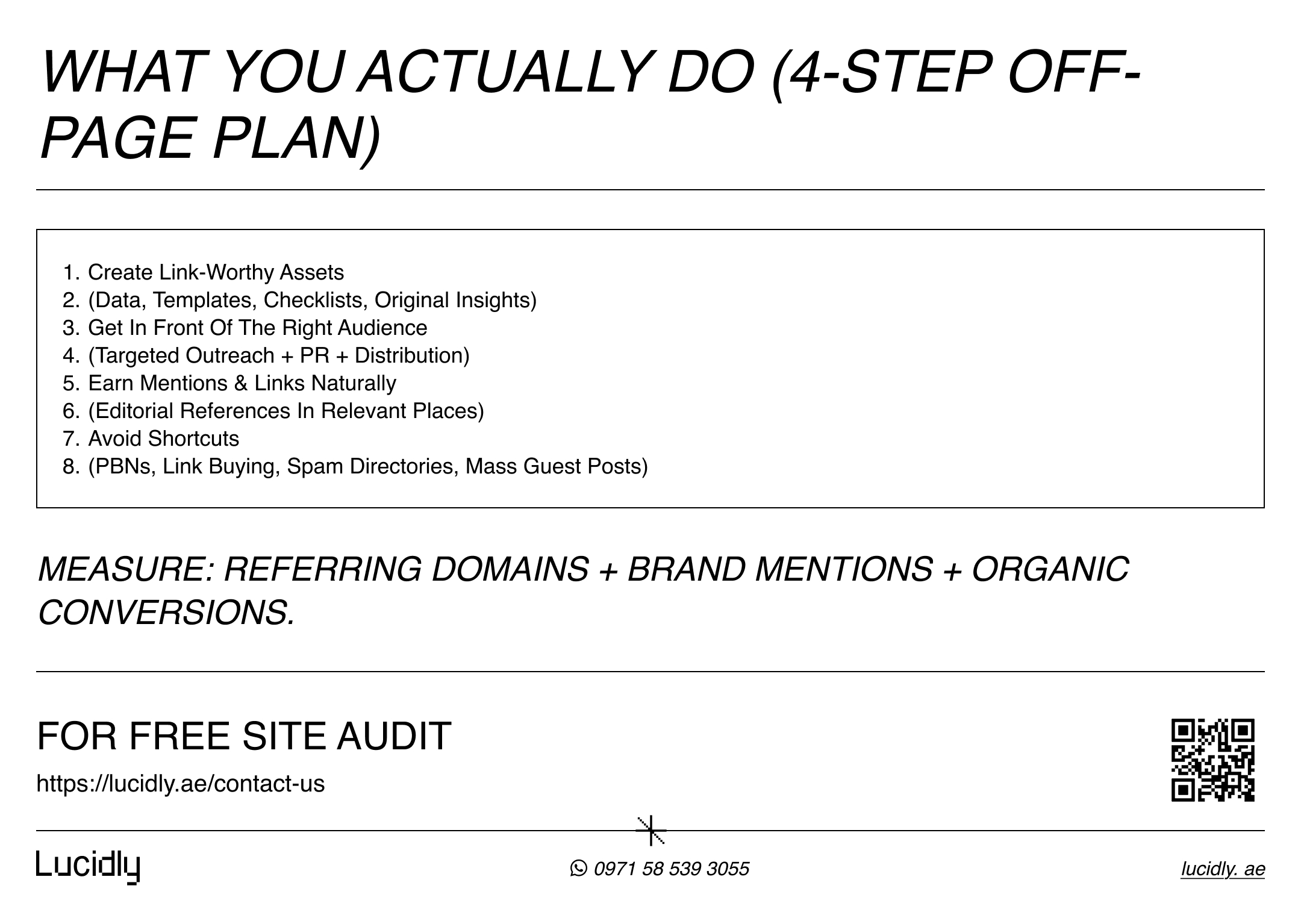
Off-page SEO isn’t about chasing links or finding shortcuts to manipulate rankings. It’s about earning trust signals by creating value that other websites and audiences genuinely want to reference.
When you focus on relevance, usefulness, and credibility, links and mentions become a natural outcome—not the goal itself.
In practice, off-page SEO means:
Create link-worthy assets that solve real problems or provide original insight
Get them in front of the right audiences through targeted outreach, PR, and distribution
Earn mentions, links, and references naturally within relevant editorial contexts
Avoid shortcuts that trigger spam systems, such as paid links, networks, or automation
This approach keeps your off-page SEO aligned with how search engines evaluate trust—and makes your efforts sustainable over time.
Off-Page SEO Techniques That Still Work in 2026 (Safe + Practical)
The most effective off page SEO techniques in 2026 don’t rely on shortcuts—they focus on earning attention, trust, and editorial recognition.
Bing’s official guidance on link building emphasises that backlinks should be built organically over time as people discover unique, high-quality content—reinforcing why sustainable off-page SEO focuses on earning trust, not forcing links.
The goal of off page optimisation is to create real reasons for reputable websites and communities to reference your brand.
When your off-site SEO efforts are built around value, relevance, and credibility, backlinks and brand mentions become a natural byproduct, not the only target.
Here are safe, sustainable off-page SEO techniques that help build authority:
Digital PR: earn coverage by pitching stories, insights, or data that journalists and editors genuinely want
Data-led content: publish original stats, benchmarks, or research others can cite
Unlinked brand mentions: find mentions of your brand and request a proper link when it adds value
Resource page outreach: suggest your best guides/tools to curated, topic-relevant resource lists
Broken link building: replace dead links with a better, updated resource on your site
Partnership links: earn links through real suppliers, partners, associations, or collaborations
Expert contributions: podcasts, webinars, quotes, and guest insights where you add real expertise (not mass posting)
Linkable assets: templates, calculators, checklists, or visuals that people naturally reference
Used consistently, these strategies strengthen SEO authority because they reflect genuine third-party validation—exactly what search engines aim to reward.
What “SEO Authority” Means in 2026 (And Why It’s Not a Metric)
In 2026, “SEO authority” isn’t a score you chase—it’s a reputation you earn.
Metrics like DA/DR can be useful for quick comparisons, but they don’t represent how search engines actually evaluate trust and credibility.
Real authority is built when your site consistently proves two things: it’s genuinely relevant to a topic, and it’s recognised by other trusted sources in that space.
Instead of obsessing over a single number, think of authority as a mix of signals, including:
Topical relevance: your content clearly serves a specific subject area and audience
Earned recognition: reputable websites reference, cite, or link to your work naturally
Brand trust signals: people search for you, mention you, and return to your content
Online reputation: reviews, sentiment, and public feedback support credibility
Consistency over time: authority grows through repeated proof, not one viral moment
This is why off-page SEO is bigger than backlinks alone: backlinks matter, but they work best when they reflect real-world trust, not manufactured “link building.”
How Backlinks Influence Rankings (Without Overpromising)
Backlinks are one of the strongest off-page signals because they act like third-party references—another website is pointing readers (and search engines) to your page.
In simple terms, a relevant link from a trusted site can help Google understand that your content is useful within that topic.
However, backlinks don’t work like a direct “ranking button.” Search engines evaluate links in context, weigh their quality and relevance, and may ignore links that look manipulative or low-value.
That’s why the impact of backlinks depends on the signal behind them, including:
Relevance: the linking site and page match your topic and audience
Trust: the source has credibility and real editorial standards
Context: the link appears naturally within helpful content
Natural patterns: links are earned over time, not forced in bulk
When backlinks reflect genuine endorsement, they support authority and rankings. When they’re manufactured, they’re often discounted—and can become a risk.
The Anatomy of a High-Quality Backlink
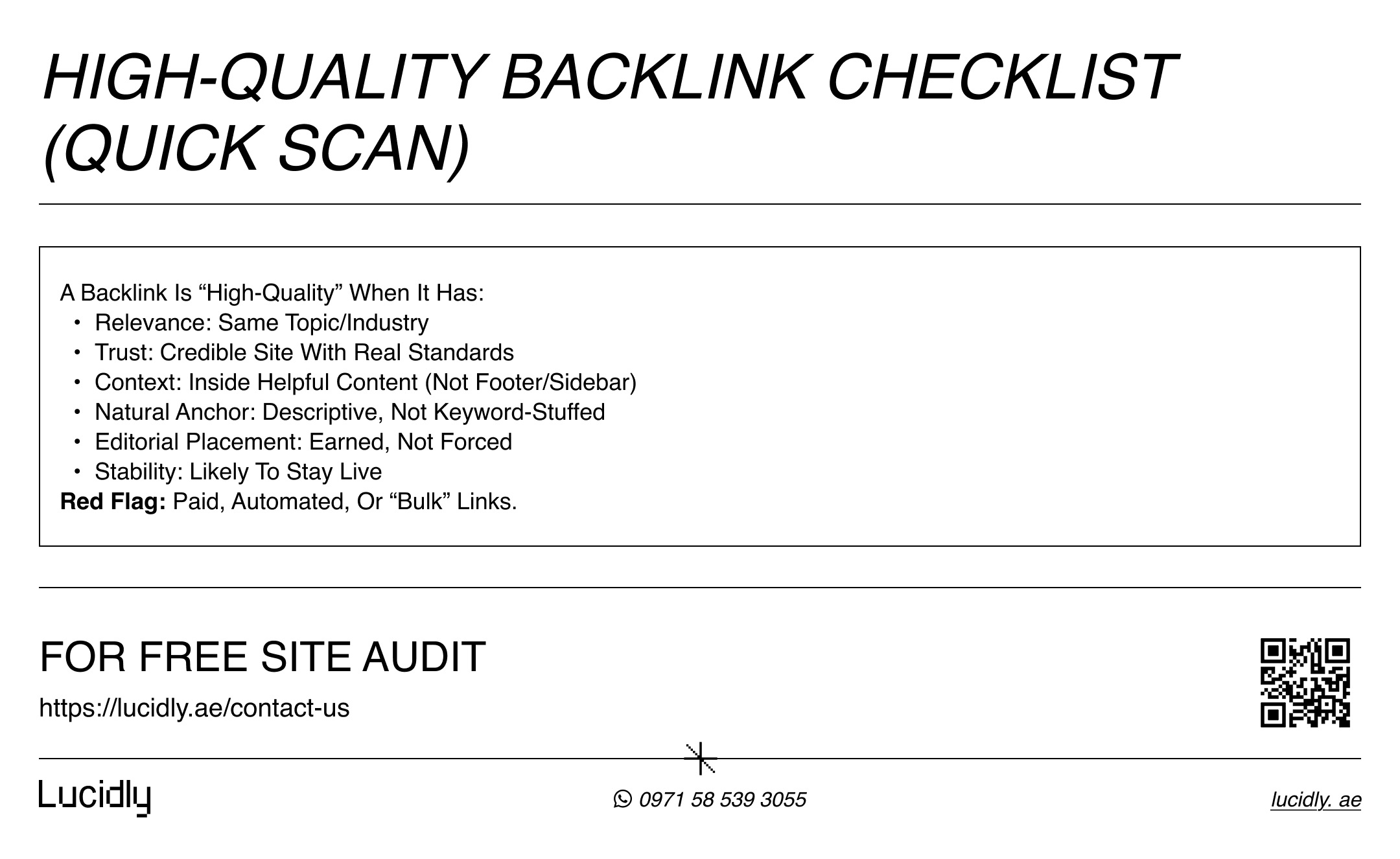
Not all backlinks are equal. A high-quality backlink is one that strengthens your authority because it comes from the right place, in the right context, for the right reason.
Search engines don’t just count links—they evaluate the signals behind them to decide whether they represent a genuine endorsement.
A high-quality backlink typically has the following characteristics:
Topical relevance: the linking site and page are closely related to your industry or subject
Editorial placement: the link is added naturally by an editor or author, not forced or automated
Contextual value: it appears within meaningful content that helps users
Natural anchor text: descriptive and relevant, without keyword stuffing
Trusted source: the website has real content, real audiences, and a credible reputation
Long-term stability: the link is likely to remain live because it adds value
When these elements align, a backlink becomes a strong authority signal rather than just another link in your profile.
Off-Page SEO Examples (Mini Case Scenarios)
Seeing off-page SEO in action makes the concept easier to apply. Instead of chasing random links, successful brands focus on earning recognition through relevance, value, and credibility.
Example 1: Data-led Digital PR
A SaaS company publishes an original industry benchmark report. The data is cited by blogs and online publications, earning editorial backlinks and brand mentions from relevant sources.Example 2: Brand Mentions → Authority
A growing service business is frequently mentioned in reviews, comparisons, and local articles. By strengthening its online reputation and converting unlinked mentions into links, the brand improves its authority without aggressive link building.Example 3: Partnerships & Resources
A B2B company collaborates with industry partners and associations. These real relationships lead to mentions on partner websites and resource pages, reinforcing trust and relevance.
These examples show that effective off-page SEO is about earning visibility—not manufacturing signals.
Off-Page SEO Beyond Backlinks (Authority Signals That Also Matter)
Backlinks are important, but they’re not the only off-page signals that can influence how your brand is perceived online. In 2026, building authority for SEO is also about strengthening your presence across the wider web—so your site looks credible, recognised, and trusted within its niche.
In the UAE, the national Digital Economy Strategy highlights a clear push toward a stronger, more competitive digital economy—making online visibility and brand credibility even more important for businesses that want to win attention and trust in search.
Key off-page signals beyond backlinks include:
Brand mentions: when websites, forums, communities, or media outlets talk about your brand (linked or unlinked).
Online reputation: reviews, ratings, and sentiment that shape trust and influence user behaviour.
Digital PR visibility: being featured in credible editorial content because you contributed data, expertise, or insight.
Community recognition: mentions from relevant industry communities, podcasts, events, or expert roundups.
Demand signals: people searching for your brand name, returning to your content, and engaging over time.
In other words, off-page optimisation is not just about links—it’s about building a brand the web naturally references.
Is Social Media Part of Off-Page SEO?
Social media is often discussed as an off-site SEO factor, but it’s important to be precise: social platforms usually don’t function like traditional backlinks that pass ranking signals. That said, social media can still support off-page SEO indirectly by helping your content reach the people who can cite it, mention it, and link to it.
Social media helps off-page SEO by:
Increasing content visibility, which creates more opportunities for brand mentions and editorial discovery
Supporting digital PR by distributing data, insights, and story angles quickly
Building brand familiarity, which can increase branded searches and trust
Driving engagement that can lead to natural references on websites, newsletters, and communities
So while social media isn’t a “link-building shortcut,” it can be a practical channel for earning the kind of attention that leads to stronger external SEO factors over time.
To learn more about tracking the right SEO metrics and improving organic conversions, contact with our Professional SEO company.
Off-Page SEO Techniques to Avoid (And Why They’re Risky)
Not all off-page SEO techniques are safe. Some tactics may create short-term movement, but they often get ignored, neutralised, or become a risk as search engines improve their spam detection systems.
Google’s Search Central spam policies make it clear that links intended to manipulate rankings can be ignored—or treated as spam—so the safest approach is to earn editorial links through genuine value and relevance.
Avoid these common high-risk practices:
Buying links to manipulate rankings (even if they look “high DA”)
PBNs and link networks built purely to pass link equity
Large-scale guest posting campaigns created mainly for backlinks
Spammy directories and low-quality listings with no real audience
Comment/forum spam or automated link drops
Over-optimised anchor text patterns that look manufactured
Link exchanges at scale (“I’ll link to you if you link to me”)
If a tactic depends on hiding intent or scaling manipulation, it’s not sustainable. In 2026, the safest approach is to earn links and mentions through real value and real relevance.
learn more about: Link Building Strategies.
How to Measure Off-Page SEO Success (What to Track)
Measuring off-page SEO isn’t just about counting backlinks. A healthier approach is tracking whether your authority is growing in a way that supports rankings and business results.
Track signals like:
Referring domains growth (unique websites linking to you, not just total links)
Link quality and relevance (are links coming from your industry?)
Brand mentions across the web (linked and unlinked)
Online reputation trends (reviews, sentiment, credibility signals)
Organic performance impact (rankings, impressions, clicks)
Conversions from organic traffic (leads, bookings, sales—not vanity metrics)
Use third-party metrics carefully. They can help with comparisons, but they shouldn’t become the goal. The goal is stronger visibility, trust, and sustainable growth.
Quick Off-Page SEO Checklist (2026)
If you want a simple way to approach off-page SEO without overthinking it, use this checklist:
Build content worth citing (data, templates, original insights)
Promote it to relevant audiences (not random outreach lists)
Earn links through editorial context, not forced placement
Strengthen brand mentions and online reputation
Focus on relevance and trust—not volume
Avoid tactics that rely on manipulation or automation
Measure results using business outcomes, not just backlink counts
FAQ
What is off-page SEO?
Off-page SEO includes all actions taken outside your website to build authority and trust—such as backlinks, brand mentions, digital PR, and online reputation signals.
Are backlinks still important?
Yes, backlinks are still one of the strongest off-page signals. But their impact depends on relevance, trust, and context—and low-quality or manipulative links may be ignored or become risky.
What is a high-quality backlink?
A high-quality backlink is relevant, editorially placed, and comes from a trusted source. It appears naturally within helpful content and uses natural anchor text rather than keyword-stuffed phrasing.
Is social media part of off-page SEO?
Social media is not a direct substitute for backlinks, but it can support off-page SEO indirectly by increasing visibility, earning mentions, and creating opportunities for editorial links and coverage.
Off-Page SEO Is About Earning Trust, Not Chasing Links
Off-page SEO works best when it reflects real-world credibility. Instead of trying to “build links” in bulk, focus on authority building through relevance, reputation, and editorial recognition.
When you invest in digital PR, valuable content assets, and genuine relationships in your industry, backlinks and brand mentions become natural outcomes—supporting rankings in a way that remains stable through algorithm updates.
Contact us for a website evaluation—message Lucidly on WhatsApp and we’ll pinpoint the on-page issues holding your pages back.