magento vs shopify is no longer just a feature comparison in 2026. It is a decision about operating model, technical complexity, development cost, maintenance overhead, and scalability.
Magento still makes sense for businesses with enterprise ecommerce requirements, custom workflows, and deeper architectural needs. Shopify wins when speed, easier management, and lower operational friction matter more.
The right choice depends on whether your business truly needs complexity or simply needs a platform that helps your team execute faster and grow with less strain.
Message Lucidly on WhatsApp for a quick Magento vs Shopify fit review based on your business model, complexity, and growth needs.
Magento vs Shopify: What Is the Real Decision in 2026?
The real comparison is not about which platform sounds more powerful. It is about which operating model fits the business more effectively.
Magento is now best understood through the Adobe Commerce lens.
Shopify is built around managed efficiency and simpler execution.
The real comparison is control versus operational simplicity.
This is where magento ecommerce vs shopify becomes a strategic decision.
"To explore how WooCommerce compares to Shopify for UAE businesses, check out this guide: WooCommerce vs Shopify (2026): Which Platform Is Better for UAE Businesses?."
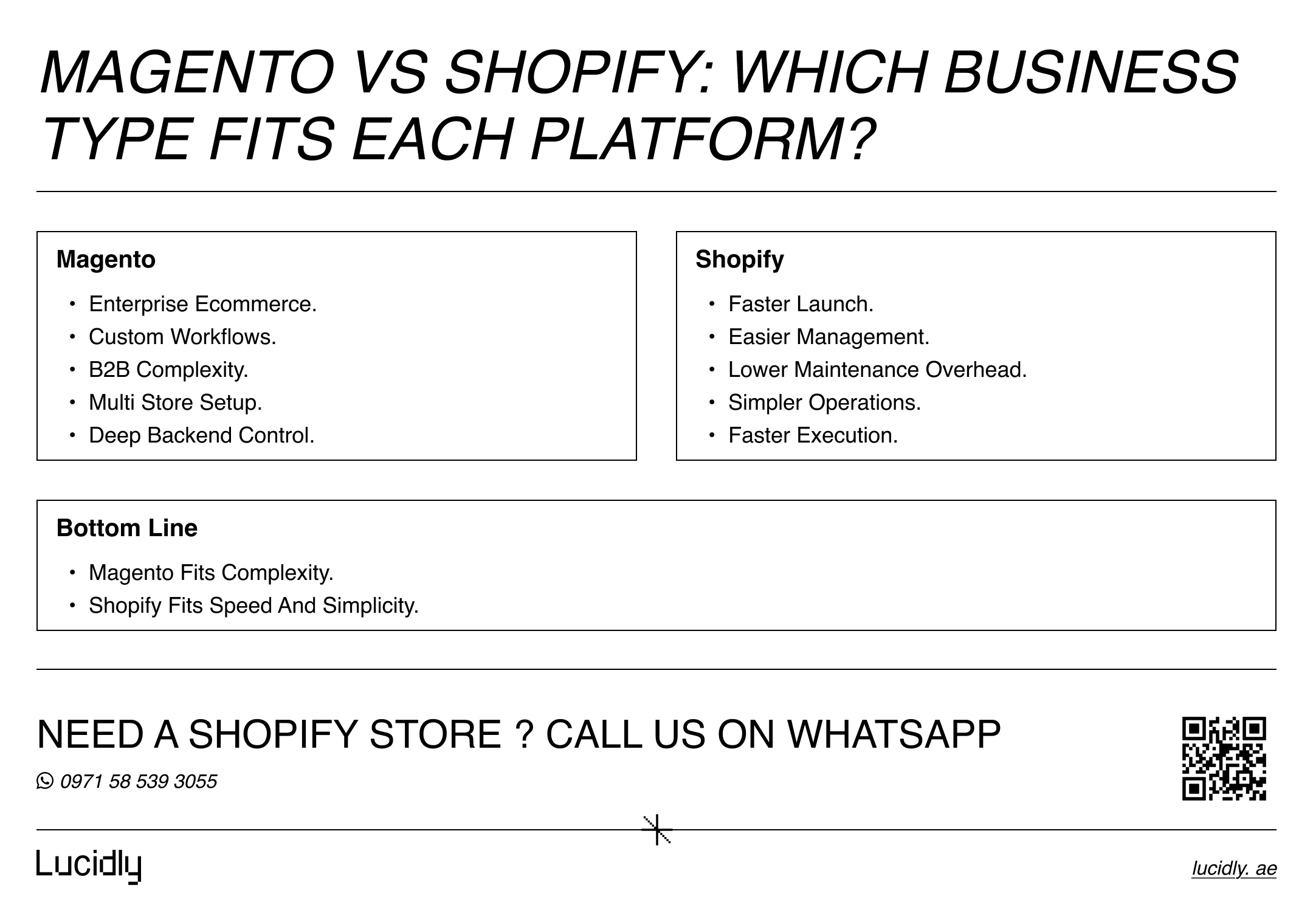
When Magento Makes Sense
Magento makes sense when complexity is built into the business model rather than added as a preference.
The business runs serious enterprise ecommerce operations.
The store depends on advanced custom workflows.
The business manages B2B logic, multi-store structures, or layered pricing rules.
The team needs deeper backend control and stronger structural flexibility.
The business can support higher development cost.
The company accepts more maintenance overhead in exchange for deeper customization and architectural control.
For businesses operating at this level, Magento is not simply a more flexible platform. It is often the more appropriate environment for handling operational depth that standard ecommerce setups may struggle to support cleanly.
When Shopify Wins
Shopify becomes the stronger choice when the business wants faster progress without carrying unnecessary technical weight.
The team wants a faster launch and quicker iteration.
The business wants lower technical dependency.
The store needs simpler day to day operations.
The company wants lower maintenance overhead.
The team values execution speed more than deep backend control.
Shopify is often the better fit when complexity would slow growth more than it would add value.
This is why Shopify wins in many practical cases. It allows teams to move faster, simplify daily management, and reduce the operational drag that often comes with more complex platforms.
Shopify vs Magento Cost: What Changes Over Time?
This comparison highlights the real trade-off in the magento vs shopify decision: Magento offers deeper technical control, while Shopify reduces operational complexity and allows teams to focus more on growth and execution.
Factor | Magento / Adobe Commerce | Shopify |
Cost | Open Source is free, but implementation can range roughly $20,000–$200,000+ depending on customization and integrations. | Monthly plans generally range $39–$399, while Shopify Plus starts around $2,300+ per month. |
Complexity | High flexibility with deeper customization and architecture control. | Lower technical complexity with a managed platform model. |
Scalability | Strong for complex multi-store, B2B, and enterprise setups. | Strong for scaling with simpler operations and faster execution. |
Maintenance | Requires more development, hosting, and technical management. | Hosting and platform maintenance are handled within Shopify. |
Ideal use case | Businesses needing heavy customization and enterprise workflows. | Businesses prioritizing speed, simplicity, and easier management. |
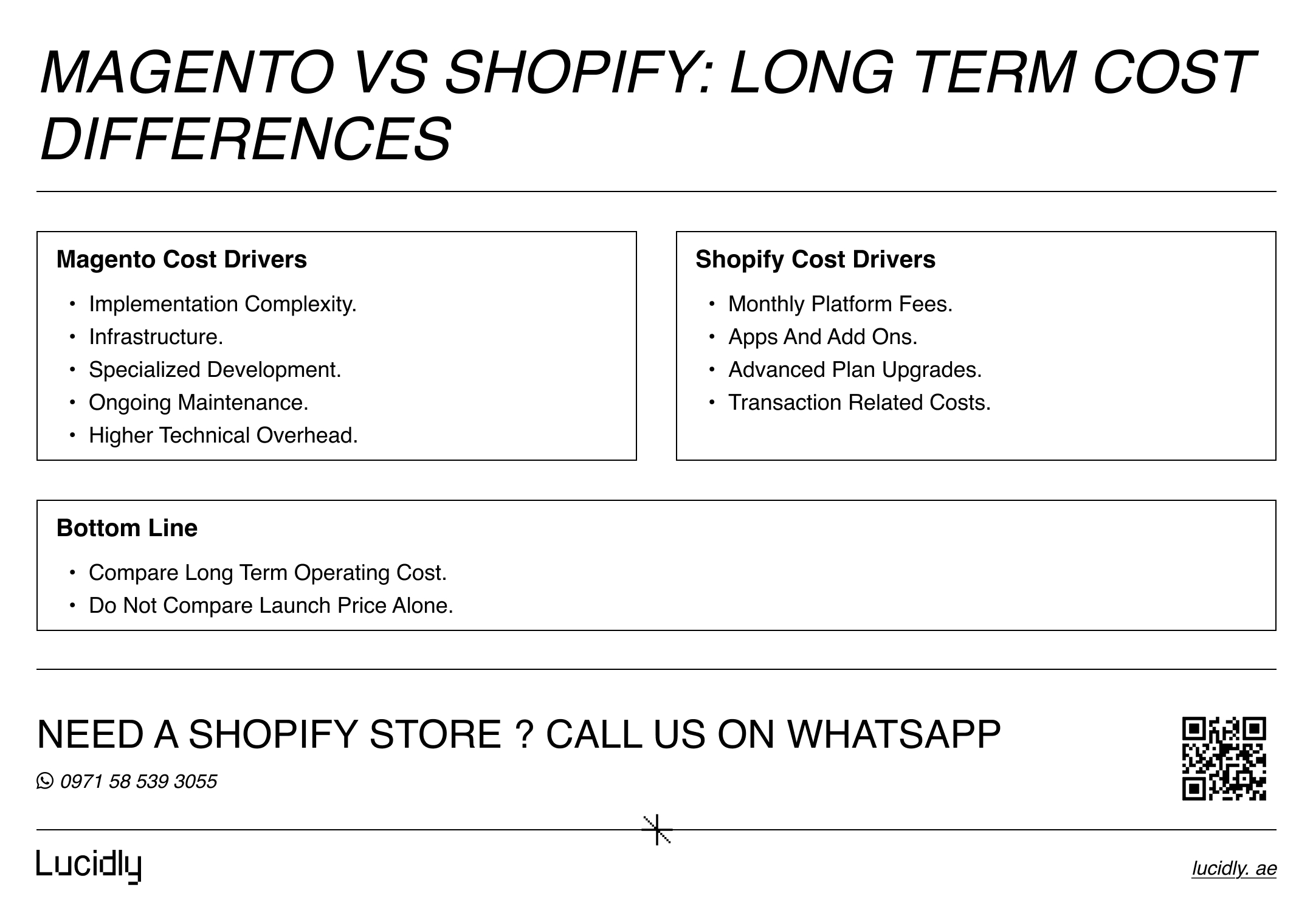
Although Magento Open Source is free to download, the real cost appears during implementation and long term operation.
A Magento store usually requires custom development, stronger hosting, technical integrations, and ongoing maintenance, which can make the total cost much higher than the platform itself.
That is why the Magento vs Shopify decision should not be based only on starting price, but on how much technical complexity, infrastructure, and operational burden the business can support over time.
Adobe Commerce vs Shopify: Where Complexity Helps and Where It Hurts
Before comparing Adobe Commerce and Shopify, it helps to clarify one point early: Adobe Commerce is the enterprise evolution of Magento, so many businesses still think about this decision as Magento vs Shopify even when the product is now positioned under Adobe.
That matters because the comparison is really about how much complexity the business truly needs, not just which platform appears more powerful.
Complexity is not always an advantage. It creates value only when the business can actually use it to support a more demanding ecommerce model.
Complexity helps when the business model is genuinely complex.
Complexity hurts when companies pay for capabilities they do not need.
In an adobe commerce vs shopify decision, Adobe Commerce is more compelling when the store requires sophisticated architecture.
Shopify often becomes the better option when complexity slows execution and adds unnecessary operational friction.
The shopify vs adobe commerce comparison becomes clearer when the real question is not power alone, but whether that power is actually needed.
The strongest platform is the one that matches the business model without adding avoidable technical weight.
This is where many platform choices go wrong. Businesses often overbuy technical depth because it feels safer for future growth, but that added complexity can slow delivery, increase cost, and create internal strain long before it delivers real value.
Is Shopify Plus right for your business? Find out in this article: Shopify Plus UAE: Who Needs It, What You Get, and When It’s Overkill."
Scalability: Which Platform Grows Better Under Pressure?
Growth is not only about traffic. It is also about how much effort the platform requires as the business expands.
Magento supports scale with deeper customization.
Magento is stronger when scale and structural complexity need to grow together.
Shopify supports scale with less operational drag.
Shopify is stronger when scale and speed need to grow together.
Scalability is not only about platform capacity.
It is also about whether growth makes the business easier or harder to operate over time.
A business that needs scale across multiple stores, customer types, pricing layers, or operational rules may find Magento more suitable. A business that wants growth with simpler internal management will often find Shopify easier to scale in practice.
Magento or Shopify: Which One Fits Your Operating Model?
The better platform is the one that matches the way your business actually operates, grows, and manages complexity over time.
Choose Magento when complexity is central to the business model.
Choose Magento when custom workflows are essential.
Choose Magento when deeper control is worth higher technical effort.
Choose Shopify when simpler execution matters more.
Choose Shopify when lower technical burden is a priority.
The best answer to magento or shopify depends on operating model, not ambition alone.
In real world magento vs shopify decisions, the better platform is the one your team can run efficiently over time.
If Shopify looks like the better fit for your business, explore Lucidly’s Shopify Development for a clearer view of setup, scope, and support in the UAE.
FAQ
Is Magento better than Shopify?
Magento is better when a business needs enterprise depth, complex customization, and stronger backend control. Shopify is better when speed, simplicity, and easier day to day management matter more.
When should I choose Magento over Shopify?
You should choose Magento over Shopify when your business has advanced workflow requirements, multi store complexity, B2B needs, or custom architecture that requires deeper flexibility.
What are the hidden costs of Magento vs Shopify?
Magento hidden costs often include implementation complexity, infrastructure, development, and ongoing maintenance overhead. Shopify hidden costs are usually more tied to apps, advanced tiers, and ecosystem related add ons.
Can Shopify handle complex ecommerce needs?
Yes, Shopify can handle many complex ecommerce needs, especially for businesses that want scale without carrying heavy internal platform complexity. Magento becomes more relevant when very specific structural control is required.
For more on how Shopify handles complex needs, check this guide: What Is Shopify? Pros, Cons, and When It’s the Right Ecommerce Platform (2026 Guide)."
In this magento vs shopify comparison, the smartest choice comes down to what your business needs to support every day, not what sounds more advanced in theory.
Magento is the stronger fit when operational complexity, custom logic, and deeper architectural control are essential to how the business runs. Shopify is the stronger fit when the goal is to simplify execution, reduce technical drag, and keep growth easier to manage. The best platform is the one that aligns with your team, your operating model, and the level of complexity you can justify long term.
Want a clearer Magento vs Shopify decision for your business? Message Lucidly on WhatsApp—or use the numbers on our Contact Us page to book a quick platform fit review.
References
Adobe Experience League. Adobe Commerce as a Cloud Service Overview.