HubSpot for Real Estate gives property businesses a more structured way to manage enquiries, organise follow-up, and connect marketing with sales.
Instead of relying on spreadsheets, inboxes, and disconnected tools, teams can use one system for CRM, marketing automation, email marketing, forms, landing pages, workflows, attribution, and sales pipeline visibility.
For agencies, brokers, and real estate teams that want better lead nurturing and cleaner operations, HubSpot can support a stronger customer lifecycle from first contact to closed deal.
If your real estate business needs a smarter way to capture leads, automate follow-up, and turn more enquiries into opportunities, Message us on WhatsApp for practical guidance on using HubSpot for Real Estate more effectively.
What is HubSpot for Real Estate and why does it fit modern property businesses?
HubSpot is not a real-estate-only platform. It is a customer platform that combines CRM, marketing, sales, and service tools in one connected system.
That matters in real estate because leads often move slowly, come from multiple channels, and need repeated follow-up before they become real opportunities.
What HubSpot means in practical terms for real estate teams
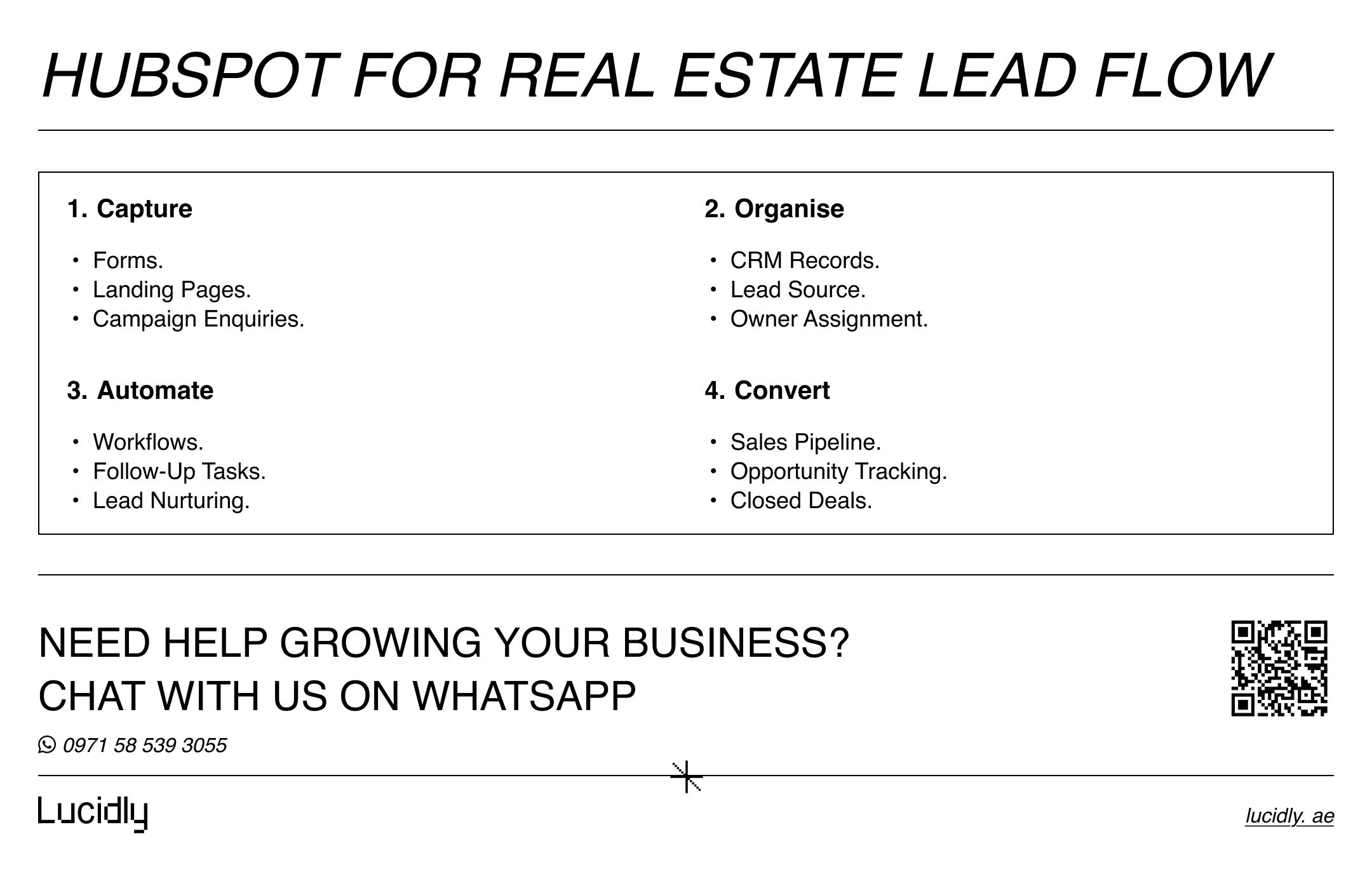
In a property business, HubSpot for Real Estate works as a central operating system for lead capture, lead tracking, follow-up, and conversion support.
It helps teams manage:
Contact records in one CRM.
Lead status and ownership.
Sales pipeline movement.
Marketing automation and workflows.
Email marketing and lead nurturing.
Landing pages and forms for enquiries.
Attribution across the customer lifecycle.
Why many property teams outgrow spreadsheets and disconnected tools
Real estate lead management becomes harder when enquiries are spread across email, WhatsApp, website forms, ad platforms, and manual notes.
That usually creates problems such as:
Slow response times.
Missed follow-up.
Unclear handoff between marketing and sales.
Weak visibility into the sales pipeline.
Poor reporting on where leads actually came from.
Where HubSpot adds real value
HubSpot marketing software is useful here because it connects front-end lead generation with back-end CRM tracking.
That gives real estate businesses a clearer structure for:
Capturing enquiries.
Qualifying leads.
Assigning owners.
Automating follow-up.
Tracking deal progress.
Measuring channel performance.
How HubSpot for Real Estate improves lead management from first enquiry to closed deal
The strongest argument for HubSpot for Real Estate is not that it gives teams more tools.
It is that it helps them use one connected system instead of several disconnected ones. HubSpot’s official product and knowledge base materials position the platform around CRM-based lead management, forms, landing pages, workflows, and lead pipeline automation.
Capturing leads through forms, landing pages, and campaigns
Property businesses need a clean way to capture different types of enquiries without losing source context.
HubSpot marketing tools support this through:
Forms for contact and enquiry capture.
Landing pages for campaigns and offers.
Marketing emails for lead engagement.
Campaign tools for channel tracking.
In real estate, that can support pages such as:
Property enquiry pages.
Valuation request pages.
Project launch landing pages.
Consultation booking pages.
Organising leads inside the CRM
Once a lead enters the system, HubSpot CRM gives teams a structured way to manage it. HubSpot’s documentation shows that users can create leads with a lead pipeline, lead stage, lead type, and lead label, then manage them through filtered views and ownership logic.
That matters in real estate because teams often need to sort leads by:
Buyer or seller intent.
Location or project.
Budget range.
Lead source.
Assigned agent.
Stage of readiness.
Managing follow-up through the sales pipeline
A strong sales pipeline makes lead management easier because it shows where every opportunity stands.
For a real estate team, that may include stages such as:
New enquiry.
Contacted lead.
Qualified lead.
Viewing booked.
Opportunity created.
Deal in progress.
Closed won or closed lost.
This gives managers and agents clearer visibility and reduces follow-up gaps.
Using workflows to reduce missed opportunities
HubSpot’s official automation documentation explains that teams can set up lead pipeline automation for lead creation, stage progression, and actions based on lead stages.
That makes workflows useful for real estate scenarios such as:
Creating tasks after a form submission.
Assigning leads to the right agent.
Sending a first follow-up email automatically.
Triggering lead nurturing when a lead is not ready yet.
Updating records when a stage changes.
HubSpot marketing tools for real estate growth: what they actually do
Many teams hear about hubspot marketing but do not know which tools matter most in practice.
For a broader view beyond platform setup, explore these digital marketing strategy tips for more leads.
The useful answer is simple: the tools that help you capture demand, follow up faster, and understand which channels create real opportunities.
HubSpot’s official Marketing Hub pages describe the platform as a lead generation and marketing automation system that includes forms, workflows, and connected customer-journey data.
Email marketing and lead nurturing
Real estate leads do not always convert quickly. Some people enquire early, compare options, then decide much later.
That makes email marketing and lead nurturing valuable for:
Buyer follow-up.
Seller lead education.
Investor nurturing.
Re-engaging cold leads.
Supporting longer decision cycles.
Landing pages and forms
Landing pages and forms are especially useful when a property business runs focused campaigns rather than sending traffic to a generic homepage.
They can be used for:
New development campaigns.
Area-specific lead generation.
Home valuation offers.
Rental enquiries.
Consultation requests.
Marketing automation and workflows
HubSpot for digital marketing becomes more useful when marketing automation reduces repetitive manual work.
This helps teams:
Respond faster.
Route leads more accurately.
Keep follow-up consistent.
Trigger actions based on lead behaviour.
Support handoff between marketing and sales.
Attribution across the customer lifecycle
Attribution matters because real estate businesses often invest in multiple channels without clear evidence of which ones create serious opportunities.
A more connected system helps answer questions such as:
Which campaign created the enquiry.
Which source created the qualified lead.
Which channel contributed to the closed deal.
Which parts of the customer lifecycle need improvement.
HubSpot works best when it supports a wider digital marketing strategy, not just software setup. Explore our digital marketing services to see how lead generation, automation, and growth planning connect.
HubSpot CRM vs HubSpot Marketing Hub: what real estate teams need to understand
This distinction should be clear early in the article because many readers confuse the CRM with the full HubSpot marketing platform.
What HubSpot CRM is used for
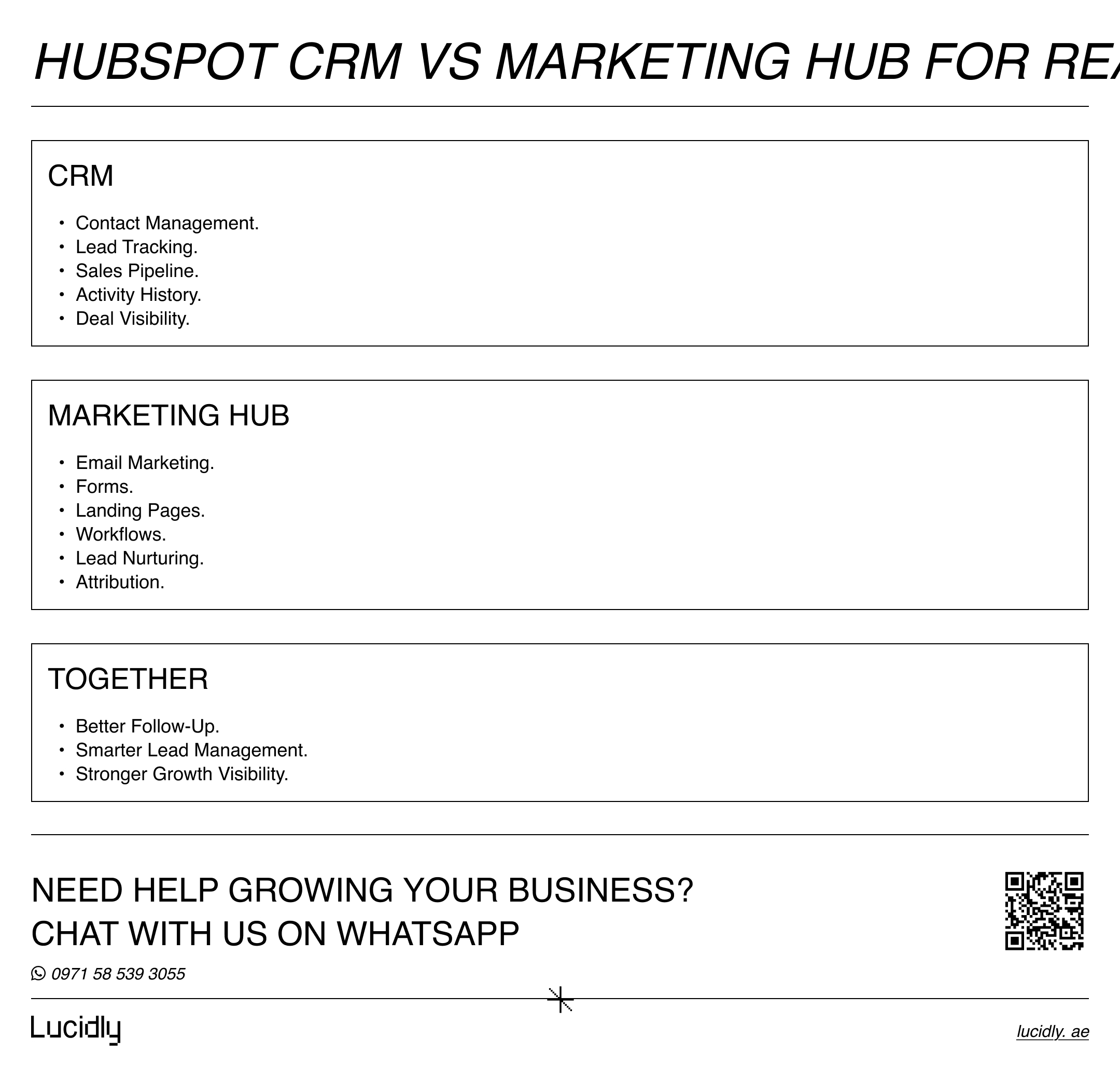
HubSpot CRM is the core record system. It is where customer data, lead records, activity history, ownership, and pipeline visibility are organised.
HubSpot describes its CRM as a platform that unifies customer data and supports marketing, sales, and service workflows.
For real estate teams, CRM is mainly useful for:
Contact management.
Activity tracking.
Lead ownership.
Deal and pipeline visibility.
Team coordination.
What HubSpot Marketing Hub is used for
Marketing Hub is the layer that supports growth and campaign execution. HubSpot officially positions it around lead generation and automation, including forms, workflows, and campaign tools.
For real estate teams, it is mainly useful for:
Email marketing.
Landing pages.
Forms.
Workflows.
Lead nurturing.
Campaign management.
Attribution and reporting.
When a property business needs both
A small agency may begin with CRM structure first. As campaigns grow, Marketing Hub becomes more useful.
That is usually the point where the business needs:
Better lead generation systems.
Cleaner handoff from marketing to sales.
Automated follow-up.
More useful reporting.
Clearer attribution.
Is HubSpot good for small businesses in real estate?
Yes, often. But not automatically.
HubSpot is positioned to scale from small businesses upward, and its CRM is available as a free product layer.
That makes it accessible for smaller property teams that want to move beyond spreadsheets.
Why smaller real estate teams may benefit early
Small agencies and brokers usually benefit when they need more structure without building a complex custom system.
That can help them:
Keep all leads in one place.
Improve response consistency.
Track follow-up clearly.
See pipeline movement.
Start building repeatable processes.
The honest limitation
HubSpot for Real Estate is still a general business platform, not a dedicated real estate operating system.
That means success depends on:
Good setup.
Clear lifecycle stages.
Useful custom fields.
Strong workflow logic.
Team adoption.
So the tool can be strong for small businesses, but only when the business actually builds a usable process around it.
How HubSpot helps with lead generation in real estate
A common buying question is not whether HubSpot has lead tools. It does. The more useful question is how those tools support real property enquiries.
To see how this fits into a wider digital marketing for real estate agents, read our guide on digital marketing for real estate agents.
HubSpot’s official materials tie lead generation to forms, landing pages, ad support, email, campaigns, and CRM-connected automation.
What that looks like in practice
In a real estate business, HubSpot can support lead generation by helping teams:
Capture enquiries through forms.
Build landing pages for focused offers.
Connect marketing campaigns to CRM records.
Enrol leads into nurturing workflows.
Track which channels generate better-quality opportunities.
Why lead generation alone is not enough
Lead generation only works well when it is connected to follow-up and qualification.
That is why HubSpot for Real Estate is more useful when it supports the full process:
Capture the lead.
Classify the lead.
Assign the owner.
Trigger follow-up.
Move the lead through the pipeline.
Measure the result.
What to set up first in HubSpot for Real Estate
A strong article should not stop at theory. It should also show what matters first.
Start with the structure before the automation
Before adding complex workflows, define the basics.
Set up:
Lifecycle stages.
Lead labels.
Lead source fields.
Deal stages.
Ownership rules.
Core views for agents and managers.
Then build the capture layer
After that, create the practical lead-entry points.
That usually includes:
Forms for key enquiry types.
Landing pages for campaigns.
Follow-up email logic.
Notifications and task creation.
Basic lead nurturing workflows.
Then connect reporting and attribution
Once capture and follow-up are running, connect reporting to business decisions.
Track:
Enquiry volume.
Qualified leads.
Conversion by source.
Pipeline progression.
Closed deals by channel.
FAQ
This section is important for SGE because it answers common questions directly and cleanly.
What is HubSpot digital marketing?
HubSpot for digital marketing refers mainly to the tools inside Marketing Hub that support lead generation, email marketing, forms, landing pages, workflows, campaigns, and reporting. In practice, it helps businesses attract leads, automate follow-up, and connect campaign activity to CRM data.
What are HubSpot marketing tools used for?
HubSpot marketing tools are used to generate leads, convert visitors, nurture contacts, automate repetitive actions, and measure performance across campaigns and the customer lifecycle. Official HubSpot documentation also points users to forms, landing pages, ads, emails, campaigns, and workflows as core parts of that process.
Is HubSpot good for small businesses?
Often yes, especially when a small business wants a clearer CRM structure, better follow-up, and room to scale. But it is only a strong fit when the setup matches the business process and the team actually uses it consistently. HubSpot positions its CRM and customer platform for businesses ranging from startups to larger organisations.
How does HubSpot help with lead generation?
HubSpot helps with lead generation through forms, landing pages, marketing emails, campaigns, automation, and CRM-connected lead management. The practical value is that capture, follow-up, and reporting sit in one system instead of being split across separate tools.
What is the difference between HubSpot CRM and HubSpot Marketing Hub?
HubSpot CRM is the central system for contact data, lead records, activity tracking, and pipeline visibility. HubSpot Marketing Hub is the growth layer used for campaigns, forms, landing pages, email marketing, workflows, and lead nurturing. Real estate teams often need CRM first, then Marketing Hub when they need stronger automation and campaign execution.
A brief note on hubspot digital marketing course
A hubspot digital marketing course can help teams understand the platform and its marketing workflows, but training alone is not the main value. The real value comes when a real estate team applies HubSpot marketing tools to actual lead generation, follow-up, and pipeline processes. HubSpot’s knowledge base points users toward Academy training for deeper learning alongside practical setup.
is HubSpot for Real Estate the right choice?
HubSpot for Real Estate can be a strong choice for agencies, brokers, and property teams that want clearer lead management, better lead nurturing, and a more connected view of marketing and sales.
Its main advantage is not just CRM or just hubspot marketing. It is the combination of CRM, marketing automation, email marketing, landing pages, forms, workflows, attribution, sales pipeline visibility, and customer lifecycle tracking in one system.
For real estate businesses that want a smarter structure for growth, that is the real value of HubSpot for Real Estate.
If your real estate business needs a smarter way to manage leads, automate follow-up, and connect marketing with sales, Message us on WhatsApp or use the phone numbers listed on our Contact Us page.
References
HubSpot. Lead Management Software. https://www.hubspot.com/products/crm/lead-management
HubSpot. Marketing Hub. https://www.hubspot.com/products/marketing
HubSpot Knowledge Base. Create Leads. https://knowledge.hubspot.com/records/create-leads