Front-End vs Back-End vs Full-Stack: The Main Types of Web Development Explained
Web development is not a single discipline—it is a combination of roles that work together to power modern business websites.
Understanding the differences between front-end, back-end, and full-stack development helps businesses choose the right technical approach, avoid overengineering, and build websites that perform reliably over time.
Each type focuses on a specific layer of the system, shaping how users experience the site, how data is processed, and how smoothly the platform scales.
When these roles are aligned, businesses gain stronger performance, clearer maintainability, and a more future-ready foundation for growth.
Message Lucidly on WhatsApp for a free website evaluation.
Front-End vs Back-End vs Full-Stack: What Are the Main Types of Web Development?
Web development is commonly divided into three main types because modern websites require both user-facing experiences and complex system logic. Separating these responsibilities allows teams to focus on clarity, reliability, and growth instead of patching problems later.
The three main types are:
Front-end development.
Back-end development.
Full-stack development.
Each type exists to solve a different set of problems—and confusing them often leads to technical debt.
Front-End Development: The User-Facing Layer
Front-end development focuses on everything users see and interact with in their browser. This layer determines how intuitive, accessible, and trustworthy a website feels from the first interaction.
What Front-End Development Is Responsible For
Front-end developers turn design concepts into functional interfaces by focusing on:
Page layout and visual hierarchy.
Responsive behavior across devices.
Accessibility for all users.
Client-side performance and stability.
Their work ensures that content is readable, navigation is predictable, and interactions feel smooth.
Ready to Build a High-Performance Website?
Turn strategy into results with Lucidly’s custom web development solutions — built for speed, SEO, and business growth.
👉 Book Your Web Development Consultation
Why Front-End Development Matters for Businesses
From a business perspective, front-end development directly affects:
First impressions and brand perception.
User engagement and bounce rates.
Conversion paths and form completion.
Mobile usability.
Even strong content and offers can fail if the front-end experience creates friction or confusion.
Back-End Development: The System Logic
Back-end development powers the logic that makes a website function reliably. While users do not see this layer, they experience its impact through speed, security, and feature stability.
What Back-End Developers Handle
Back-end development typically includes:
Databases and data storage.
APIs and system integrations.
Authentication and authorization.
Business rules and workflows.
Security and data protection.
This layer ensures that information flows correctly between users, servers, and external systems.
Why Back-End Development Is Critical for Scalability
Strong back-end architecture allows websites to:
Handle increased traffic without slowing down.
Add new features without breaking existing ones.
Integrate tools such as CRMs or payment systems.
Maintain performance as complexity grows.
According to Google Search Central, technical foundations such as crawlability, performance, and clean structure play a major role in how websites are discovered and ranked in search. These foundations are directly influenced by back-end development decisions.
Full-Stack Development: End-to-End Ownership
Full-stack development connects front-end and back-end responsibilities into a single, cohesive view of the system. A full-stack developer understands how user interactions, system logic, and data flow work together.
What Full-Stack Development Really Means
Full-stack development does not mean “doing everything at once.” It means:
Understanding the full system architecture.
Connecting front-end and back-end decisions.
Reducing gaps between design and functionality.
Making informed trade-offs across layers.
This system-level understanding often leads to more consistent and maintainable solutions.
When Full-Stack Development Makes Sense
Full-stack development is especially effective for:
Startups and early-stage products.
MVPs and pilot projects.
Small to mid-sized business websites.
In these cases, speed, clarity, and alignment matter more than deep specialization.
Front-End vs Back-End vs Full-Stack: Key Differences
The differences between these development types are mainly about scope and responsibility.
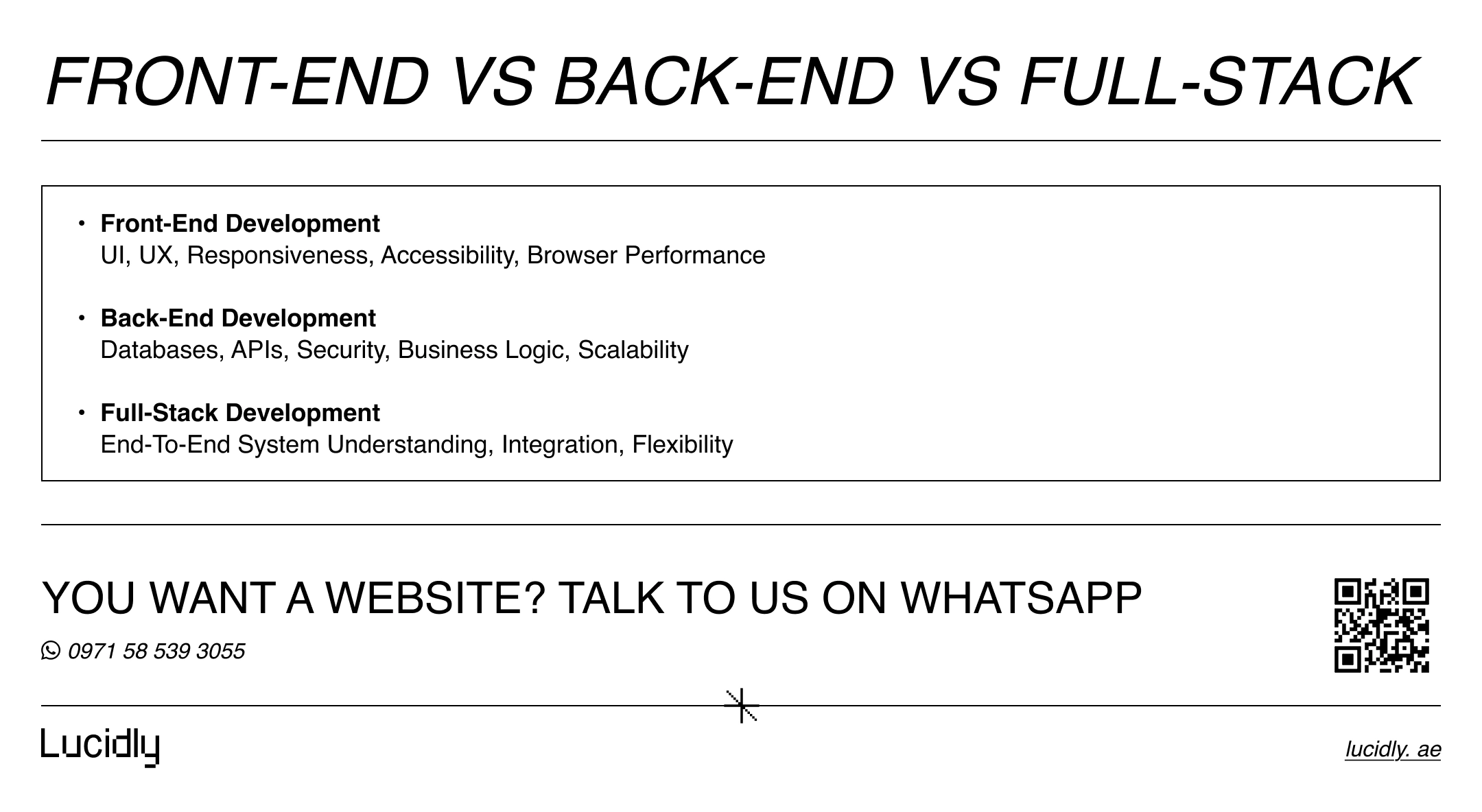
Front-end development focuses on usability, accessibility, and user interaction.
Back-end development focuses on data integrity, security, and scalability.
Full-stack development focuses on system cohesion and end-to-end reliability.
These differences also affect performance, SEO readiness, and maintenance costs over time.
Which Type of Web Development Does Your Business Need?
The right development approach depends on your business goals and growth stage.
Choosing Based on Business Goals
Content-driven and lead generation sites benefit from strong front-end and stable back-end foundations.
E-commerce and platforms with user accounts require advanced back-end systems.
Early-stage projects often benefit from full-stack development for faster iteration.
Choosing Based on Growth and Budget
Specialized teams offer depth but require coordination.
Full-stack development offers flexibility but has scaling limits.
The best choice balances current needs with future growth.
Learn more on our Professional SEO Services in Dubai page.
How Front-End vs Back-End vs Full-Stack Development Affects SEO and Performance
Web development decisions shape how search engines and users experience a website. Rendering methods, internal linking, page structure, and performance optimisation depend on how front-end and back-end systems are built—and how well they work together.
Clean architecture and predictable structure make it easier for search engines to crawl, index, and understand content.
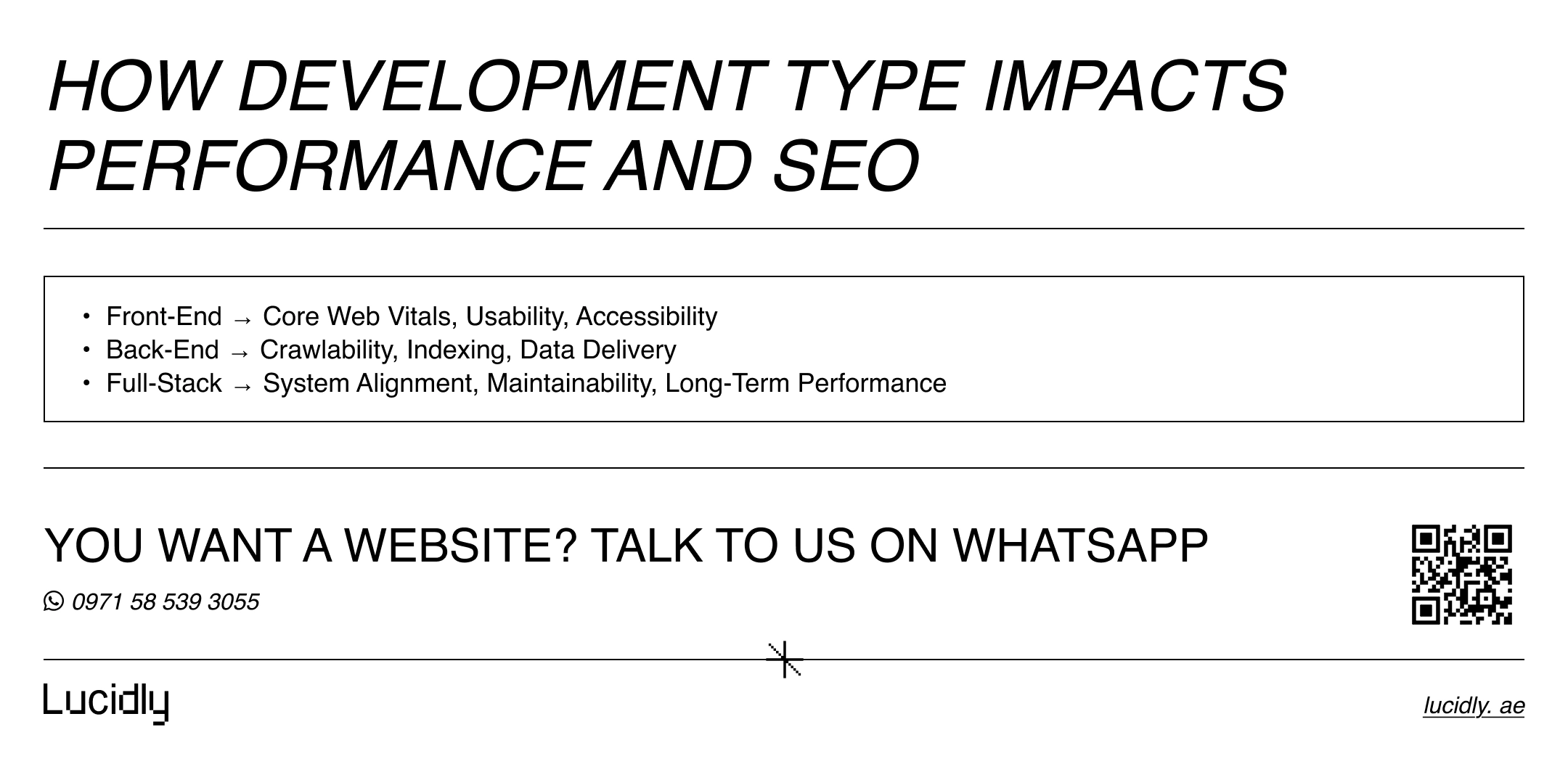
Performance metrics such as Core Web Vitals also require coordination between front-end rendering and back-end delivery, which is why role alignment across front-end vs back-end vs full-stack development is essential for long-term visibility and stability.
Security, Reliability, and Long-Term Trust
Security and maintenance are core outcomes of professional web development, not optional extras.
Why Security and Maintenance Matter
Reliable web development ensures:
Secure data transmission and authentication
Protection against common vulnerabilities
Ongoing compatibility with browsers and devices
Long-term platform stability
According to the UAE Digital Government’s digital trust guidelines, secure and well-maintained digital platforms are essential for protecting user data and delivering sustainable online services.
FAQ
What is the difference between front-end and back-end development?
Front-end is what users see and use (UI, layout, responsiveness). Back-end runs behind the scenes (databases, APIs, security, logic).
What does a full-stack developer do?
A full-stack developer works across both front-end and back-end, connecting the interface, server logic, and data into one working system.
Which type is best for my business?
It depends: front-end for UX and conversions, back-end for features and scalability, full-stack for fast builds and smaller teams.
Does the development type affect SEO and performance?
Yes. Front-end impacts Core Web Vitals and usability, back-end impacts crawlability and delivery, and full-stack helps align both.
How long does each type take?
Front-end sites are usually faster, back-end-heavy projects take longer due to integrations and security, and full-stack can be efficient for smaller scopes.
Front-end vs back-end vs full-stack development each serves a distinct purpose in building modern business websites.
There is no single “best” type—only the most suitable approach for a specific context and business goal.
When roles are clearly defined and aligned, websites become easier to maintain, faster to scale, and better positioned to compete in both search visibility and user experience.
In the end, choosing the right front-end vs back-end vs full-stack development approach is about building systems that support long-term growth—not short-term fixes.
Let’s Build Your Next Website — The Right Way
Whether you need a new website, redesign, or eCommerce platform, Lucidly creates responsive, SEO-ready websites that drive real results.
contact us for a website evaluation—message Lucidly on WhatsApp and we’ll pinpoint the technical and on-page issues holding your pages back.
References
MDN Web Docs — Web Development Overview
UAE Digital Government — Digital Trust & Cybersecurity
Google Search Central — Search Essentials (Technical SEO & Performance)