Ecommerce website speed is how quickly your store loads and responds on mobile and desktop. It impacts rankings and conversions by reducing bounce, increasing add-to-cart rate, and improving checkout completion.
This guide covers ecommerce performance optimisation—Core Web Vitals ecommerce, mobile performance, and practical fixes like image optimisation, caching, CDN, and reducing script bloat.
Message Lucidly on WhatsApp for a quick speed optimisation for ecommerce audit.
Why Ecommerce Website Speed Impacts CRO More Than Most Teams Think
Speed is not a technical vanity metric. It changes how people behave. When pages feel slow, shoppers browse fewer products, trust the store less, and abandon sooner—especially on mobile. In ecommerce, this shows up as:
Fewer product views per session.
Lower add-to-cart rate.
Lower checkout completion.
Higher return-to-search behavior.
The practical takeaway: ecommerce website speed is a CRO lever. If your store is already getting traffic, improving performance can be one of the highest-ROI upgrades you can ship.
Now let’s make this operational: what “fast” means, how Google measures it, and where to start.
If you’re building the full store from the ground up, our Ecommerce Website Development in the UAE guide .
How Fast Should an Ecommerce Website Load
“Fast” needs a target, not a feeling. For a store, focus on speed from a user perspective (first usable view) and from a Core Web Vitals perspective (real interaction quality).
Before you look at tools, set these practical targets for a mobile ecommerce speed experience:
Category and product pages should feel usable quickly (not “loading… loading…”).
Interactions (opening filters, switching variants, adding to cart) should respond instantly.
The page should not jump around while loading (layout stability).
A store can look visually loaded while still being slow if scripts block interactions. That’s why we need Core Web Vitals next.
Core Web Vitals Ecommerce: The Metrics That Matter for Rankings and UX
Core Web Vitals are Google’s user-experience metrics tied to page performance. For core web vitals ecommerce, don’t treat them like a checkbox—treat them as a map to revenue leaks.
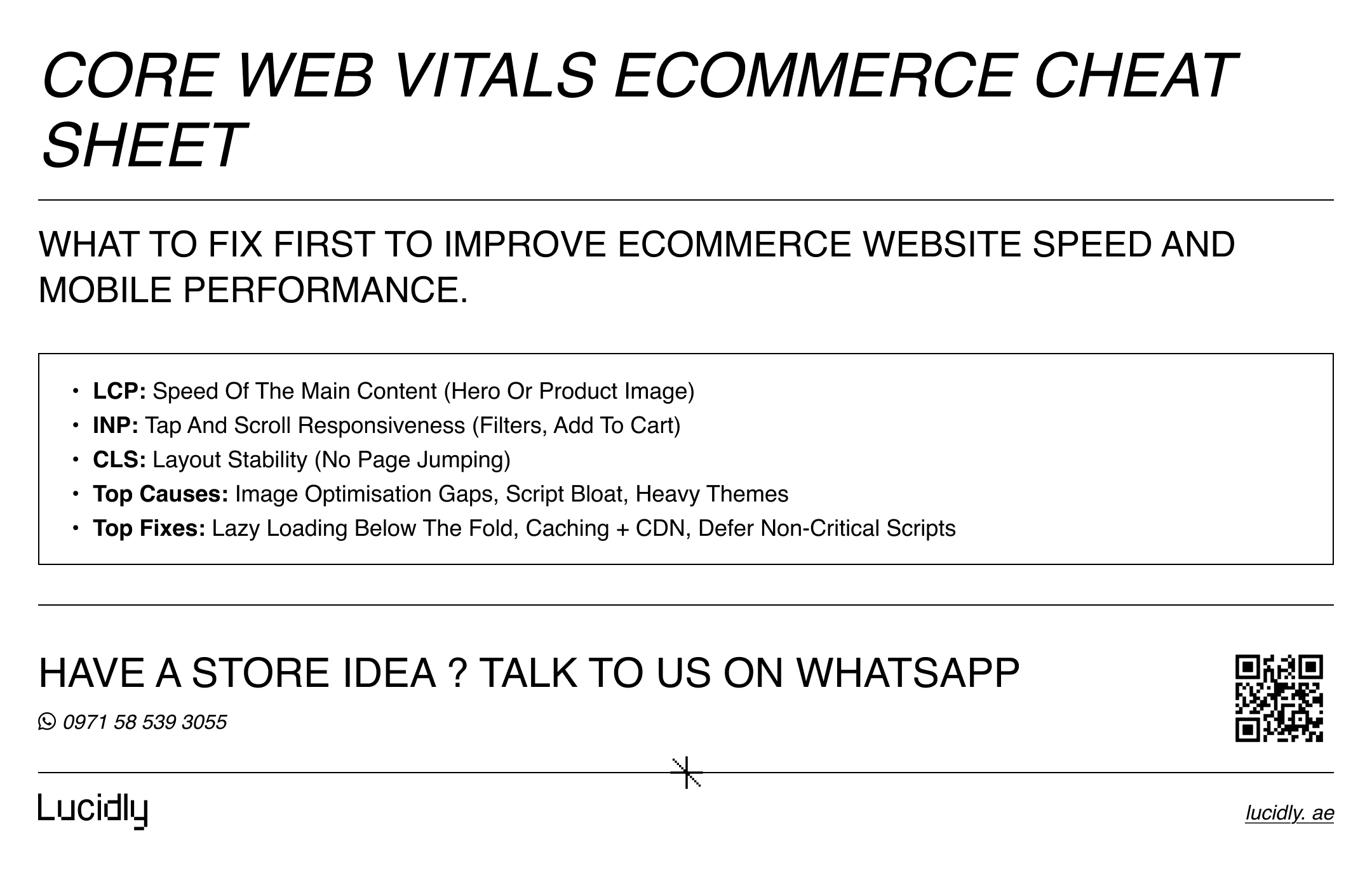
Largest Contentful Paint: How Fast the Main Content Appears
LCP is how quickly the main content becomes visible. On ecommerce pages, LCP is often:
Hero banner on category pages.
Product image on product pages.
If LCP is slow, shoppers feel the store is slow—even if the rest loads later.
Interaction to Next Paint: How Fast the Store Feels When Tapped
INP is about responsiveness. It’s where mobile performance lives. Slow INP is what causes:
Delayed “Add to cart”.
Laggy variant selectors.
Frozen filters.
Stuttering scrolling.
For CRO, INP is often the biggest win.
Cumulative Layout Shift: Why Pages Jump and Kill Trust
CLS measures layout shifts (content moving while loading). In ecommerce, CLS is usually caused by:
Images without dimensions.
Late-loading banners.
Dynamic UI elements (popups, sticky bars).
A stable page feels premium. A shifting page feels broken.
This is why ecommerce website speed is not only “loading time”—it’s perceived quality during interaction.
Why Is My Store Slow
Most stores aren’t slow because of one thing. They’re slow because of a stack of “small” problems that compound—especially as apps and tracking scripts grow.
Here are the most common causes you should check first:
Image optimisation not done properly (oversized images, wrong formats).
Too many scripts and third-party tags (script bloat).
Heavy theme code and unnecessary features.
Too many apps loading sitewide.
Poor caching strategy or misconfigured CDN.
Too many render-blocking resources.
Excessive product page widgets (reviews, chat, personalization)
The good news: the quickest wins usually come from removing weight and improving delivery—not rewriting the entire store.
Next, we’ll turn that into an audit you can run fast.
For a deeper look at the UX patterns that improve discovery and conversions, read Ecommerce UX in the UAE.
Ecommerce Website Speed Audit: What to Measure and Where to Look
A good speed audit answers two questions:
What’s slow? (page types + devices).
Why is it slow? (weight + blocking + response).
Start by testing these page types separately:
Homepage.
Top category page.
A mid-category page with filters.
Best-selling product page.
Cart + checkout steps.
Then compare mobile vs desktop. Many stores look fine on desktop but fail mobile ecommerce speed due to heavier CPU constraints and network variability.
Now use the audit to label each issue into one of these buckets:
Payload too heavy (images, scripts).
Rendering blocked (CSS/JS).
Server response slow.
Too many third-party requests.
Layout instability (CLS).
Interaction lag (INP).
Once you know the bucket, the fix becomes obvious. Let’s walk the fixes in the order that usually delivers the biggest lift.
The Quickest Speed Wins for Ecommerce
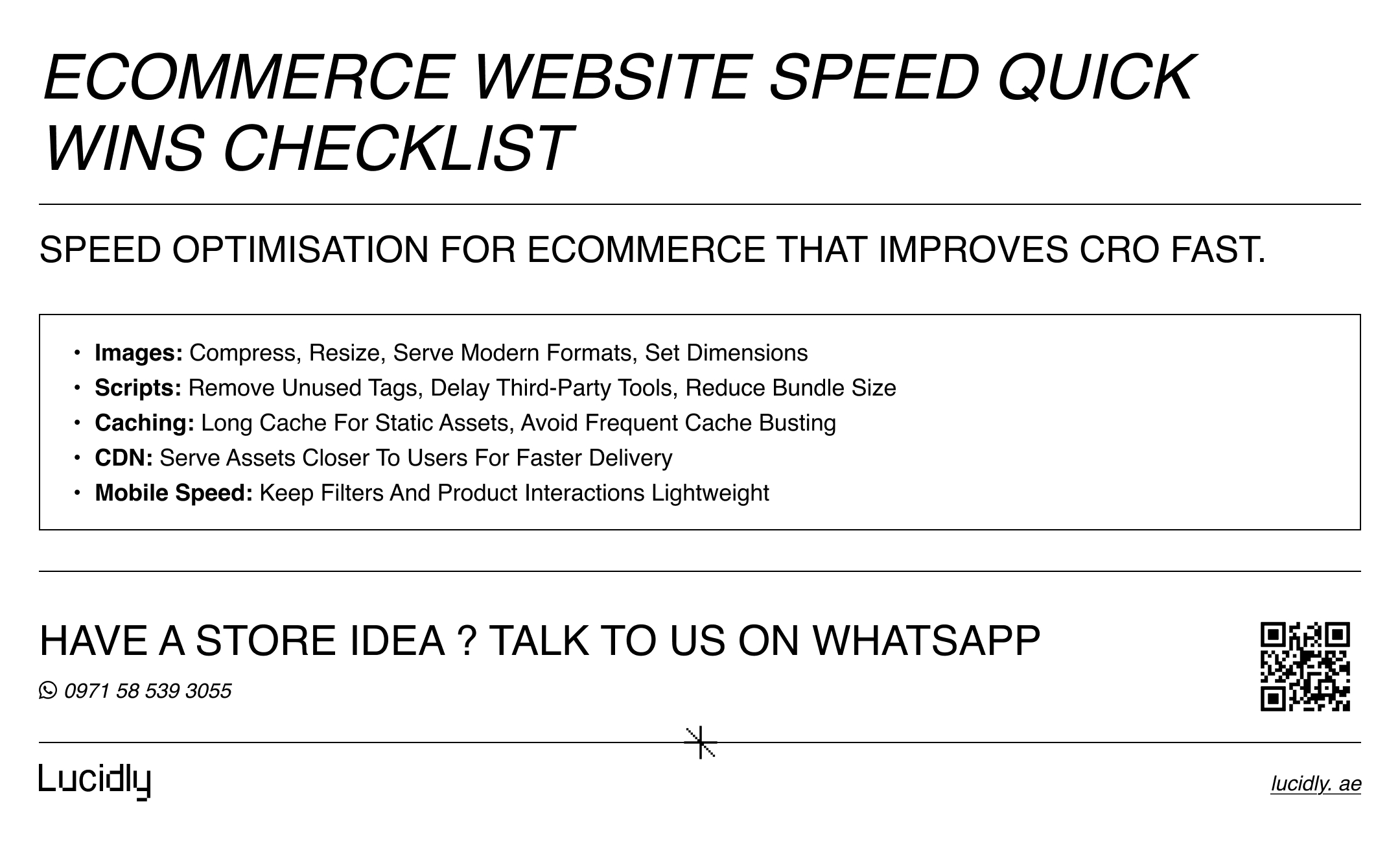
If you need results fast, don’t start with “advanced performance tuning.” Start with wins that cut weight and reduce blocking. This is the fastest path to improve store speed without breaking the site.
1) Image Optimisation That Actually Works
Images are usually the #1 weight driver in ecommerce. The goal is not “compress a bit”—the goal is to deliver the right size, format, and loading behavior.
Start with:
Serve modern formats where supported.
Use responsive images so mobile doesn’t download desktop sizes.
Ensure product and category images have dimensions set to avoid CLS.
Use lazy loading for below-the-fold images (but keep LCP image eager).
A simple rule: the LCP image should load fast; everything else can load later.
2) Kill Script Bloat Before It Kills CRO
Most stores quietly accumulate scripts: analytics, heatmaps, chat, A/B tools, review widgets, personalization, popups, tracking pixels. Each one adds requests and blocks interaction.
Take a ruthless approach:
Remove tags you don’t use.
Load non-critical tools after user interaction.
Avoid running heavy scripts on every page.
Combine or simplify tracking where possible.
Audit “app-installed” scripts that remain after uninstall.
If you want a fast online store, script governance is mandatory.
3) Use Caching and a CDN the Right Way
Caching reduces how often the server needs to rebuild pages and assets. A CDN reduces latency by serving assets closer to the user.
Practical steps:
Cache static assets aggressively (images, CSS, JS).
Ensure cache headers are correct and consistent.
Use a CDN for global asset delivery.
Avoid “cache busting” that forces full reloads too often.
This is foundational speed optimisation for ecommerce—especially for shoppers browsing on mobile networks.
4) Reduce Theme Weight and Unused Code
Themes often ship features you don’t need. Every extra slider, animation, and script impacts ecommerce website speed.
Focus on:
Removing unused sections and components.
Reducing heavy libraries.
Deferring non-critical JS.
Minimizing CSS and eliminating unused styles.
This is performance tuning that doesn’t require replatforming—just discipline.
For a performance-first ecommerce website speed setup, explore Lucidly’s Ecommerce Solutions in the UAE to improve mobile performance, optimise Core Web Vitals, and remove script bloat.
Mobile Performance for Ecommerce: What Breaks First and How to Fix It
Mobile speed is different because phones have less CPU and slower networks. A page can be “small enough” but still laggy if JS is heavy. That’s why mobile performance improvements often focus on interaction, not only load.
Make Filters and Faceted Navigation Fast
Filters are a conversion feature—but they can become a performance tax if implemented poorly.
Improve them by:
Loading filter UI efficiently (avoid heavy JS frameworks for simple UI).
Reducing the number of filter options shown by default.
Avoiding re-rendering the entire page on every filter change.
Keeping filter changes responsive (INP-focused).
A smooth filter experience is a direct CRO lift.
Keep Product Pages Light and Responsive
Product pages are where scripts pile up: reviews, UGC, recommendations, chat, payment badges, tracking, variant logic.
To improve store speed on product pages:
Load non-critical widgets after the main content.
Keep variant selectors lightweight.
Defer below-the-fold reviews and carousels.
Avoid autoplay media and heavy animations.
Your product page should “feel instant” when the user taps.
CRO Impact: Where Speed Shows Up in Your Funnel
Speed isn’t just “ranking.” It changes behavior in specific steps:
Category page speed → more product clicks.
Product page responsiveness → more add-to-carts.
Cart speed → fewer drop-offs before checkout.
Checkout speed → fewer abandons on payment.
If you track funnel steps, you’ll often find ecommerce website speed improvements correlate with:
Higher engagement (more pages per session).
Higher add-to-cart rate.
Better checkout completion.
This is why performance is not a dev-only concern—it’s revenue architecture.
For a broader set of high-impact conversion tests beyond performance improvements, see Ecommerce CRO (2026).
Ecommerce Performance Optimisation Roadmap
To keep this practical, use a simple roadmap that avoids endless tuning.
Phase 1: Fix the Biggest Weight Drivers
Start with:
Image optimisation.
Script bloat reduction.
Caching + CDN configuration.
These deliver the biggest change in perceived speed quickly.
Phase 2: Improve Interaction Quality
Then focus on INP and mobile responsiveness:
Defer heavy scripts.
Reduce JS execution time.
Optimize filters and product interactions.
Remove UI elements that cause CLS.
Phase 3: Maintain Speed With Governance
Speed decays as teams add apps and tags. Add guardrails:
Monthly script audit.
Performance budget (max scripts, max image weight).
Rules for adding new apps/tools.
Regular checks across key page types.
This keeps core web vitals ecommerce stable and prevents regression.
FAQs
How fast should an ecommerce website load?
A good target is “usable fast” on mobile: the main content appears quickly, interactions respond instantly, and the page doesn’t shift while loading. If shoppers can scroll, tap filters, and add to cart without lag, your ecommerce website speed is in the right zone.
How do Core Web Vitals affect ecommerce?
Core Web Vitals reflect real UX: how quickly the main content shows (LCP), how responsive interactions feel (INP), and how stable the layout is (CLS). Improving core web vitals ecommerce typically improves both search visibility signals and conversion outcomes—especially on mobile.
Why is my store slow?
Most often it’s a mix of heavy images, script bloat from apps and tags, unoptimized theme code, and weak caching/CDN setup. Fixing image optimisation, reducing scripts, and configuring caching and a CDN usually delivers the quickest improvement.
What are the quickest speed wins?
Start with the highest-ROI basics: resize and compress images properly, remove unnecessary scripts, defer non-critical widgets, and ensure caching and CDN are configured correctly. These speed optimisation for ecommerce moves often deliver immediate improvements without a redesign.
A fast online store is a conversion advantage. Treat ecommerce website speed as part of CRO to reduce friction across browsing, filters, product pages, and checkout.
Start with quick wins—image optimisation, caching, CDN, and script cleanup—then move into performance tuning that protects Core Web Vitals and mobile experience.
Map fixes by page type and ship improvements in weeks, not months.
Ready to improve mobile performance and reduce checkout drop-offs? Message Lucidly on WhatsApp—or use the numbers on our Contact Us page to book a quick speed audit review.
References
Google Search Central — Core Web Vitals and Google Search results. (Google for Developers)
web.dev — Interaction to Next Paint (INP): what it measures and how to improve it. (web.dev)
web.dev — Largest Contentful Paint (LCP): definition and optimisation guidance. (web.dev)
MDN Web Docs — INP glossary definition and interaction responsiveness overview. (developer.mozilla.org)