Ecommerce website mistakes don’t usually look dramatic. They look like small frictions that stack up: a slow checkout, confusing navigation, product pages that don’t answer real questions, or fees that appear too late.
Each issue reduces trust and increases hesitation—especially on mobile. The good news is you can fix most conversion killers without a full redesign.
This guide breaks down the most common online store conversion pitfalls, shows how to spot them in your funnel, and gives practical fixes you can implement this week to lift add-to-cart rate, checkout completion, and revenue.
Struggling with conversion drops? Message Lucidly on WhatsApp for a quick conversion readiness audit.
The Real Reason Stores Don’t Convert: Friction Stacks Up
Before you blame traffic quality, assume friction. Most online store problems are not one “big bug”—they’re a chain of small blockers: extra taps, unclear information, slow loading, weak trust cues, and last-minute surprises.
That’s why common ecommerce errors can quietly destroy performance even when product-market fit is strong.
To diagnose properly, separate symptoms from causes. High bounce might be speed, mismatch, or poor category relevance.
Low add-to-cart often points to weak product descriptions or missing trust. Checkout drop-offs often signal slow checkout, confusing steps, or fee surprises.
Fixing ecommerce website mistakes is about removing hesitation from the journey—one high-impact point at a time.
If you want to see how to build a store that reduces friction from the start, read Ecommerce Website Development UAE: A Complete Guide to Building an Online Store That Sells.
Mistake #1: Slow checkout (and slow site speed)
Speed isn’t just a “technical metric.” It’s a conversion factor—especially when a buyer is about to pay. When checkout lags, people don’t wait. They leave.
Before the list, here’s how slow checkout shows up in real stores: the cart takes seconds to update, payment buttons feel unresponsive, address fields are heavy, and third-party scripts delay completion.
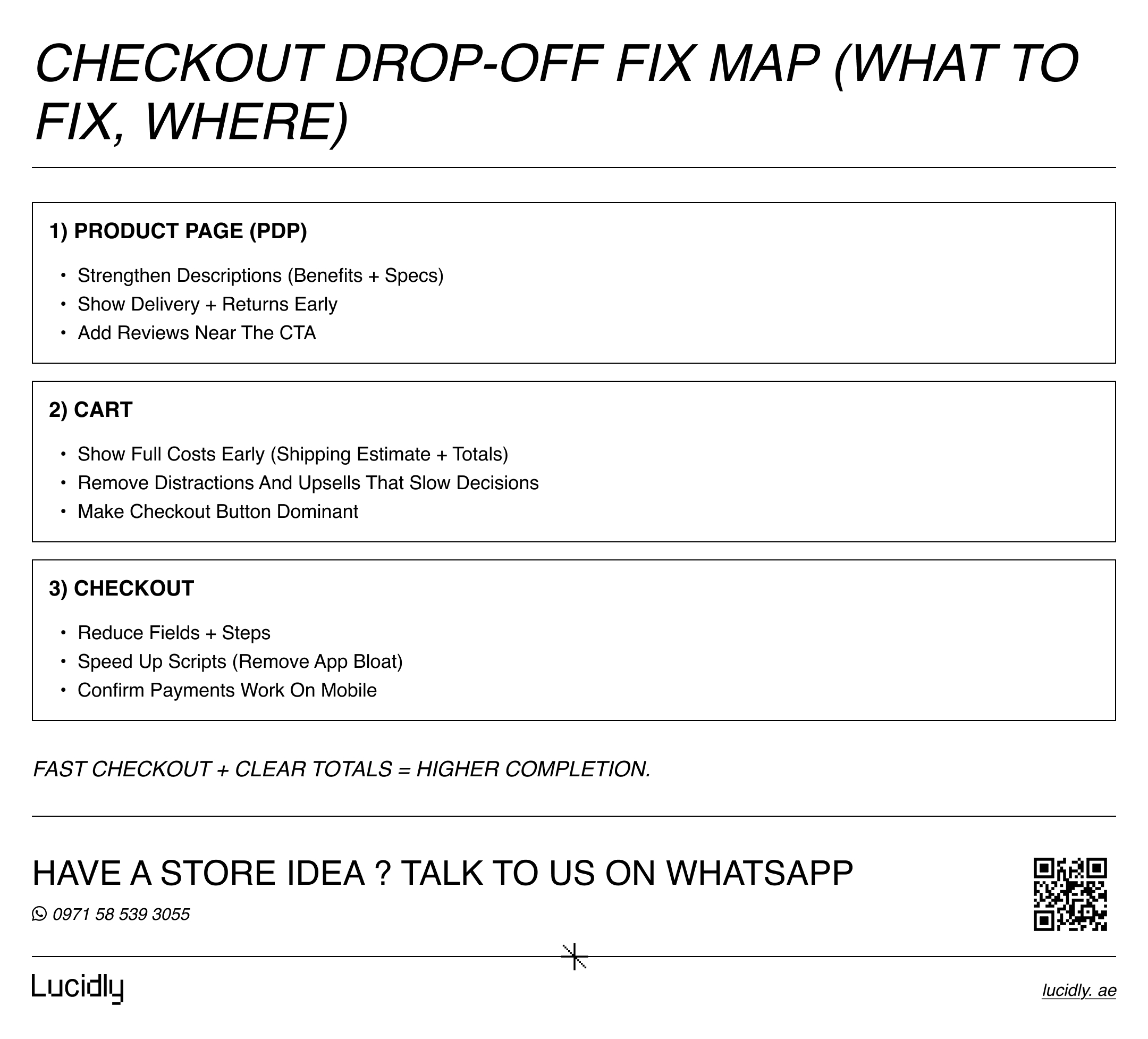
Reduce steps and fields: remove optional inputs, shorten forms, enable address autocomplete.
Audit scripts and apps: remove non-essential tags, delay marketing scripts until after purchase where possible.
Optimize the critical path: prioritize cart and checkout templates over less critical pages.
Set a performance budget: treat new apps as “costs” in milliseconds, not just monthly fees.
Monitor outcomes: track checkout abandonment by device, browser, and payment method.
These are ecommerce mistakes to avoid because once a user is ready to buy, any delay feels like risk. Fixing ecommerce website mistakes here often delivers the fastest revenue lift.
Mistake #2: Poor navigation and weak category structure
Navigation is not decoration—it’s how shoppers find confidence. Poor navigation creates uncertainty: “Am I in the right place? Can I find what I need? Is this store professional?” When categories don’t match intent, customers bounce or search—and many searches fail.
Before the list, remember this: a good store structure does two jobs at once—helps people browse and helps search engines understand relevance. That’s why this is both UX and SEO.
Build intent-based categories: group by how people shop, not how your warehouse labels items.
Make menus scannable: fewer top-level options, clearer wording, consistent hierarchy.
Fix filters: avoid filter overload; prioritize high-use filters; keep them fast and stable.
Create strong paths: add internal links from best categories to best sellers and key collections.
Improve on-site search: synonyms, typo tolerance, better “no results” handling.
These online shop mistakes kill conversion because shoppers can’t build momentum. Fixing ecommerce website mistakes in navigation is often cheaper than redesign—and more effective.
Mistake #3: Weak product descriptions (no decision-making content)
A product page has one job: help the buyer decide. Weak product descriptions force customers to guess, which increases return risk in their mind—and increases abandonment in your analytics.
Before the list, ask: does your product page answer the buyer’s real questions in under 10 seconds on mobile?
Use a clear structure: short value summary, key benefits, then scannable specs.
Add “decision details”: sizing, compatibility, materials, care, what’s included, warranty.
Put delivery/returns where it matters: above the fold or near the add-to-cart, not hidden in footers.
Add product FAQs: address objections (fit, authenticity, delivery time, exchange process).
Use proof: reviews, Q&A, real images, and usage notes.
This is one of the most common ecommerce pitfalls because teams focus on visuals and ignore clarity. Fixing ecommerce website mistakes on product pages improves add-to-cart rate and reduces support load.
Mistake #4: Hidden fees and surprise totals
People don’t mind paying. They mind surprises. Hidden fees—or costs revealed too late—trigger the “I’m being tricked” reaction, which destroys trust at the exact moment you need it most.
Before the list, note where fee surprises usually happen: shipping costs appear at the final step, taxes aren’t estimated, or payment-related fees are added after a user commits.
Show shipping estimates early: on product pages and cart, not only at checkout.
Make total cost clarity a feature: display estimated total and delivery timeline as soon as possible.
Use thresholds transparently: free shipping thresholds and minimums should be visible.
Avoid last-step shocks: if a fee exists, disclose it earlier with plain language.
Test the flow like a customer: new user, mobile device, different emirates/cities.
These online store problems are avoidable—and fixing them removes the feeling of risk. Fixing ecommerce website mistakes here often increases checkout completion immediately.
For a deeper look at reducing cart abandonment and improving checkout completion, read Ecommerce Checkout Optimisation: How to Reduce Cart Abandonment and Increase Sales.
Mistake #5: Weak trust signals (especially on mobile)
Trust isn’t a badge. It’s a consistent experience. Weak trust signals happen when the store feels anonymous, policies are vague, and shoppers can’t tell what happens after they pay.
Before the list, remember the first-time buyer mindset: “Will this arrive? Can I return it? Can I reach someone if there’s a problem?”
Make policies visible: shipping, returns, warranty—clear and specific.
Use social proof strategically: reviews near CTAs, real customer photos, verified purchase labels.
Show real support: WhatsApp/contact options, response expectations, business identity.
Use payment reassurance without clutter: security cues and trusted payment methods.
Keep branding consistent: mismatched fonts, broken layouts, or generic templates reduce confidence.
These common ecommerce errors hurt conversion more than teams realize. Fixing ecommerce website mistakes around trust is one of the highest-ROI improvements you can make.
Mistake #6: Ecommerce UX mistakes that create micro-friction
Big problems are obvious. Micro-friction is subtle—and deadly. Ecommerce UX mistakes often look like “small design choices,” but they create hesitation on mobile: tiny tap targets, confusing buttons, pop-ups blocking CTAs, or a search experience that doesn’t help.
Before the list, think in terms of “momentum.” Every unnecessary tap slows the user’s decision-making.
Improve tap targets: bigger buttons, clearer hierarchy, less clutter around CTAs.
Reduce distractions: fewer pop-ups and interruptions on product and cart pages.
Fix search experience: faster results, better sorting, stronger filter interaction.
Make errors friendly: clear form errors, preserve inputs, offer suggested fixes.
Support repeat shopping: wishlist, recently viewed, and “buy again” where relevant.
These are ecommerce mistakes to avoid because they multiply across the journey. Fixing ecommerce website mistakes here improves browsing-to-cart progression.
Mistake #7: Ecommerce SEO mistakes that waste paid + organic traffic
Conversion doesn’t start at checkout. It starts where people land. Ecommerce SEO mistakes can waste both paid and organic traffic by sending users to thin pages, duplicated pages, or slow templates that don’t match intent.
Before the list, keep this simple: even great traffic won’t convert if the landing page is weak.
Strengthen category pages: intent-based copy, clear sorting, strong merchandising, and proof.
Control faceted navigation: prevent index bloat from filter URLs (canonicals/noindex rules).
Fix internal linking: guide users from categories to best sellers and problem-solving content.
Use structured data: Product + Breadcrumb to support visibility and clarity.
Keep pages fast: heavy scripts and slow templates reduce conversion and rankings.
These ecommerce pitfalls often look “invisible” because the site still loads and ads still run. But fixing ecommerce website mistakes here improves both acquisition efficiency and conversion.
For a detailed guide on must-have ecommerce pages, features, and integrations, check out our Ecommerce Website Features Checklist.
Fix-first framework: Diagnose the funnel before you redesign
Redesigns are expensive. Diagnosis is cheap—and usually more effective. The best teams fix leaks in order of impact, then iterate.
Before the steps, start with one question: where is the biggest drop—product page, cart, or checkout?
Locate the drop-off stage: PDP → Cart → Checkout → Purchase.
Segment by device: mobile vs desktop (mobile friction is usually the real culprit).
Prioritize by impact: checkout fixes first, then product clarity, then navigation.
Fix one variable at a time: measure results cleanly.
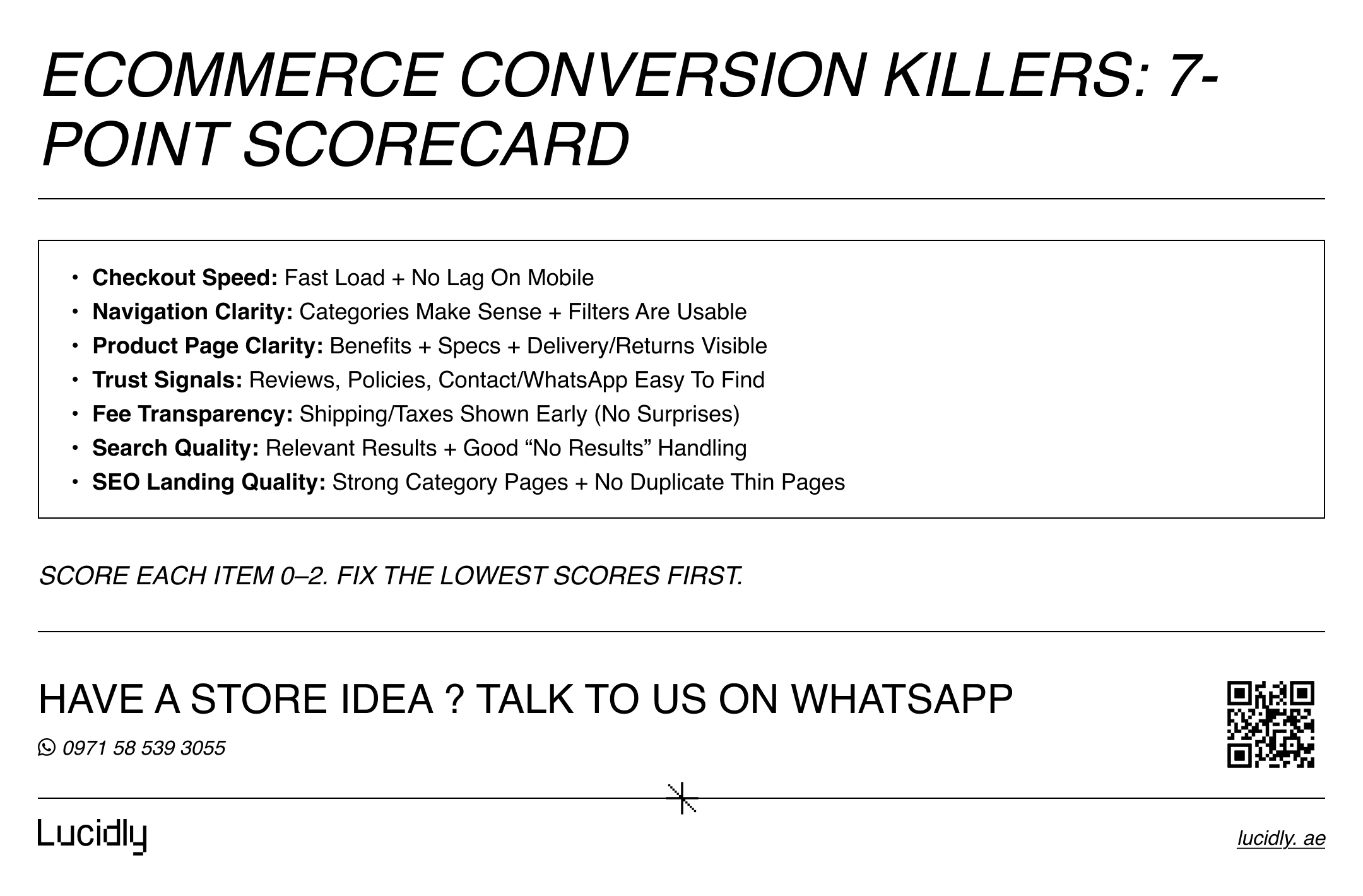
Create a scorecard: grade speed, clarity, trust, fees, and UX from 0–2.
This framework helps you fix ecommerce website mistakes without guessing—and without shipping changes that don’t move revenue.
For a fix-first conversion plan, explore Lucidly’s Ecommerce Solutions in the UAE to remove checkout friction, improve navigation, and strengthen trust signals.
Pre-launch review checklist (so you don’t ship a conversion killer)
Before you launch a new store, a new theme, or a major release, run a simple checklist that prevents the biggest conversion losses.
Before the bullets, assign an owner to each test and confirm it’s done on real mobile devices—not only in staging previews.
Checkout speed + payment success tests: multiple devices, multiple payment methods
Navigation paths: can a user reach top products in 3 clicks?.
Search tests: common queries, typos, “no results,” filters, and sorting.
Product page clarity: benefits, specs, delivery, returns, warranty.
Fee transparency: shipping estimates and totals visible early.
Trust signals: reviews, policies, contact/WhatsApp visible on mobile.
SEO basics: indexability, canonicals, internal links, schema, fast templates.
If you do this consistently, you prevent the most damaging ecommerce website mistakes before they reach customers.
FAQ
Why do ecommerce sites fail to convert?
Most stores fail to convert because friction stacks up: slow checkout, unclear product pages, weak trust cues, confusing navigation, and fee surprises. Even small issues multiply on mobile and reduce confidence at the moment of purchase.
What are the most common mistakes?
The most common conversion killers are slow checkout, poor navigation, weak product descriptions, hidden fees, weak trust signals, UX micro-friction, and SEO issues that land users on thin or duplicated pages.
Can I fix an underperforming store?
Yes. Start by diagnosing where users drop (product page vs cart vs checkout), then fix the highest-impact leaks first—usually checkout speed, fee transparency, product clarity, and trust. Iterate with clean measurement.
What should I review before launch?
Review checkout speed and payment success, navigation and search paths, product page clarity, fee transparency, trust visibility on mobile, and core SEO basics (indexability, canonicals, internal links, schema, and speed).
You don’t need a redesign to raise conversion—you need to remove friction. Fix slow checkout, improve navigation, strengthen product descriptions, make fees transparent, and build trust signals that are obvious on mobile.
Use funnel diagnosis to prioritize changes, then validate with clean tracking so every improvement has a measurable impact.
Want a fast conversion audit to spot your biggest ecommerce website mistakes? Message Lucidly on WhatsApp—or book a quick audit via our Contact Us numbers.
References
Google Search Central — SEO best practices for ecommerce sites. (Google for Developers)
Google Search Central — Core Web Vitals and Google Search (performance + UX signals). (Google for Developers)
Baymard Institute — Cart & Checkout Usability Research (checkout friction + abandonment drivers). (Baymard Institute)
Google Analytics (GA4) Developer Docs — Measure ecommerce (events + implementation guidance for tracking). (Google for Developers)