In the UAE, an online store has to earn trust fast: it must load instantly on mobile, make delivery costs clear early, and support the payment methods shoppers expect.
This guide covers ecommerce website development uae step by step—from choosing Shopify, WooCommerce, or Magento to integrating Tabby/Tamara, COD, and reliable shipping tracking.
You’ll also get a practical SEO-ready checklist so your category and product pages can rank, convert, and scale without rebuilds.
Use it to plan confidently and launch without costly surprises.
Message Lucidly on WhatsApp for a quick ecommerce audit and next-step plan.
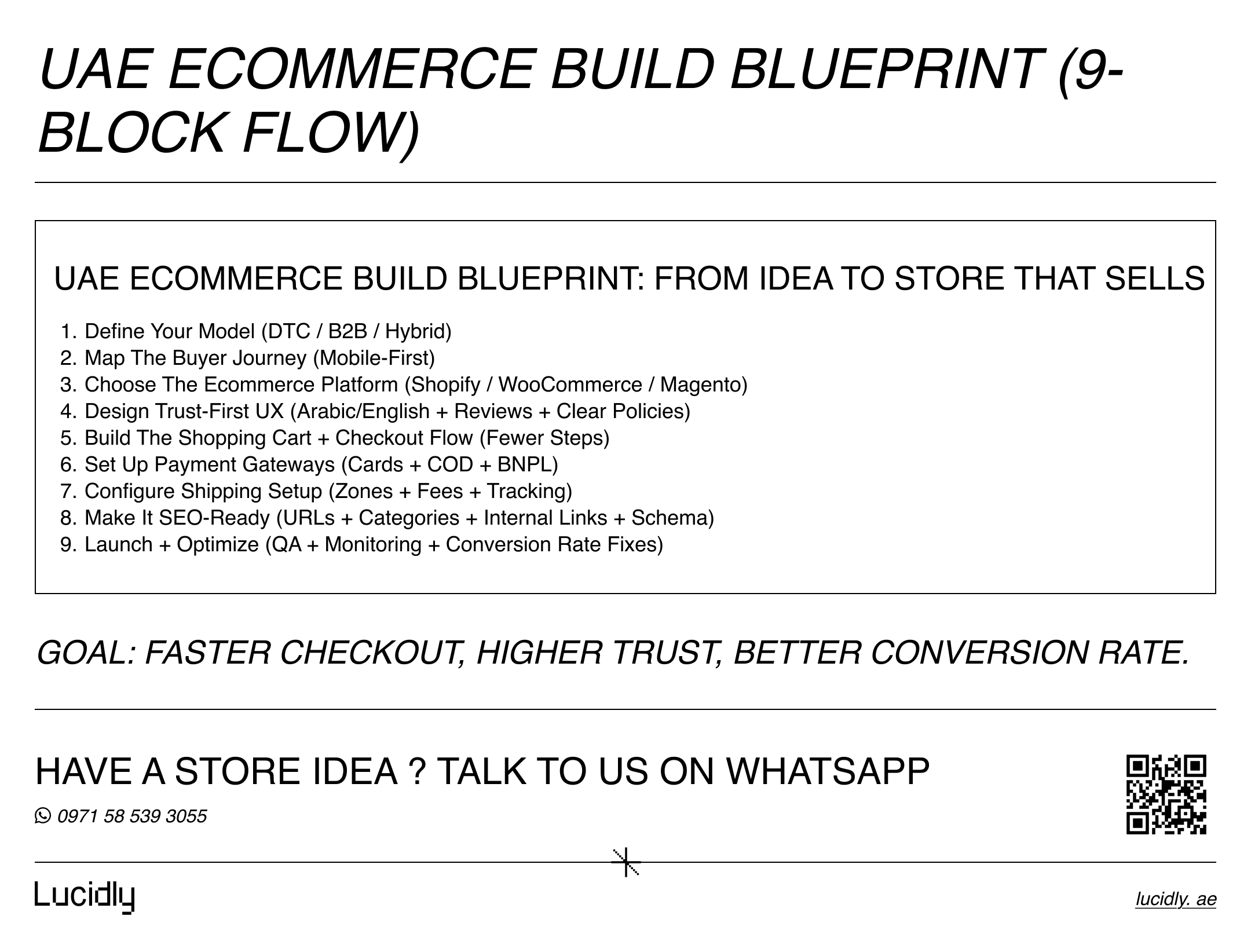
Before You Build: Define the Store You’re Actually Selling
The fastest way to waste budget is to start with features before you’ve defined the store’s job. In the UAE, “a nice website” isn’t enough—your online shop has to reduce friction and build confidence at every step, especially on mobile.
In ecommerce website development uae, that starts with clarity: what you sell, who you sell to, and how customers will discover and buy from you.
If you’re searching for leading ecommerce website development in Dubai, you can check out our article: Top Ecommerce Agencies Dubai to compare top providers and find the best fit for your store.
Pick your business model (it changes your build)
Your store structure, shopping cart behavior, checkout flow, and integrations depend on the model you choose.
The same ecommerce platform can work for different models, but configuration—and priorities—shift.
Before you list features, align on the model:
DTC (Direct-to-Consumer): Brand storytelling, product page conversion, retention, upsells
Wholesale/B2B: Tiered pricing, MOQ rules, quotes, account logins, invoice workflows
Marketplace-led hybrid: Strong product feeds, inventory sync, and operational control
Map a UAE buyer journey you can measure
A “store that sells” is a store that measures.
Your journey should reflect real behavior in Dubai, Abu Dhabi, and across the UAE: mobile-first browsing, fast comparisons, and a strong preference for clear delivery terms and flexible payments.
Before writing a single line of code, map the funnel:
Discovery: Search + social + influencer traffic + WhatsApp referrals
Consideration: Category pages, filters, product details, reviews
Decision: Cart, shipping cost visibility, payment options (cards, COD, BNPL)
Retention: Order updates, easy returns, post-purchase offers
The conversion blueprint (simple and effective)
A clean blueprint keeps your build focused and prevents scope creep.
It also makes it easier to brief your designer and developer so you don’t end up with pretty pages that don’t convert.
Here’s the blueprint many UAE stores use to protect conversion rate:
Homepage: Clear value, best sellers, fast routes into categories
Category pages: Filters, strong thumbnails, quick add-to-cart where suitable
Product pages: Delivery timeline, returns clarity, trust signals, sticky CTA on mobile
Cart: Transparent totals, shipping estimator (or early cost messaging)
Checkout: Minimal fields, local payment options, reliable error handling
If you’re looking to build a trusted online store in Abu Dhabi, defining your store’s purpose upfront ensures a smooth mobile experience, clear shipping, and full payment support—complementing our article Top Ecommerce Agencies Abu Dhabi.
Ecommerce Website Development UAE: Platform Options (Shopify vs WooCommerce vs Magento)
The platform choice is the foundation for everything that follows: speed, cost, flexibility, SEO control, and the quality of your checkout flow.
If you’re targeting ecommerce website development Dubai searches, this comparison is also where you earn trust—because it answers what most decision-makers care about first.
For ecommerce website development uae, pick the ecommerce platform that matches how you actually operate, not what looks popular.
Before you pick a platform, confirm three realities: your catalog size, your integration needs (payment gateways, shipping setup, ERP/CRM), and how quickly you need to launch.
Shopify (best for speed and stability)
Shopify is often the fastest path to a professional store—especially if you want speed to market and fewer technical headaches.
It’s a common starting point for teams who want predictable maintenance and strong app support.
Before you commit, know what Shopify typically gives you:
Reliable hosting and performance without heavy DevOps
A strong ecosystem for payment gateways and conversion tools
Apps for upsells, reviews, loyalty, and automation
Faster iteration for campaigns and seasonal promos
WooCommerce (best for content-led growth)
WooCommerce is ideal when content marketing and SEO are central. If you want guides, landing pages, and a strong internal linking strategy alongside products, WooCommerce can be a strong fit.
Before choosing WooCommerce, accept that performance and maintenance matter more as you scale. Done right, WooCommerce supports:
Deep content integration (WordPress strengths)
Flexible customization without enterprise-level cost
Strong control over URLs, categories, and on-page SEO details
This is a common reason businesses researching ecommerce web development uae services consider WooCommerce when SEO is a long-term strategy.
Magento / Adobe Commerce (best for complex stores)
Magento is built for complexity: large catalogs, advanced pricing rules, multi-store setups, and B2B logic. If your store needs serious operational depth, Magento is a strong candidate.
Before going Magento, plan for:
Higher implementation and hosting complexity
Stronger QA requirements
More structured development process
If you’re wondering which platform is the best fit for your store, check out our detailed article Shopify vs WooCommerce vs Custom UAE to find the platform that matches your operational needs and business growth.
Conversion-Focused UX Checklist (UAE)
In the UAE, UX isn’t just aesthetics—it’s speed, clarity, and trust. The goal is simple: fewer taps, fewer doubts, and fewer surprises at checkout. Use this checklist to protect conversion rate on mobile and across Arabic/English audiences.
For a deeper look at Core Web Vitals, mobile performance, and how speed affects conversions, read Ecommerce Website Speed.
Before you “add more design,” lock these essentials:
Mobile-first layout: Tap-friendly buttons, spacing, and readable typography on small screens.
Fast product-to-cart path: Clear CTAs and a frictionless route from product page to shopping cart.
Autofill-ready forms: Proper field labels and input types to reduce typing during checkout flow.
Fewer checkout steps: Keep checkout short (ideally one-page) and remove optional fields.
True Arabic RTL support: Native RTL layouts, not mirrored hacks, with consistent spacing and fonts.
Stable language switching: Switching Arabic/English should not reset cart, session, or currency.
Trust signals where they matter: Reviews/UGC on product pages, clear delivery timelines, and visible returns/refunds policy before checkout.
Support access in context: WhatsApp support visible in header or product pages for quick reassurance.
This is where strong ecommerce website design uae often wins—by removing doubt before the customer reaches checkout.
For a deeper look at the UX patterns that improve discovery and conversions, read Ecommerce UX in the UAE.
Payments in the UAE: Cards, COD, and BNPL (Tabby/Tamara)
Payments are not a technical checkbox—they’re a conversion lever. Shoppers expect flexibility.
If your payment stack doesn’t match expectations, your ads and SEO work harder just to lose customers at checkout.
Securing your online store is as important as offering trusted payment methods—see our guide on Ecommerce Security.
In ecommerce website development uae, payments should be designed as part of the customer journey from day one—not treated as a last-minute integration.
Before you implement payment gateways, decide what “must-have” means for your category (fashion, beauty, electronics, grocery, luxury, etc.).
To choose the right provider, understand integration requirements, and secure your checkout properly, read our guide: Payment Gateways in the UAE.
Must-have payment methods
Your baseline should reflect UAE norms and your product price points. Not every store needs every method—but most stores need a smart set.
Before you choose, consider the minimum set most UAE stores cover:
Card payments (Visa/Mastercard)
Wallet options (when relevant)
Cash on Delivery (COD) where it improves conversion for your niche
Localized currency display (AED) and multi-currency if you sell regionally
BNPL (Buy Now Pay Later) and why it matters
BNPL can increase conversion and average order value for certain categories. The key is to treat it as part of the checkout experience, not an afterthought.
Before adding BNPL, evaluate:
Your average order value (BNPL is stronger above certain thresholds)
Your return rate (BNPL can affect support workflows)
Where BNPL messaging appears (product page, cart, checkout)
Tabby and Tamara are common BNPL integrations for UAE-focused stores.
For a detailed guide on must-have ecommerce pages, features, and integrations, check out our Ecommerce Website Features Checklist.
Checkout optimization principles
Even with perfect payment methods, a messy checkout loses sales. Checkout optimization is mostly about reducing effort and preventing errors.
Before you polish design, polish behavior:
Minimize form fields and reduce typing
Show full costs early (including delivery and taxes where applicable)
Make errors obvious, fixable, and non-destructive
Support retries without wiping the cart
If you’re looking to offer the payment flexibility UAE shoppers expect in Sharjah, integrating the right methods from the start ensures trust and smooth conversions—aligning perfectly with our article Top Ecommerce Agencies Sharjah.
For a deeper look at reducing friction during payment and improving conversions, read our article ecommerce checkout optimisation.
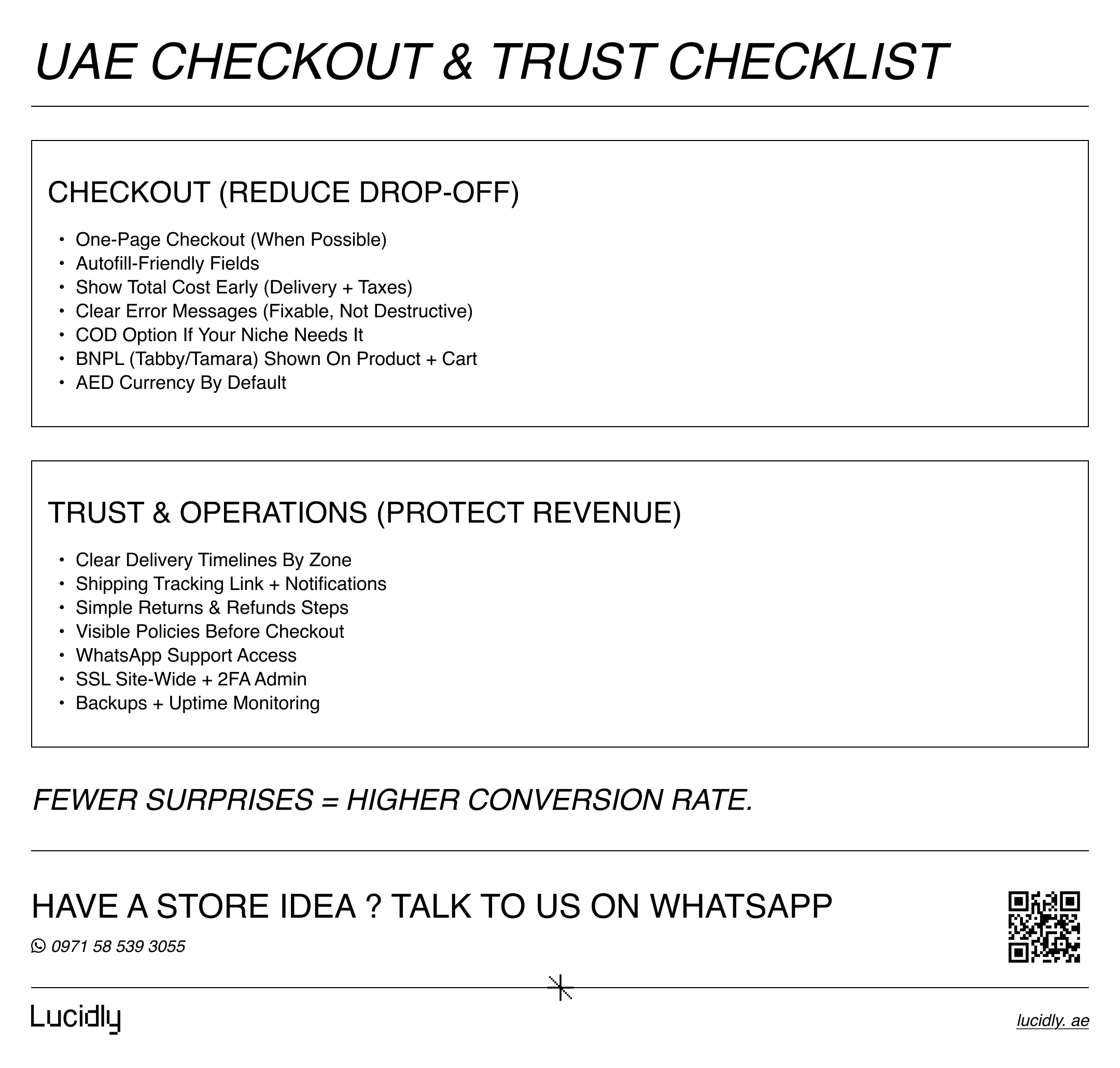
Shipping, Delivery & Returns: The Operations Layer Most Stores Ignore
Logistics is where customer experience becomes reality. In the UAE, delivery speed and transparency heavily influence trust—especially when customers compare multiple stores in minutes.
In ecommerce website development uae, shipping setup and returns should be planned as core conversion infrastructure, not treated as “ops details” to fix after launch.
Before you build shipping rules, decide what you can reliably deliver and how you’ll communicate it.
Shipping logic (zones, fees, and thresholds)
Your shipping strategy should be clear enough to understand at a glance and flexible enough to support promotions. Confusing shipping policies create cart abandonment.
Before you finalize shipping settings, define:
Delivery zones (Dubai, Abu Dhabi, Northern Emirates, remote areas)
Fees per zone, and any weight/size rules
Free shipping thresholds (a conversion lever when used carefully)
Delivery time messaging (e.g., same-day only where operationally true)
Shipping integrations and tracking
Modern shoppers expect tracking. Even if your backend is simple, your customer-facing updates should feel reliable.
Before you integrate, list your operational needs:
Courier or aggregator integration
Automated tracking links and status updates
Customer notifications (email/SMS/WhatsApp where appropriate)
Returns workflows and labels (if available)
Returns and refunds workflow
Returns are not a “policy page.” They’re a process. Stores that handle returns smoothly earn repeat customers—even when the first order doesn’t fit.
Before you publish policies, define:
How customers initiate returns
How you verify eligibility (time window, condition rules)
Refund timelines and method rules
Who pays return shipping (and when)
This operational clarity is a key differentiator in ecommerce site development uae projects competing on trust.
For a practical guide to shipping rates, zones, tracking, and returns, see Shipping and Fulfilment in the UAE.
SEO-Ready Ecommerce: Build It Right From Day One
SEO is easiest when it’s built into your store structure—not added after launch. If you treat SEO like a plugin, you’ll pay later through messy URLs, duplicate pages, and category pages that struggle to rank.
In ecommerce website development uae, plan the SEO foundation alongside design and development.
SEO Checklist (Technical + Content)
Before launch, verify the essentials:
Clean, readable URLs for categories and products
Correct canonical handling (especially for variants and filtered pages)
XML sitemap + robots.txt configured properly
No accidental noindex on core pages
301 redirects in place if migrating from an old site
Then strengthen the pages that usually drive revenue:
Add a short category intro (2–4 lines) with natural keywords
Build internal links to subcategories and best sellers
Control filters to prevent index bloat
Use unique product descriptions where possible (avoid supplier copy)
To grow beyond product-only keywords, publish content that matches shopping intent:
Buying guides, size guides, and comparison pages
Brand story and trust pages
Structured Data (Recommended)
Structured data helps search engines understand your pages. Use Product and Review schema where relevant, and FAQ schema for your FAQ section—only if the content is accurate and visible.
Cost, Timeline & What Impacts Both (UAE Reality Check)
Most budget disappointment comes from unclear scope. “Ecommerce website development cost in Dubai” varies widely because what people call “a store” ranges from a themed setup to an integrated build with complex operations.
Before you request quotes, define scope in plain language and list required integrations: payment gateways, shipping setup, analytics, and any ERP/CRM needs.
For a more detailed pricing breakdown by store type, read Ecommerce Website Cost UAE.
What ecommerce development typically includes
A professional build is more than pages. It includes systems, QA, and launch support.
Before you compare proposals, check whether they include:
UX/UI design (or theme customization)
Product catalog setup and data migration
Shopping cart configuration and checkout flow setup
Payment gateway integration and checkout configuration
Shipping rules and tracking integration
Analytics and conversion tracking setup (e.g., GA4 events)
QA across mobile devices and browsers
Launch support and post-launch fixes
If you’re trying to build ecommerce website uae shoppers trust, this checklist is the difference between “looking live” and being truly ready.
If your build includes product catalog setup, variant structure, and bulk data uploads, see Product Data and Catalogue Management.
Timelines (what’s realistic)
Timelines depend on complexity and integrations.
Before committing to a launch date, consider:
Fast MVP: Validated products + tight catalog + minimal integrations
Standard build: Custom design + full payments/shipping + SEO foundations
Complex build: ERP/CRM, advanced pricing, multi-store requirements
For a conversion-focused build, explore Lucidly’s E-Commerce Website Development in Dubai for end-to-end ecommerce solutions across the UAE.
If you want to explore the top ecommerce website development companies in the UAE, check out our article: Top Ecommerce Website Development Companies UAE.
Launch, Security & Compliance Checklist
Launching an ecommerce store isn’t the finish line—it’s the moment real customers start testing your checkout, payments, and operations. A structured launch checklist protects revenue and prevents avoidable failures.
Pre-Launch Technical & Security Essentials
Before going live, verify the moments where sales actually happen:
Test every payment method end-to-end (including BNPL and COD).
Confirm shipping fees and delivery estimates by zone.
Check mobile checkout flow across multiple devices.
Verify order confirmations (email/SMS).
Fix 404 errors and confirm redirects + sitemap submission.
Track analytics events (add-to-cart, begin checkout, purchase).
Ensure Ecommerce Maintenance and Support is in place to maintain. performance, security, and smooth checkout.
At the same time, secure the foundation:
SSL enabled site-wideز
Secure admin access (strong passwords + 2FA where possible).
Updated themes, plugins, and dependencies.
Automated backups with restore testing.
Uptime and checkout monitoring in place.
Compliance Basics
Before launch, make sure customer-facing policies are clear and accessible:
Privacy policy and terms & conditions.
Transparent returns and refunds policy.
VAT-aware pricing and invoicing where required.
FAQs
What is ecommerce website development?
Ecommerce website development is the process of building an online store that can showcase products, manage a shopping cart, process payments through payment gateways, and support shipping setup, order management, and returns. It also includes performance, security, and SEO foundations so the store can rank and convert consistently.
How long does it take to build an ecommerce website?
It depends on scope and integrations. A small MVP can launch quickly using a proven ecommerce platform with standard features. A more complex build—custom UX, multiple payment gateways, detailed shipping setup, or ERP/CRM connections—takes longer due to QA, data migration, and real-device testing.
Which platform is best for ecommerce in the UAE?
The best platform depends on your needs. Shopify is strong for speed and stability, WooCommerce is powerful for content-led growth, and Magento is built for complex requirements and large catalogs. If you’re planning ecommerce website development uae, choose the platform that makes your checkout flow reliable and your operations easy to run.
If you’re planning Ecommerce Migration in the UAE, choose the platform that makes your checkout flow reliable and your operations easy to run.
What should I prepare before starting?
Prepare your product catalog and category structure, pricing and VAT approach, payment method priorities (cards, COD, BNPL), delivery zones and policies, return rules, and brand assets (photos, copy, policies).
Then define success metrics like conversion rate and map a simple buyer journey from discovery to checkout.
To avoid common conversion blockers before launch, read Common Ecommerce Website Mistakes That Kill Conversion (and How to Fix Them).
What is the cost of developing an ecommerce website in Dubai?
Prices vary depending on the platform and scope, but you can find realistic details for Shopify, WooCommerce, or custom builds in Dubai in this guide: Ecommerce Website Price in Dubai .
The stores that win in the UAE don’t just “launch”—they build a system customers trust and teams can improve over time. Get the platform right, design for mobile-first conversion, integrate payments and delivery properly, build SEO into your structure from day one, and use Ecommerce Analytics along with targeted experiments as described in Ecommerce CRO to monitor performance, identify trends, and optimize revenue.
If you’re planning ecommerce website development uae, use this guide as your blueprint: reduce checkout friction, make operations dependable, and turn traffic into consistent sales.
For UAE brands building a store that sells, message Lucidly on WhatsApp to review your ecommerce goals and build roadmap—or reach us via our Contact Us page.
References
UAE Federal Tax Authority – E-Commerce VAT Guide (PDF)
Google Search Central – Product structured data
Schema.org documentation (structured data reference)
BNPL market context (mentions Tabby/Tamara; market adoption)
COD + payment flexibility as a trust/conversion lever in UAE ecommerce