Choosing from the top ecommerce website development companies in dubai in 2026 is less about “who has the nicest design” and more about execution: mobile speed, a clean checkout, UAE payment options, shipping rules, and reliable post-launch support.
This guide gives you a Dubai-focused shortlist and a practical comparison framework, so you can evaluate any ecommerce website development company dubai brands hire without getting trapped in vague scopes or surprise add-ons.
For Dubai brands building a store that sells, message Lucidly on WhatsApp to review your scope, integrations, and launch roadmap.
Top Ecommerce Website Development Companies in Dubai (2026)
Here’s a fast way to compare top ecommerce website development companies in dubai by “best fit,” not hype. Use it as a starting point, then validate each agency against deliverables and timelines.
Company | Best for | Typical platform fit | What to validate before signing |
Lucidly (Dubai/UAE) | Conversion-first ecommerce + clear deliverables | Shopify / WooCommerce / custom scope-led builds | Mobile performance, tracking readiness, QA checklist, post-launch iteration plan |
Tomsher (Dubai) | Structured ecommerce execution + multi-platform builds | Shopify / WooCommerce / Magento + custom/open-source | Integration handling, documentation quality, launch QA, support terms |
Branex (Dubai) | Brand-led UX/UI with ecommerce implementation | Custom web + ecommerce builds | Checkout flow quality, mobile speed, scope clarity beyond visuals |
Element8 (Dubai) | Mid-to-premium ecommerce builds with strategy | Shopify / WooCommerce / Magento options | Timeline realism, performance standards, ongoing support model |
GCC Marketing (Dubai) | Full-service ecommerce builds across many frameworks | Shopify / WooCommerce / Magento / others | Platform recommendation logic, integration depth, support/SLA |
if you’re searching top ecommerce website development companies in dubai, these are the profiles you’ll see in serious shortlists.
Lucidly (Dubai/UAE)
If you want a conversion-first build with clean structure and measurable deliverables, Lucidly positions itself as an ecommerce website development company dubai brands can use when growth and clarity matter.
Their focus emphasizes performance, ecommerce UX, and “build-for-measurement” thinking—useful if you’re treating the store as a growth engine, not a one-off project.
What to validate (so you know it’s the right fit):
Conversion-focused UX (product discovery → checkout flow).
Performance-first build (mobile speed + page experience).
Clear deliverables (roadmap, milestones, QA checklist).
Tracking readiness (events + funnel steps from day one).
Post-launch iteration support (improvements, new integrations, growth updates)
If you’re comparing top ecommerce website development companies in dubai and you care about outcomes, Lucidly is strongest when the scope includes UX, performance, tracking, and ongoing iteration—not just design.
If you want to explore more about ecommerce website development UAE, you can read our comprehensive guide on top providers across the country.
Tomsher (Dubai)
Tomsher positions itself around ecommerce delivery in Dubai with multi-platform capability and a structured approach (including common platforms like Shopify, WooCommerce, and more).
It’s a fit for teams that want a defined process and clearer implementation phases.
What to validate:
Platform depth relevant to your store type.
Integration handling (payments, shipping, operational tools).
QA approach and launch readiness checklist.
Post-launch support terms and response expectations.
Branex (Dubai)
Branex is often shortlisted by Dubai brands that prioritize strong design presentation paired with development execution.
It can be a fit when brand, layout, and UX polish are important—especially for catalog-heavy stores where product discovery matters.
What to validate:
Mobile performance (not only visuals).
Category structure + navigation clarity.
Checkout flow: steps, trust signals, payment placement.
A written scope that separates “included” from “add-ons”.
Element8 (Dubai)
Element8 positions ecommerce services in Dubai across major platforms and highlights scope-based pricing and end-to-end build support.
It’s often evaluated for mid-to-premium builds where execution quality and timeline discipline matter.
What to validate:
Timeline realism and milestone planning.
Performance standards (mobile speed + UX).
Integration experience relevant to your operations.
Ongoing support model after launch.
GCC Marketing (Dubai)
GCC Marketing positions itself as a Dubai ecommerce development company working across multiple frameworks and platforms.
It can be a fit for businesses that want broader agency-style delivery—especially if you also need marketing alignment.
What to validate:
Why they recommend a platform for your store type.
Integration depth for payments/shipping/ops tools.
Deliverables clarity (what you get vs what’s extra).
Maintenance options and any SLA-like commitments.
"For a broader view of leading ecommerce agencies across the UAE, check out our guide: Top Ecommerce Website Development Companies UAE ."
What a Real Ecommerce Agency Should Deliver (Not “Design-Only”)
A strong agency doesn’t just create pages—it builds a store that sells and operates smoothly.
Before you shortlist ecommerce agencies dubai, confirm the deliverables cover the full store lifecycle (build → launch → measurement → iteration).
This is what separates a serious best ecommerce development company dubai from a design-only provider.
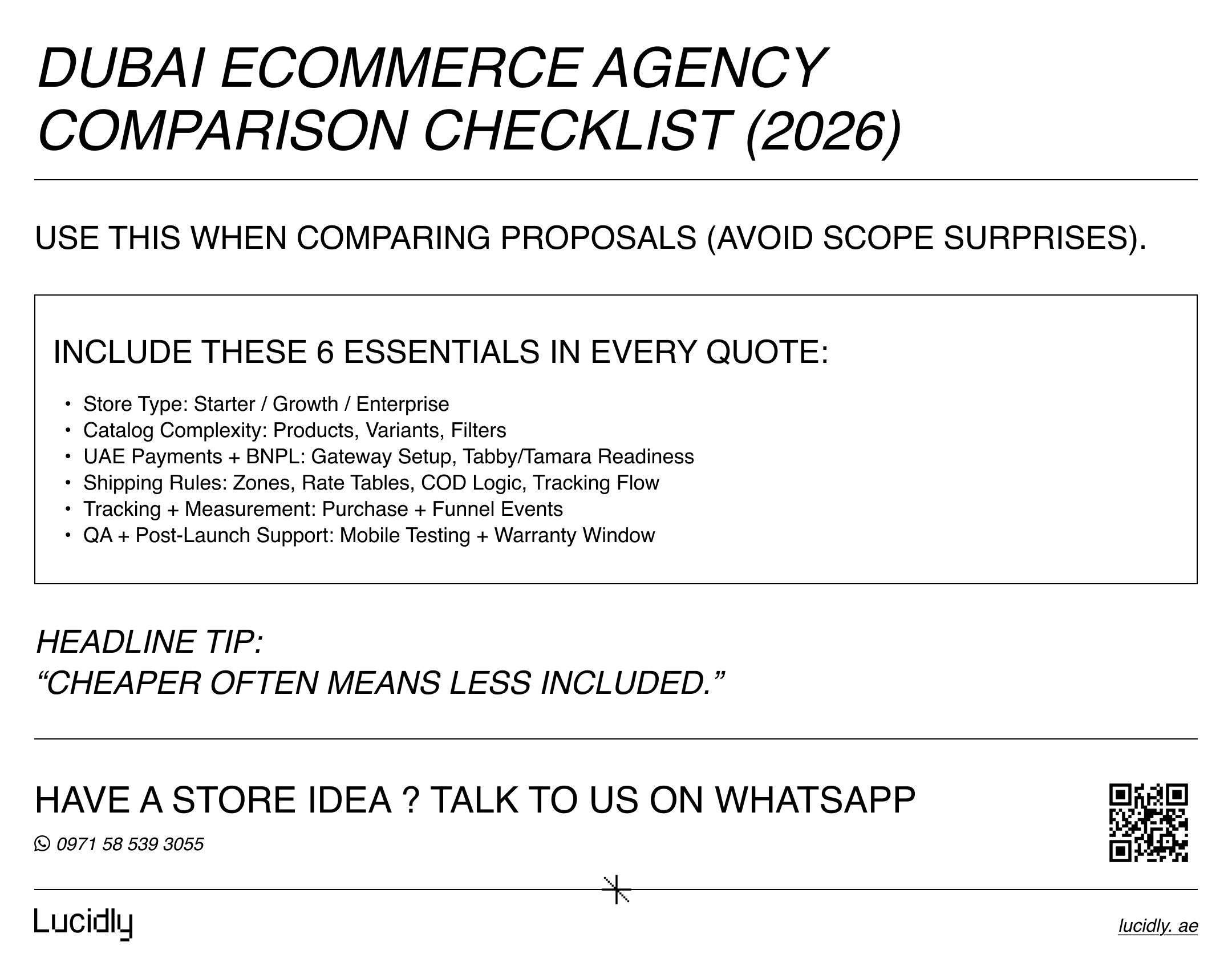
Minimum deliverables you should see in writing:
Store architecture: categories, navigation, filters, search basics.
Checkout UX: reduce friction, trust signals, clear payment placement.
UAE payments: gateway setup + BNPL readiness where relevant.
Shipping logic: address flow, rate rules, tracking workflow.
Tracking: purchase events + key funnel steps (add-to-cart → checkout → purchase).
Mobile QA: testing critical flows on real devices.
Post-launch plan: fixes, improvements, and support process.
If these aren’t included in the proposal, you’re likely buying a site that looks good—but doesn’t perform.
How to Compare Agencies Fairly in Dubai (SMEs vs Enterprise)
Dubai buyers often fall into two buckets: Dubai SMEs who need speed, clarity, and manageable operations—and enterprise teams who need deeper integrations, governance, and scalability.
The best approach is to compare top ecommerce developers dubai using the same criteria across both:
Platform fit: Shopify vs WooCommerce vs custom (and why).
Integration experience: gateways, BNPL, shipping, ERP/CRM, analytics.
Timelines + milestones: phase plan, review points, QA gates.
Support model: response times, maintenance scope, iteration cadence.
Ownership + handover: admin access, documentation, training, code ownership.
Performance standards: mobile speed expectations and testing process.
This is how you evaluate a ecommerce website development company dubai on outcomes, not promises—and it’s also how Google tends to reward content that solves the buyer’s problem clearly.
Realistic Ecommerce Timeline in Dubai (2026)
A realistic timeline depends on scope, integrations, and how ready your content/catalog is. When comparing top ecommerce website development companies in dubai, ask them to map your project into one of these ranges and justify it:
Starter store (3–6 weeks): up to ~50 products, standard checkout, basic shipping, minimal automation
Growth store (6–10 weeks): 200–500 products, filters, promotions, bundles, landing pages, tracking plan
Advanced / enterprise (10–16+ weeks): Arabic/English UX, ERP/CRM, custom checkout logic, performance work
Common timeline stretch points in Dubai:
Payment onboarding and gateway configuration.
BNPL readiness (eligibility + placement in checkout flow).
Shipping rule testing (zones, rate tables, COD logic).
Arabic/English UX QA and content readiness.
Integration testing + UAT with stakeholders.
A proposal that’s fast and detailed can be great. A proposal that’s fast and vague usually becomes expensive later.
For an idea of typical costs, check our guide: Ecommerce Website Price in Dubai (2026), which breaks down pricing for different store types and platforms.
Contract Checklist for Dubai Ecommerce Projects (Before You Commit)
In Dubai, the fastest way to avoid surprises is to treat the proposal like a contract, not a brochure.
Before you commit to any ecommerce website development company dubai, ask for a written “project pack” that makes delivery measurable and enforceable.
It should clearly define what you get, when you get it, and what happens if scope changes—especially around payments, BNPL, shipping rules, and bilingual UX.
Request a “deliverables list” tied to pages, features, and integrations (not vague promises).
Ask for a milestone-based plan (design sign-off → build → integrations → QA → launch), with review gates.
Confirm ownership and access (admin roles, hosting, domain, source files, and handover documentation).
Define change control (how additions are priced, approved, and scheduled).
Validate measurement readiness (tracking events + funnel steps included in scope).
Lock support expectations (warranty window, ongoing maintenance, response times, and escalation path).
Match experience to your store type by reviewing similar Dubai builds and operational complexity.
This approach helps you compare top ecommerce website development companies in dubai based on real delivery—not sales talk.
Tips Before Choosing an Ecommerce Development Company in Dubai
Before choosing from the top ecommerce website development companies in dubai, don’t start with names—start with clarity.
Use this checklist to avoid scope surprises and pick the right fit:
Define your store type: Starter / Growth / Enterprise (based on complexity, not just product count)
Lock the platform direction: Shopify vs WooCommerce vs custom (and why)
List must-have Dubai/UAE requirements: payments, BNPL, shipping rules, ERP/CRM, Arabic/English UX if needed
Ask for written deliverables: sitemap + key templates (home, category, PDP, cart, checkout)
Demand a milestone timeline: phases, review points, QA gates, and launch criteria
Confirm tracking scope: purchase events + key funnel steps (add-to-cart → checkout → purchase)
Test their work like a buyer: mobile speed, product browsing, checkout friction, trust signals
Clarify post-launch support: warranty window, maintenance options, response time expectations
Treat “not written” as not included: anything missing from scope usually becomes a paid add-on later
For a practical, conversion-focused ecommerce build in 2026, explore Lucidly’s E-Commerce Website Development services in Dubai
FAQs
Which are the top ecommerce development companies in Dubai?
A practical shortlist to start comparing includes Lucidly, Tomsher, Branex, Element8, and GCC Marketing—because they’re commonly positioned in Dubai for ecommerce delivery across different store types.
Use the comparison table and deliverables checklist to validate fit before choosing.
How do I compare agencies fairly?
Normalize scope first: store type, catalog complexity, integrations, bilingual UX, performance/QA, and support. Then compare deliverables and milestones—not just price. This prevents “cheap now, expensive later” proposals.
What’s a realistic ecommerce timeline in Dubai?
Most starter stores land around 3–6 weeks, growth stores around 6–10 weeks, and advanced/enterprise builds 10–16+ weeks—depending on integrations, Arabic/English UX, and testing requirements.
What deliverables should be included?
At minimum: store architecture, checkout UX, UAE payments + BNPL readiness, shipping logic, tracking setup, mobile QA, and a post-launch support plan—written clearly in the scope.
Choosing among the top ecommerce website development companies in dubai comes down to fit: platform expertise, integration experience, measurable deliverables, and realistic post-launch support.
If you want a store built for conversion and growth—not just design—prioritize teams that talk about scope clarity, tracking, performance, and iteration.
If you have an idea for an online store and want to build it the right way, message Lucidly on WhatsApp to review your scope and launch roadmap—or reach out via our Contact Us page.