Getting shipping right in the UAE is one of the fastest ways to increase conversion and repeat orders.
Customers here expect clarity: delivery times they can trust, tracking updates that actually update, and a returns experience that doesn’t feel like a fight.
If your checkout shows vague fees, inconsistent zones, or “we’ll call you” delivery promises, you’ll lose carts—even if your product is great.
This guide walks you through a practical ecommerce shipping uae setup: how to structure pricing, build shipping zones, configure checkout and tracking, choose fulfilment options, and launch a returns system that protects margins without damaging trust.
Message Lucidly on WhatsApp for a quick shipping & returns setup review.
What “Good Shipping” Means in the UAE
Shipping isn’t just logistics—it’s part of your brand. In the UAE, “good shipping” usually means:
Transparent pricing: customers see fees early, not at the final step.
Realistic delivery times: aligned with your carrier performance and city coverage.
Reliable tracking: proactive tracking emails (and often WhatsApp updates).
Low-friction returns: clear policy + simple pickup/drop-off options.
UAE customer expectations (and why they matter)
Many shoppers decide whether they trust your store at the moment they see delivery details. If the experience is unclear, they assume service will be unclear too. The best stores treat delivery communication as part of UX: simple, predictable, and consistent.
If you're building your store from the ground up, our Ecommerce Website Development in the UAE guide covers the full foundation for creating an online store that converts.
Ecommerce Shipping UAE Rates: How to Price Without Killing Margin
Your pricing model should match your margins, average order value (AOV), and product characteristics (weight, fragility, value). When people search for shipping rates uae, they’re usually trying to answer: “What should I charge—and will customers accept it?”
Four pricing models that work well
1) Flat rate
Simple and predictable. Best for stores with similar order sizes and consistent costs.
2) Zone-based pricing
Different rates by city/area. Great when your delivery cost changes meaningfully by location (common in the UAE).
3) Weight-based or item-based pricing
Useful for heavy products, bulky packaging, or mixed-category carts. Pair with shipping calculators to reduce surprises.
4) Hybrid pricing (recommended for most stores)
Example: flat rate within Dubai + zone-based outside Dubai + free shipping above a certain threshold.
Should I offer free shipping?
Free shipping can lift conversion—but only when it’s engineered, not emotional.
Offer free shipping when:
Your AOV can absorb it (or you can set a threshold to raise AOV)
Your return rate is under control
Your margins can handle “delivery as marketing”
Avoid blanket free shipping when:
Your products are heavy/bulky
Your orders are low value
You’re still learning your true delivery and failed-delivery costs
A practical approach: offer free shipping above a threshold that protects margin and nudges larger baskets. This keeps your ecommerce shipping uae strategy profitable while still competitive.
For a detailed guide on must-have ecommerce pages, features, and integrations, check out our Ecommerce Website Features Checklist.
Shipping Zones: UAE Zones That Actually Make Sense
Shipping zones aren’t a technical detail—they’re your pricing logic made visible. A zone plan that customers understand will reduce checkout drop-offs and “why is shipping so expensive?” messages.
Use shipping zones that reflect how carriers price and how customers think geographically.
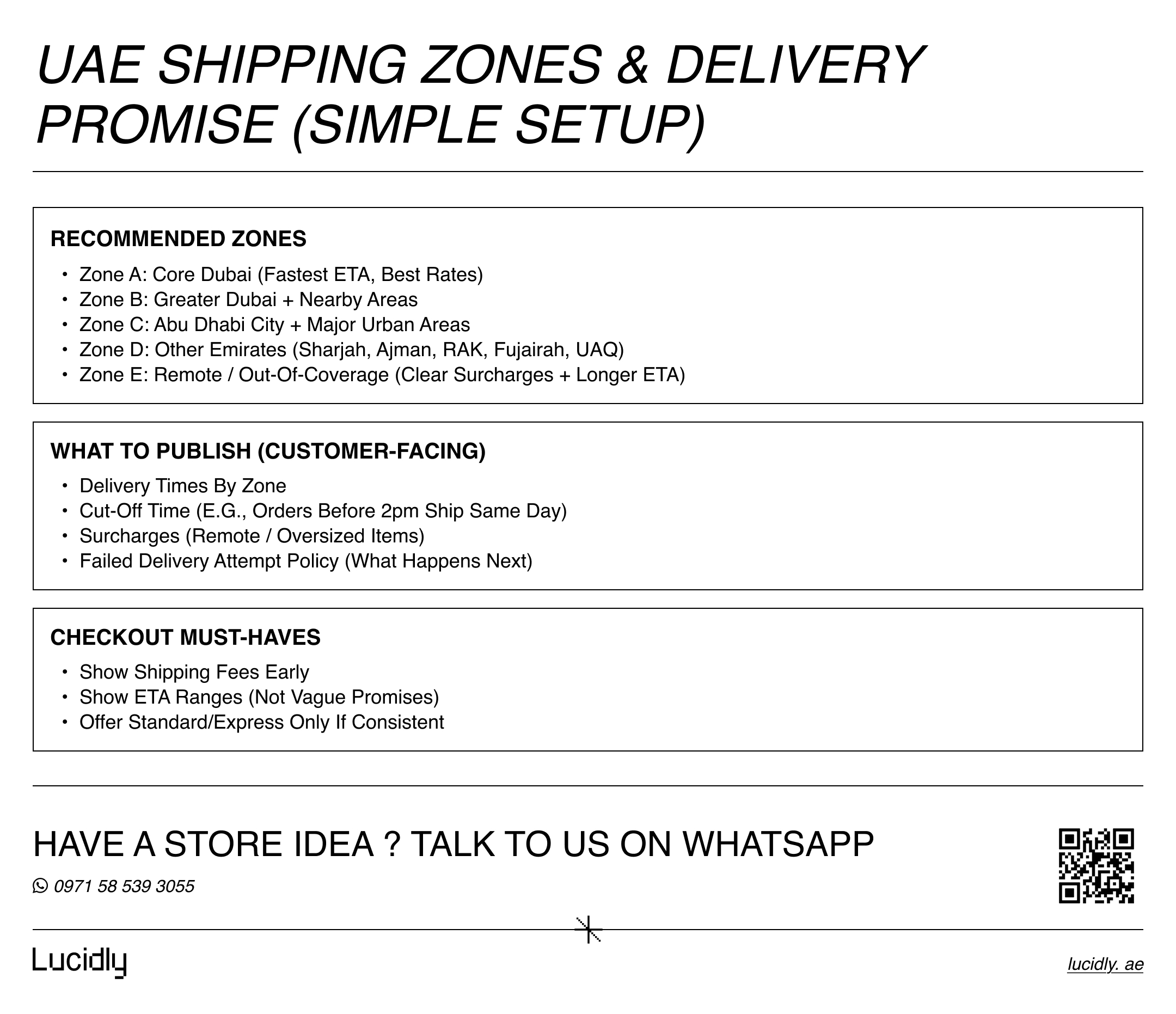
A practical zone structure (that fits most UAE stores)
Zone A: Core Dubai
Fast delivery expectations, often best rates, high density.
Zone B: Greater Dubai + nearby areas
More variability in delivery times.
Zone C: Abu Dhabi (city) + major urban areas
Often predictable, but pricing differs from Dubai.
Zone D: Other Emirates (Sharjah, Ajman, RAK, Fujairah, UAQ)
May require different cost logic and delivery promises.
Zone E: Remote/out-of-coverage areas
If you serve them, be transparent about surcharges and delivery windows.
Publish the rules customers care about
On your shipping page and checkout, clarify:
Delivery times by zone
Cut-off time (e.g., “Orders before 2pm ship same day”)
Surcharges (remote areas, oversized items)
What happens after a failed delivery attempt
This is where your second mention of ecommerce shipping uae fits naturally—because zone clarity is a UAE-specific conversion lever.
Ecommerce Delivery Setup: Checkout, Cart, and Delivery Promise
If your checkout is where trust collapses, fix this before you negotiate better courier rates. A strong ecommerce delivery setup is built around three principles: show fees early, show delivery times clearly, and reduce complexity.
What to show in the cart and checkout
Shipping cost estimate (or “calculated at checkout” only if it’s truly accurate)
Delivery times by zone (simple ranges, not vague statements)
Delivery options (Standard / Express) only if you can meet them consistently
Clear address fields and phone formatting (reduce failed deliveries)
Shipping calculators: helpful or harmful?
Shipping calculators work best when:
Your product weights/dimensions are accurate
Your shipping rules are stable
Your store has mixed items that affect cost meaningfully
They hurt when:
Your data isn’t clean
The customer sees frequent “surprises”
The result changes after payment
Used properly, shipping calculators reduce support tickets and abandoned checkout—especially in online store shipping uae scenarios where customers compare multiple stores quickly.
If you’re seeing drop-offs at the cart or checkout stage, read our Checkout Optimisation guide to reduce abandonment and improve conversions.
Tracking That Builds Trust (Not Just a Tracking Number)
Tracking is not “a link.” It’s a communication system that reduces anxiety and decreases “Where is my order?” messages.
Carrier integration (why it matters)
With solid carrier integration, your store can:
Auto-push orders to the carrier
Auto-update tracking statuses
Trigger tracking emails and delivery notifications
Reduce manual errors and delays
Even if you’re small, basic integration often pays for itself in reduced support load.
Tracking emails that customers actually read
Your tracking emails should answer:
What’s the status right now?
When should I expect delivery?
What should I do if I miss delivery?
Recommended flow:
Order confirmed (includes expected dispatch time)
Shipped (tracking link + delivery time estimate)
Out for delivery (same-day expectation window if possible)
Delivered (confirmation + returns info)
This is a natural place to add your third ecommerce shipping uae mention: UAE buyers often judge store quality by how “professional” tracking feels.
Fulfilment Options in the UAE: Choose the Right Model
The “best” fulfilment model depends on order volume, product type, and how fast you need to scale.
Option 1: Self-fulfilment (in-house)
Best when:
You have manageable order volumes
You need full control over packaging and branding
You can dispatch consistently
Watch out for:
Staffing bottlenecks
Missed cut-offs
Manual errors as you scale
Option 2: 3PL / fulfilment partner
Best when:
You’re growing fast
You need consistent SLA-driven dispatch
You want predictable operations
Watch out for:
Storage + pick/pack fees
Minimums
Less flexibility for special packaging
Option 3: Hybrid fulfilment
Best when:
You have a “fast movers” set that benefits from a 3PL
You have special items you want to handle in-house
This is where the phrase ecommerce fulfilment uae fits naturally, and where you can mention fulfilment options again without repeating unnecessarily.
Returns Setup: Policy, Labels, and Workflow
Returns are not optional in ecommerce—they’re part of the purchase decision. A good returns system protects margins by preventing abuse while making genuine customers feel safe.
Start with a clear returns policy ecommerce page that’s written in plain language and visible before purchase.
How do I handle returns?
Use a process customers can understand in 30 seconds:
Customer requests return (portal, form, or WhatsApp)
You confirm eligibility (time window + product condition)
Return method chosen (pickup vs drop-off)
Item received + inspected
Refund/exchange processed within a stated timeline
Return labels and reverse logistics
If you use return labels, decide:
Who pays for return shipping (customer vs store vs conditional)
Whether you offer free returns only above an order threshold
How you handle damaged items and missing packaging
A common UAE-friendly approach:
Free returns for damaged/wrong items
Paid returns for change-of-mind (unless you’re premium and using it as a growth lever)
This is a great place for your fourth ecommerce shipping uae use, because returns expectations in the UAE are strongly tied to perceived store legitimacy.
.jpg)
Recommended Setup by Store Stage
Every UAE store reaches a point where shipping rules that worked yesterday stop working today.
The smartest approach is to match your shipping and fulfilment setup to your current order volume, then upgrade only what will reduce friction and protect margin.
New store (0–30 orders/day)
At this stage, speed and simplicity win. Your goal is to launch a clear shipping experience customers understand instantly—without overbuilding systems you won’t fully use yet.
Simple zones (Dubai / Abu Dhabi / Other Emirates)
Flat or hybrid pricing
Basic tracking emails
Clear, strict-but-fair returns policy ecommerce page
Growing store (30–200 orders/day)
Once orders increase, the biggest risk becomes inconsistency: missed cut-offs, manual errors, and unclear delivery promises.
Here, tighten your shipping zones and introduce automation where it prevents operational drag.
More granular shipping zones
Carrier integration to reduce manual work
Better delivery times logic by zone
A lightweight returns workflow (form + tracking + inspection)
Established store (200+/day)
At scale, reliability is the competitive edge. You need systems that handle exceptions smoothly, keep tracking communication consistent, and optimize shipping costs using data—not guesswork.
Consider 3PL for consistency
Automation for tracking emails, exceptions, and returns
Data-driven shipping rates UAE optimization (margin + conversion)
To reinforce the local context naturally, you can mention online store shipping uae once here—only if it fits your paragraph flow (for example, in the first sentence of the “Growing store” section).
For a performance-first shipping and fulfilment setup, explore Lucidly’s Ecommerce Solutions in the UAE to plan shipping zones, integrate carriers, automate tracking, and build a returns process that protects margin.
Common UAE Shipping Mistakes to Avoid
Showing delivery fees only at the final checkout step
Promising delivery times you can’t consistently hit
No clear remote-area policy
Tracking link with no real updates
Overly vague returns rules (“subject to approval” without criteria)
This section supports your fifth ecommerce shipping uae mention naturally: most of these mistakes are exactly what UAE shoppers punish with abandonment.
FAQ
How do I set up shipping for an online store in the UAE?
Set up shipping by defining shipping zones first (Dubai, Abu Dhabi, other Emirates, remote areas), then choose a pricing model (flat, zone-based, or hybrid). Show shipping costs early in checkout, publish realistic delivery times per zone, and enable carrier integration to automate labels and tracking updates. Add tracking emails so customers always know where their order is.
Should I offer free shipping?
Offer free shipping only if your margins can support it. The safest option is free shipping above a threshold that protects profitability and raises AOV. Many UAE stores use a hybrid approach: low-cost shipping below the threshold, free above it, and zone-based surcharges only when costs genuinely increase.
How do I handle returns?
Create a clear returns policy ecommerce page with the return window, condition rules, fees (if any), and refund timeline. Use a simple flow: request → eligibility check → pickup/drop-off → inspection → refund or exchange. If you use return labels, be explicit about who pays and how change-of-mind returns are handled.
What’s the best fulfilment approach?
The best fulfilment approach depends on volume and complexity. In-house fulfilment works for low-to-mid volume and full control. A 3PL is best when you need consistent dispatch and SLA at scale. Hybrid fulfilment is ideal when fast movers can be outsourced while special items stay in-house—keeping costs controlled and delivery performance predictable for ecommerce shipping uae.
Shipping is a key trust factor in UAE ecommerce. When your rates are clear, shipping zones are logical, tracking emails are reliable, and your returns policy is simple, customers buy with confidence and come back again.
To improve your ecommerce shipping uae setup, focus on the basics: set zones, price sustainably, publish realistic delivery times, use carrier integration, and keep returns easy to follow. Done right, shipping becomes a conversion advantage—not just a cost.
Ready to upgrade your ecommerce shipping UAE setup and reduce checkout drop-offs? Message Lucidly on WhatsApp—or use the numbers on our Contact Us page to book a quick shipping & returns review.
References
UAE Government – Consumer Protection (official guidance) (U.AE)
Shopify Help Center – Setting up Shipping Zones / Shipping Rates (Shopify Help Center)
Aramex (UAE) – Developer Solution Center / Aramex APIs (shipping + tracking integration) (aramex.com)