If your store has hundreds (or thousands) of URLs, ecommerce SEO UAE is rarely “just keywords.” It’s usually a technical and structural problem: near-duplicate pages created by filters, multiple product URLs competing with each other, and missing structured data that limits visibility.
This guide is a practical playbook for seo for online stores in the UAE—covering ecommerce site structure, faceted navigation, canonical tags, internal linking, and schema markup—so your catalogue scales without losing search performance.
One rule matters most: win by controlling what Google crawls and indexes, not by publishing more pages.
Message Lucidly on WhatsApp for a quick ecommerce SEO UAE audit of filters, canonicals, and schema.
Why Ecommerce SEO is Different for UAE Online Stores
Ecommerce SEO is different because ecommerce sites generate “unlimited” URLs. Every category, sort order, filter combination, and product variant can become a new page.
Without control, that creates duplicate content, wastes crawl budget, and dilutes category authority.
In the UAE, the context adds pressure: bilingual journeys (Arabic/English), mobile-first browsing, and trust requirements before checkout.
That’s why ecommerce search optimisation here is a system—structure, indexation, and templates—more than a content-only exercise.
Now we’ll build the foundation first: an ecommerce site structure that prevents duplication and makes category pages stronger.
If you're still shaping the foundation of your store, our Ecommerce Website Development in the UAE guide covers how to build an online store that sells from day one.
Ecommerce SEO UAE Site Structure That Scales (Architecture Blueprint)
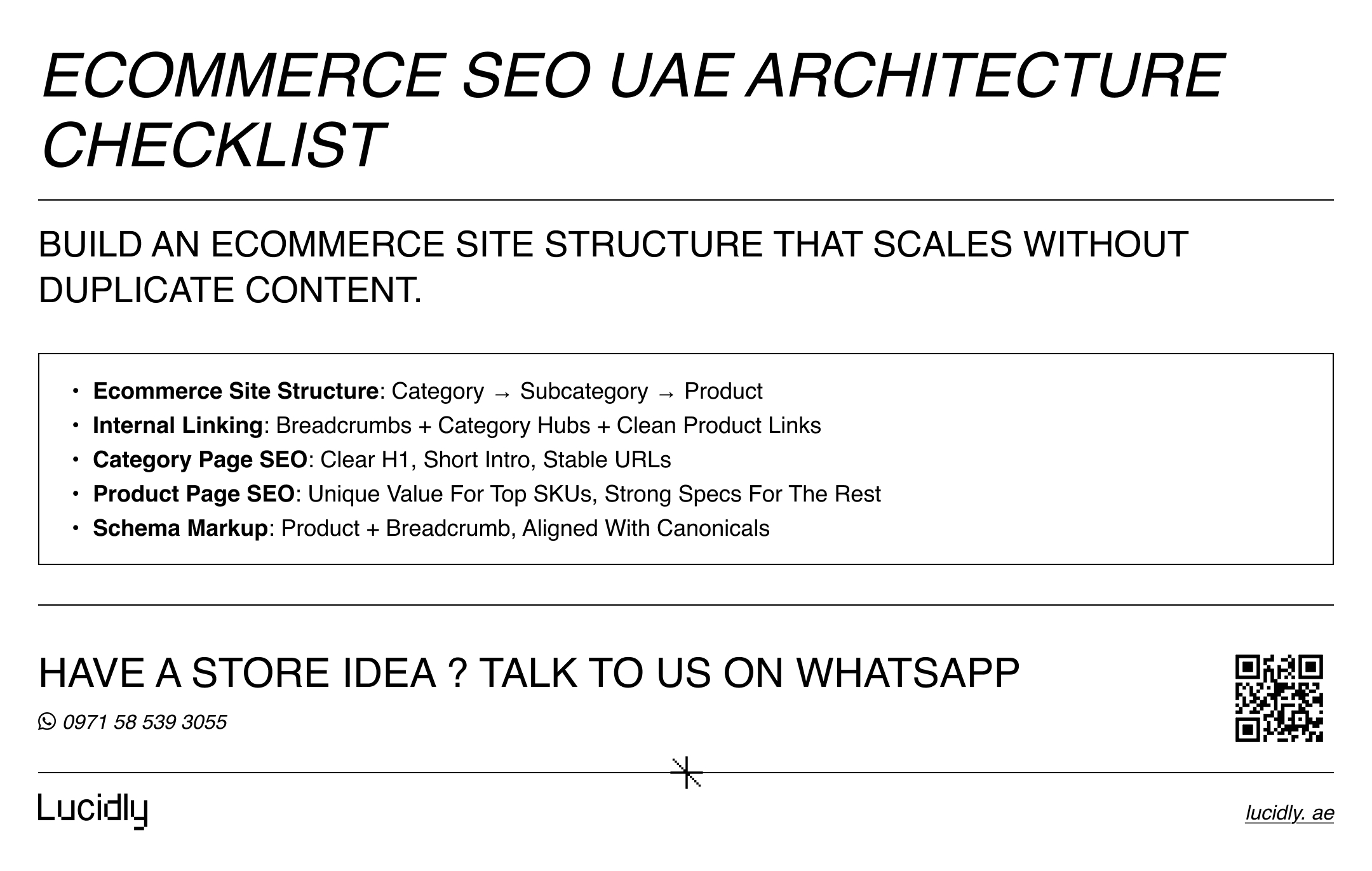
A strong ecommerce site structure behaves like a pyramid: broad categories at the top, more specific subcategories underneath, and product pages at the bottom. This helps users browse quickly and helps search engines understand priority pages.
Below are the structural decisions that keep ecommerce SEO UAE clean and scalable.
Map Intent Into a Category Pyramid
Before you touch filters or canonicals, map how customers search. You don’t need endless categories—you need the right ones that represent real demand.
Use this approach:
Define Core Categories (highest-demand “department” pages).
Define Subcategories (narrower intent: product type + use case).
Add Brand/Collection Hubs only when brand searches are meaningful.
Decide which pages are SEO landing pages (indexable) vs utility pages (not meant to rank).
This is where many stores fail: they let navigation become the SEO strategy. Better store seo treats taxonomy as search strategy, and menus as UX.
URL Rules That Prevent Duplicate Content
Clean URL rules reduce duplication and make canonical tags easier later. Your URLs should be consistent across the catalogue.
Follow these rules:
Keep category URLs stable and readable (avoid random IDs).
Avoid multiple paths to the same product.
Choose one “primary” product URL and use it everywhere (menus, internal links, sitemaps).
Avoid indexing sort URLs by default (e.g., ?sort=price_asc).
This prevents a common issue: the same product indexed in multiple URL formats and competing with itself.
Internal Linking That Supports Rankings
Internal linking is the architecture “glue.” Even good categories fail if internal links don’t reinforce them.
Start with:
Breadcrumbs (category → subcategory → product) on all relevant pages.
Category pages linking to priority subcategories.
“Related categories” links only when intent overlaps.
Product pages linking back to the most relevant category hub.
This improves category authority and clarifies what should rank for what.
Next, we’ll optimize the pages that usually drive the most organic revenue: category pages.
Category Page SEO (What Makes Category Pages Rank in the UAE)
Category pages are your “money pages.” They target broad, high-intent searches and can scale traffic faster than blog content.
In ecommerce SEO UAE, category wins come from clarity: clear intent, clean indexation, and a page experience that helps shoppers decide quickly.
Category Page SEO Essentials
A category page should be more than a product grid. It needs structure, relevance, and trust.
Focus on:
Clear H1 + short intro aligned with intent.
Stable URL that doesn’t change with sorts/session parameters.
Filters designed for UX without creating index bloat.
Merchandising signals (best-sellers, featured, price bands) where useful.
Trust blocks (delivery/returns/payments) placed without overwhelming the page.
That’s category page seo designed to rank and convert.
Content Blocks That Don’t Harm UX
Teams avoid category copy because they fear “SEO text walls.” The fix is compact structure, not silence.
Use:
2–4 short paragraphs (above or below grid based on UX).
A “How to choose” mini section in bullets.
A short FAQ block (2–4 questions).
Internal links to key subcategories or brand hubs.
This content clarifies intent and reduces bounce without keyword stuffing.
Next, we’ll go down one level to product pages—where duplication and thin content often hurt performance.
Product Page SEO (Variants, Descriptions, and Indexing Rules)
Product pages capture long-tail demand, but they often fail due to copy-paste descriptions and uncontrolled variants.
A strong product page seo system for ecommerce SEO UAE balances scale and uniqueness: you decide where uniqueness matters, and where structured attributes are enough.
Do Product Pages Need Unique Descriptions?
Not every product needs a long description, but key products should be unique.
Prioritise unique descriptions for:
Best-sellers
High-margin items
Products with high search demand
Highly competitive products
For the rest, build “unique value” using structured content:
Detailed specifications
Sizing/material info
Use-case guidance
FAQs
Delivery/returns clarity
This improves quality without making content production impossible.
Variant Handling Without Creating Duplicate Content
Variants (size/color) are a top cause of duplicate content. If every variant becomes indexable, you create hundreds of pages competing for the same query.
Use this rule:
Minor variants without distinct demand → keep one indexable parent page; handle variants on-page.
Variants with distinct demand + distinct content → consider separate indexable pages with self-canonicals.
Now we’ll address the biggest technical culprit in ecommerce: filters.
If your store handles multiple SKUs, variants, and product attributes, our guide to Product Data and Catalogue Management explains how to structure catalogue data without creating SEO and operational issues.
Faceted Navigation (Filters) — The SEO Control Room
Filters improve UX, but uncontrolled faceted navigation is the fastest way to destroy ecommerce SEO. It can generate millions of crawlable URLs with little value.
For ecommerce SEO UAE, the winning strategy is curated indexation: filters are for users, but only a small subset becomes indexable pages.
Faceted Navigation: What to Index vs What to Block
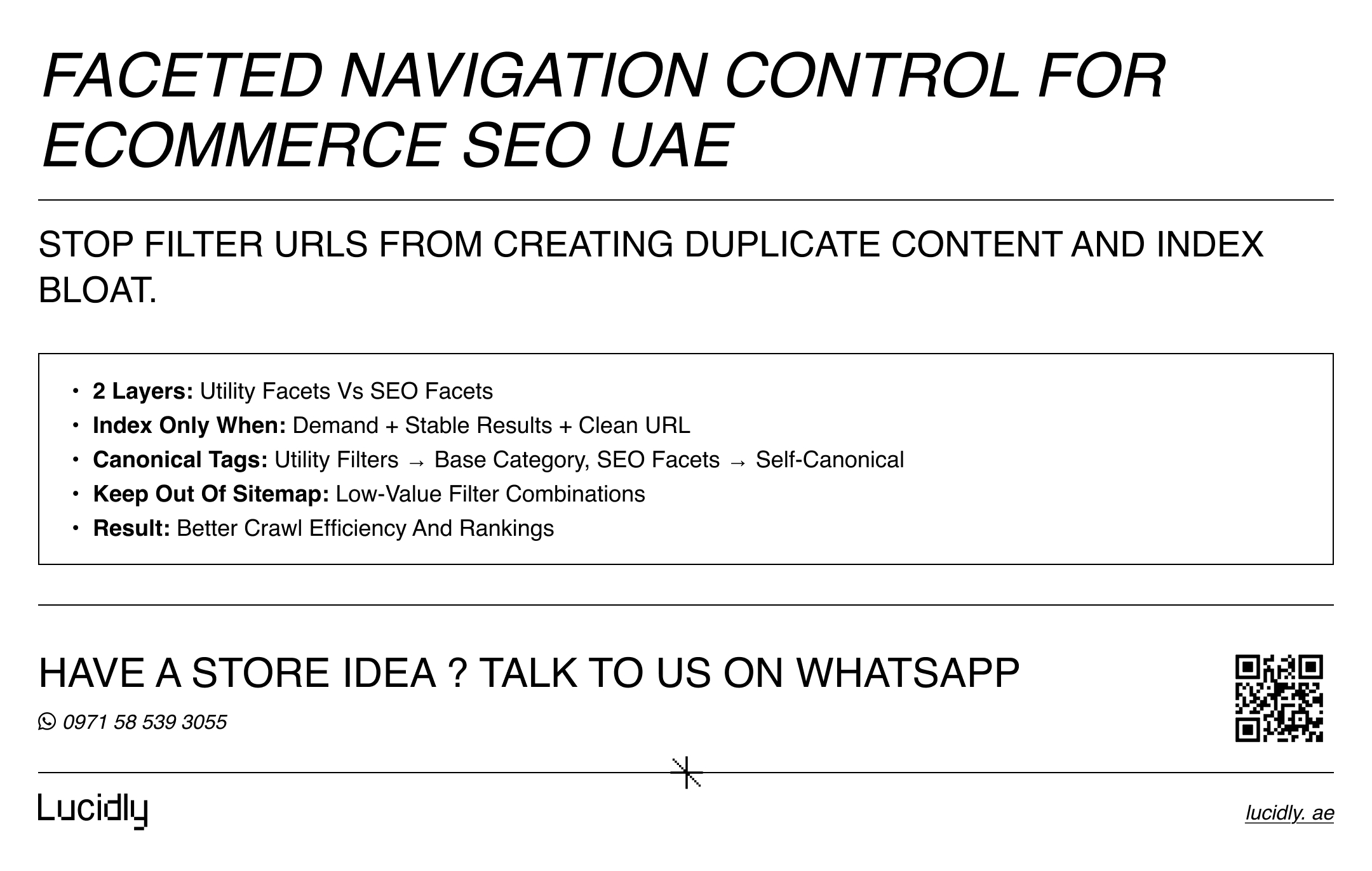
Think of filters as two layers:
Utility facets: help users refine; not meant to rank
SEO facets: curated combinations with real demand and stable intent
Index a filter page only when:
It targets meaningful search demand.
Results are stable (not empty or constantly changing).
The page can justify its intent (copy + merchandising).
The URL can be clean and consistent (preferably a static path).
Crawl & Indexation Rules for Filters
To control filters, you need consistent rules across the site.
Apply this system:
Keep utility filter combinations out of XML sitemaps.
Use canonical tags to point utility facet URLs back to the base category when appropriate.
Use noindex when a page must exist for users but shouldn’t appear in search results.
Avoid allowing infinite parameter combinations to be crawlable.
Ensure internal linking prioritises core categories and curated facet pages—not random filter states.
Next, we’ll lock duplication control with canonical tags.
Canonical Tags Strategy (Rules by Page Type)
Canonical tags tell search engines which URL is the “preferred” version when duplicates exist. In ecommerce, canonicals are not optional—they are your duplication safety system. In ecommerce SEO UAE, canonicals must be consistent, predictable, and aligned with site structure.
Canonical Tags for Categories, Filters, and Pagination
Start with the baseline:
Every indexable page should have a self-referencing canonical.
Sorting URLs usually canonical back to the base category.
Utility filter URLs usually canonical back to the base category.
Curated SEO facet pages should have clean URLs, unique intent, and self-canonicals—and only then deserve sitemap inclusion.
For pagination, keep it consistent: paginated pages are typically self-canonical unless you intentionally support a true “view all” page.
Canonical Tags for Products Across Multiple Categories
If the same product is accessible through multiple paths, set a firm rule:
Pick one preferred product URL.
Canonical every duplicate version to the preferred URL.
Make internal links always point to the preferred URL (menus, category grids, related products).
Now we’ll add the visibility layer many stores miss: schema markup.
Schema Markup That Helps Ecommerce (and What to Avoid)
Schema markup helps search engines understand your pages and can unlock rich results. For ecommerce, the priorities are Product schema, breadcrumbs, and clean organization signals. But schema must be governed carefully to avoid mismatches.
Product + Breadcrumb + Organization Schema Markup
Use these core types:
Product schema (JSON-LD): name, brand, SKU, offers (price, currency, availability), identifiers
Breadcrumb schema: reinforces hierarchy and supports the ecommerce site structure
Organization/Website schema: confirms brand identity and site-level signals
This structured layer supports ecommerce search optimisation at scale.
Schema Governance (So You Don’t Create SEO Issues)
Keep schema accurate and aligned:
Schema must match visible content (price, availability, reviews).
Schema should represent the canonical URL (avoid marking a non-canonical variant).
Validate changes before rollout.
Monitor rich result errors in Search Console.
Next, we’ll convert this into an action plan with a practical ecommerce SEO checklist.
Ecommerce SEO Checklist (UAE Store Launch + Fix Plan)
If you want to improve ecommerce SEO UAE fast, you need a prioritised approach. Don’t start by writing more pages—start by fixing indexation leaks and strengthening revenue templates.
Quick Audit Checklist (Core Items)
Below is a practical ecommerce seo checklist you can run in hours:
Confirm a clean ecommerce site structure (category → subcategory → product).
Ensure breadcrumbs and internal linking support priority categories.
Make category pages indexable, stable, and aligned with intent (category page seo).
Prevent index bloat from sorts and low-value filter URLs.
Apply a variant strategy that avoids duplicate content (product page seo).
Implement consistent canonical tags across templates.
Only index curated facet pages with demand (faceted navigation control).
Add and validate schema markup (Product + Breadcrumb + Organization).
What Pages Should I Optimise First?
Prioritise in this order:
Top revenue categories (category page seo impact is biggest)
Best-selling products (product page seo improves conversions)
Curated high-intent facet landing pages
Supporting hubs (brands/collections) only if demand justifies
Now let’s answer the key questions teams ask when implementing seo for online stores.
For a performance-first ecommerce SEO UAE setup, explore Lucidly’s Ecommerce Solutions in the UAE to fix site structure, control filters, and implement clean canonicals and schema.
For stores moving to a new platform, our Ecommerce Migration in the UAE guide explains how to preserve SEO value and avoid traffic or sales loss during migration.
FAQs
How is ecommerce SEO different?
Ecommerce SEO is different because it’s an indexation and scale problem. You must control duplication from filters, variants, and sorting, strengthen category authority with internal linking, and implement schema markup properly.
How do I avoid duplicate content with filters?
Treat faceted navigation as UX-first but SEO-curated. Keep most filter combinations non-indexable, use canonical tags back to base categories, and only index curated facet pages with demand and stable results.
Do product pages need unique descriptions?
Key products should have unique descriptions and unique value. For long-tail SKUs, you can win with structured attributes, clear specs, FAQs, and strong on-page clarity—without writing essays.
What pages should I optimise first?
Start with revenue-driving category pages, then best-selling products, then curated facet pages, then optional hubs. This order improves rankings and conversions fastest in ecommerce SEO UAE.
When architecture is clean, filters are controlled, canonicals are consistent, and schema is accurate, ecommerce seo uae becomes a dependable growth channel—bringing qualified traffic and sales without duplicate-content drag.
Ready to improve ecommerce seo uae and stop duplicate-content leaks from filters? Message Lucidly on WhatsApp—or use the numbers on our Contact Us page to book a quick SEO structure review.
References
WebAgency.ae — Faceted Navigation SEO: Best Practices & Guide (Hype Web Agency)
GTECH — Canonical Tags & E-Commerce SEO Guide (GTECH Information Technology)
Google Search Central — Consolidate duplicate URLs Canonicalization rel canonical (Google for Developers)