If you’re serious about growth in 2026, ecommerce conversion rate optimisation isn’t a “nice-to-have”—it’s the fastest, most controllable path to higher revenue without buying more traffic. The goal isn’t to chase random “best practices.”
It’s to run focused experiments that remove friction, increase trust, and improve the value of each visit.
This guide gives you a clean, practical testing plan: what to test first, what typically moves revenue, and how to run A/B testing ecommerce the right way—without false wins or messy conclusions.
Want clean CRO tracking in GA4? Message Lucidly on WhatsApp for a quick audit.
What Is CRO in Ecommerce?
Before the tactics, anchor the definition.
CRO in ecommerce is the process of improving how many visitors buy (and how much they buy) by testing changes across your store experience—product pages, category pages, cart, checkout, and landing pages.
In practice, ecommerce conversion rate optimisation is about three outcomes:
More completed purchases (higher conversion rate).
Higher order value (AOV and bundles).
Higher profit per visitor (not just “more clicks”).
That’s why modern conversion optimisation ecommerce focuses on revenue per visitor (and ideally profit per visitor), not vanity metrics.
The Revenue-First CRO Framework (So You Don’t Test Randomly)
A good test backlog is not a list of ideas. It’s a prioritized plan tied to how money is made.
Here’s a simple framework to keep ecommerce experimentation practical and revenue-driven:
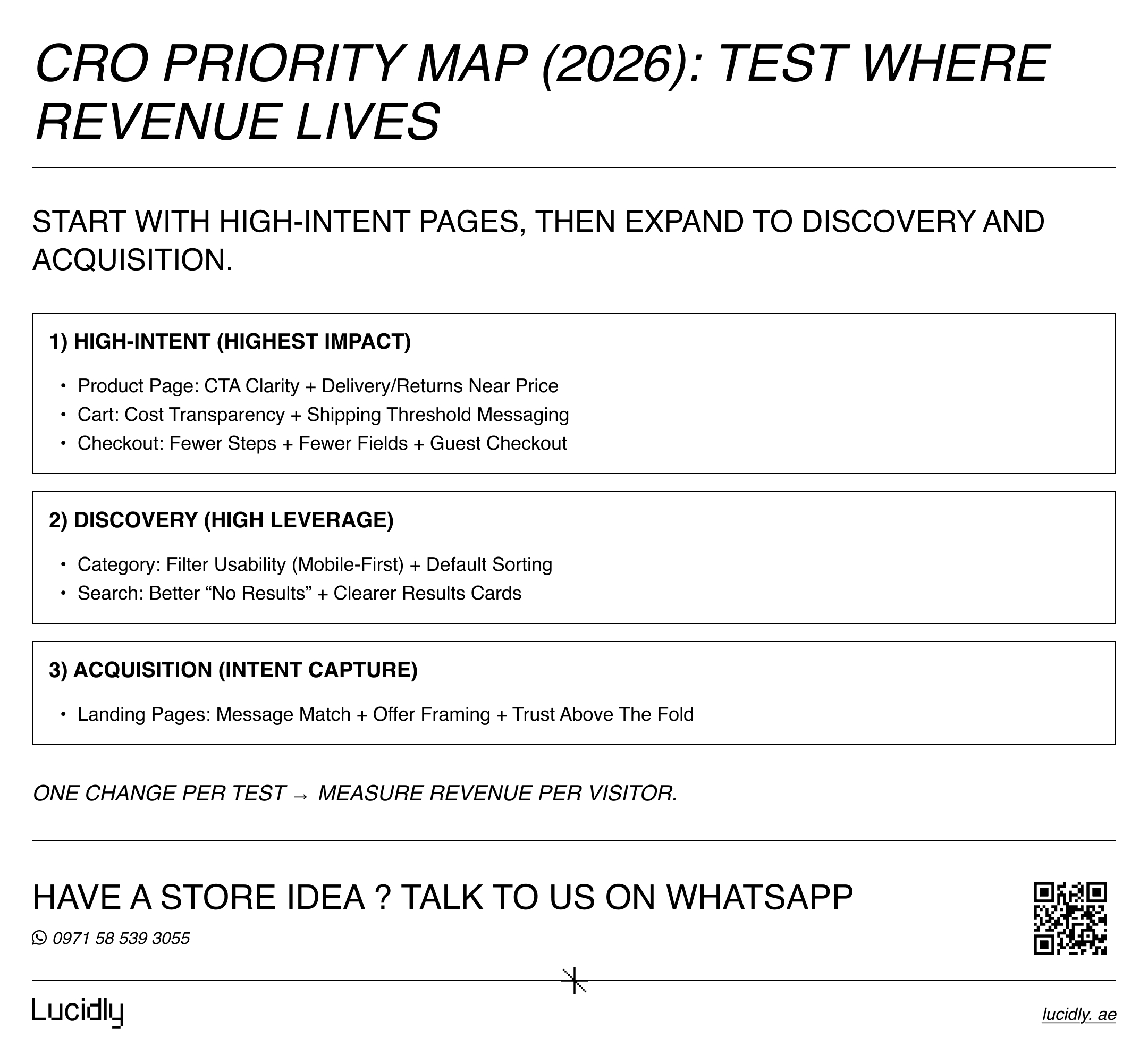
1) High-intent pages first
These pages are closest to a purchase decision, so the impact is usually higher:
Product pages.
Cart.
Checkout.
Before starting any CRO tests, make sure your store is set up for conversions. Check out Ecommerce Website Development in the UAE for a complete guide.
2) Discovery pages next
These affect what shoppers find and whether they reach product pages with intent:
Category pages.
Site search results.
Collection navigation.
3) Acquisition landing pages where it matters
If you’re running ads or SEO-driven campaigns, your landing pages can either waste intent—or convert it efficiently.
This prioritization helps you run ecommerce conversion rate optimisation like a system, not a guessing game.
What Should I Test First?
Most stores don’t need “more ideas.” They need a decision rule.
To choose what to test first, use a simple scoring approach: Impact × Confidence ÷ Effort.
Step 1: Start with a clear diagnosis
Before you build tests, you need evidence of friction. The fastest way is to combine funnel data with behavioral tools:
Heatmaps to see where attention clusters (or doesn’t).
Session recordings to watch real friction: rage taps, dead clicks, scroll drop-offs.
Funnel analysis to confirm where users abandon (PDP → cart, cart → checkout, checkout → payment).
Now you can stop guessing and start targeting.
For accurate performance tracking and customer insights, see Ecommerce Analytics: GA4 Revenue Tracking.
Step 2: Pick one primary metric per test
If your target is to improve ecommerce conversion rate, choose one of these primary outcomes (based on the page type):
Product page: add-to-cart rate, revenue per visitor.
Cart: checkout start rate, revenue per visitor.
Checkout: completion rate, revenue per visitor.
Category/search: product clicks, add-to-cart rate, revenue per visitor.
This is the backbone of clean ecommerce cro.
Product Page Tests That Usually Increase Revenue
Product pages are where intent turns into action. Small changes here can outperform “site-wide redesigns,” especially when you keep tests focused.
CTA tests that reduce hesitation
Your main CTA is the most important button on the page—treat it like a revenue lever.
Before you test, align on what you want the CTA to communicate: speed, certainty, or flexibility.
High-impact CTA tests:
Button copy: “Add to cart” vs “Buy now” (depends on product type and decision time).
CTA placement on mobile: keep it visible when scrolling (sticky CTA).
Supporting text near CTA: delivery ETA + returns summary (risk reversal).
Why it works: Shoppers don’t just want a button—they want confidence. This is ecommerce conversion rate optimisation in its simplest form: reduce uncertainty at the moment of choice.
Offer testing that increases AOV without discounting your brand
Not all offers are discounts. The best offers reduce decision fatigue and make the purchase feel “smart.”
Offer testing ideas:
Bundle framing: “Complete the set” vs “Frequently bought together”.
Threshold offers: “Free shipping over X” vs “Free gift over X”.
Quantity breaks (where appropriate): “Buy 2 save 10%” vs “Buy 3 save 15%”.
Keep the test clean: one offer mechanic at a time, measured on revenue per visitor.
Trust and proof tests that lift conversion
In 2026, trust signals still win—especially on mobile and for first-time buyers.
Trust tests worth running:
Reviews placement and formatting (summary near top; full reviews lower).
Returns and delivery clarity near price/CTA.
Payment method icons at decision points (not just footer).
These changes often improve ecommerce conversion rate because they remove fear, not because they “look nicer.”
Category Page and Navigation Tests That Improve Product Discovery
If shoppers can’t find what they want quickly, your product pages won’t get a chance to convert.
Category pages are an underrated engine of ecommerce optimisation, especially for large catalogs.
Filtering tests that reduce browsing friction
Filters are not features—they’re decision tools.
High-impact filter experiments:
Default filter order based on usage (size/fit/price first on mobile).
“Apply filters” button vs instant filtering (reduces accidental results changes).
Showing the number of results per filter option (helps decision confidence).
This type of conversion optimisation ecommerce increases qualified product views, not just clicks.
Sort order experiments that change outcomes
Default sorting is a “silent recommendation.” Test it.
Common sort tests:
Bestsellers vs “Recommended” (algorithmic) vs newest.
Price low-to-high (works for commodity markets; can hurt premium brands).
Measure downstream impact: add-to-cart rate and revenue per visitor—not just category clicks.
Site search tests that recover lost sessions
Search visitors often have the highest intent. Treat search like a sales channel.
High-impact search tests:
Better “no results” pages (suggestions, synonyms, popular categories).
Showing key filters immediately on search results.
Highlighting delivery/availability in results cards where relevant.
This is practical CRO for online stores: fewer dead-ends, more forward motion.
Cart and Checkout Tests That Remove Revenue Leakage
Checkout is where revenue disappears quietly. Your job is not to “make it pretty”—it’s to reduce abandonment.
Checkout structure tests (the biggest wins are often boring)
If your checkout experience creates friction, even perfect product pages can’t save conversion.
High-impact checkout tests:
Guest checkout as default (account creation optional after purchase).
Fewer form fields (remove anything not required for delivery/payment).
Autofill support and better field validation.
Clear cost breakdown early (shipping, taxes, fees).
These are classic ecommerce cro improvements because they remove pain, not because they add persuasion.
Cart page tests that increase completion and AOV
Cart pages can either be a trap—or a helpful checkpoint.
Cart experiments worth running:
Clear delivery estimate and returns summary (again: risk reversal).
Shipping threshold messaging (if you use it).
Cross-sell placement: minimal, relevant, not distracting.
Done right, this supports ecommerce conversion rate optimisation by keeping focus on completion.
Pricing Experiments That Increase Revenue Without Killing Trust
Pricing tests can be powerful, but they’re also the easiest way to damage credibility if handled poorly.
Treat pricing experiments like controlled, ethical tests.
Pricing experiments that are usually safe
Start with framing and structure before changing the actual number.
Pricing experiments to test:
Price anchoring with a legitimate comparison (e.g., bundle value vs individual items).
Subscription vs one-time (when the product fits).
Shipping threshold tuning (find the best trade-off between AOV and conversion).
When you run pricing experiments, always use guardrails like refund rate, support tickets, and complaints—not just conversion.
A/B Testing Ecommerce: How to Run Tests That You Can Trust
A test that “wins” but isn’t real is worse than no test at all.
Here are the rules that keep A/B testing ecommerce clean:
Run one meaningful change per test
If you change layout, CTA, price framing, and copy at once, you won’t know what caused the result.
Choose the right primary outcome
For real ecommerce conversion rate optimisation, prioritize:
Revenue per visitor.
Profit per visitor (if you can measure it).
Completed purchases (as a supporting metric).
Use guardrails so you don’t buy revenue at a cost
Common guardrails:
Refund rate.
Support contact rate.
Average discount rate (if relevant).
Bounce rate or exit spikes (page-specific).
This is how ecommerce experimentation stays honest.
How Long Should A/B Tests Run for Ecommerce Conversion Rate Optimisation?
The short answer: long enough to capture stable behavior—not just a weekend spike.
Here’s a practical rule set:
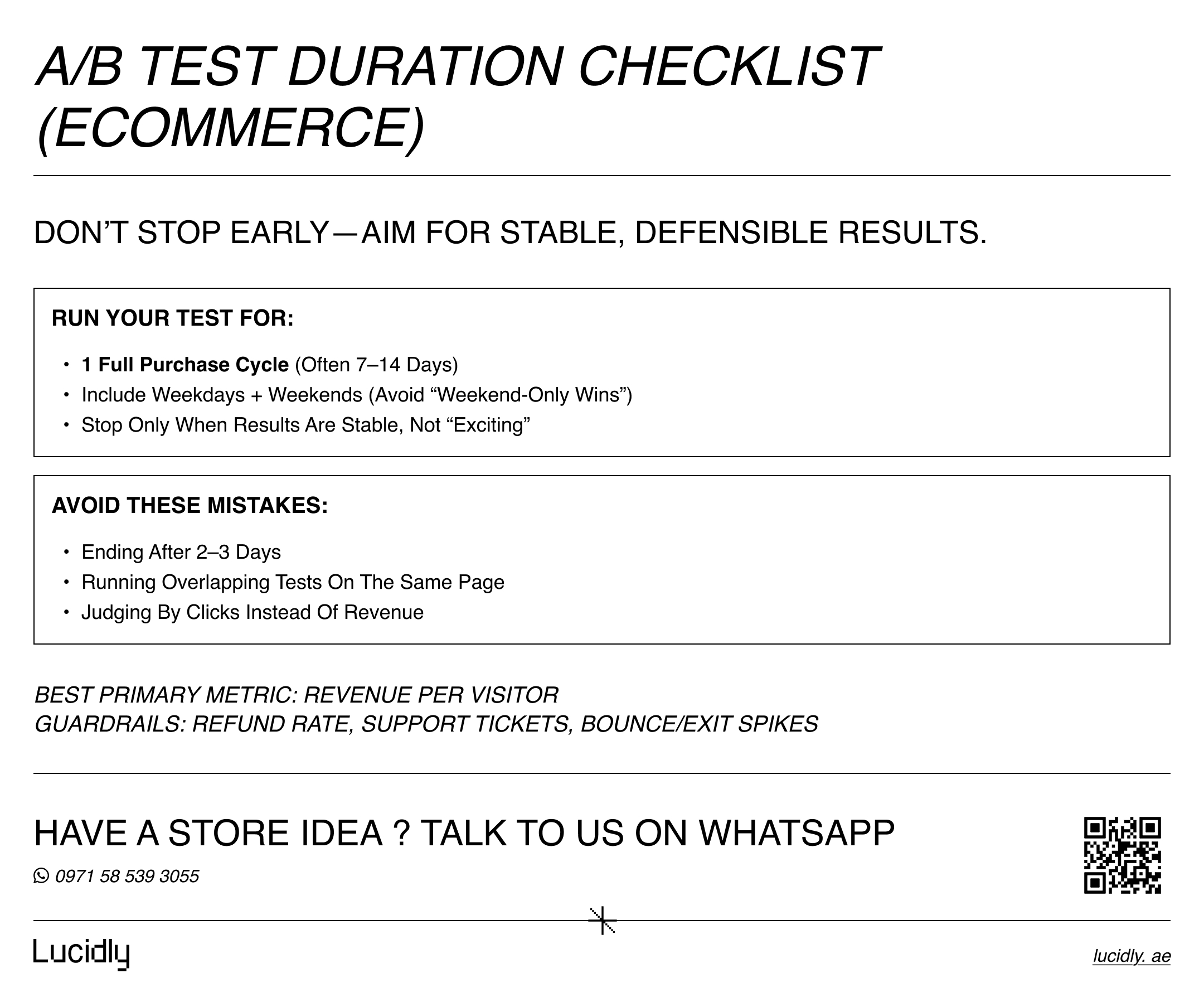
Run tests across at least one full purchase cycle (often 7–14 days for many stores).
Don’t stop early because results look “exciting” after 2–3 days.
Avoid overlapping tests on the same page that compete for attention.
If your traffic is low, focus on bigger changes that have a chance to produce measurable impact—and prioritize high-intent pages.
What Changes Typically Improve Revenue?
If you want a shortlist of what usually works across industries, this is it.
The changes below repeatedly show up in strong ecommerce conversion rate optimisation programs:
Clear delivery + returns information near price and CTA.
Fewer checkout steps and fewer required fields.
Strong offer framing (bundles, thresholds, relevant add-ons).
Better mobile usability for filters and sorting.
Trust signals placed at hesitation points (not buried).
Cleaner, faster experiences on mobile (because friction compounds).
If you’re building a content strategy, linking CRO insights to UX and performance topics can strengthen topical relevance and support organic growth—especially when your site has multiple buying-intent pages.
For a measurement-first ecommerce CRO setup, explore Lucidly’s Ecommerce Solutions in the UAE to improve GA4 tracking, revenue attribution, and funnel visibility.
FAQ
What is CRO in ecommerce?
CRO in ecommerce is the practice of improving purchase outcomes—conversion rate, AOV, and revenue per visitor—by running structured tests across the shopping journey.
What should I test first?
Start with high-intent pages (product, cart, checkout). Use analytics to find drop-offs, then validate the “why” with heatmaps and session recordings. Prioritize tests with high impact, high confidence, and low effort.
How long should A/B tests run?
Typically 7–14 days for many stores, but the real rule is: run long enough to cover a full purchase cycle and reach stable results. Don’t stop early based on short-term spikes.
What changes typically improve revenue?
Clarity near the CTA (delivery/returns), simpler checkout, better offer structure (bundles/thresholds), improved filtering and sorting on category pages, and trust signals placed at decision points.
In 2026, ecommerce conversion rate optimisation isn’t just about “tweaking a button and hoping.” Real gains come from a small set of high-impact tests: reduce hesitation around price and the CTA, remove friction in cart and checkout, and make filtering and sorting effortless on mobile.
Start with a clear hypothesis, change one meaningful thing at a time, and measure results by revenue per visitor—the metric that truly reflects growth, making it a key part of Ecommerce Checkout Optimisation.
If you want cleaner measurement and funnels you can trust in GA4 so every test has a clear winner: Message Lucidly on WhatsApp—or use the numbers on our Contact Us page to book a quick analytics audit.
References
Baymard Institute — Checkout usability research (best practices + recurring friction points in cart/checkout). (Baymard Institute)
Google Analytics (GA4) Developer Docs — Measure ecommerce (recommended ecommerce event model + implementation guidance). (Google for Developers)
Optimizely — Sample size calculator (planning experiments so duration/sample size are defensible). (Optimizely)
VWO — A/B test duration calculator (estimating how long tests should run based on traffic + baseline + MDE). (vwo.com)