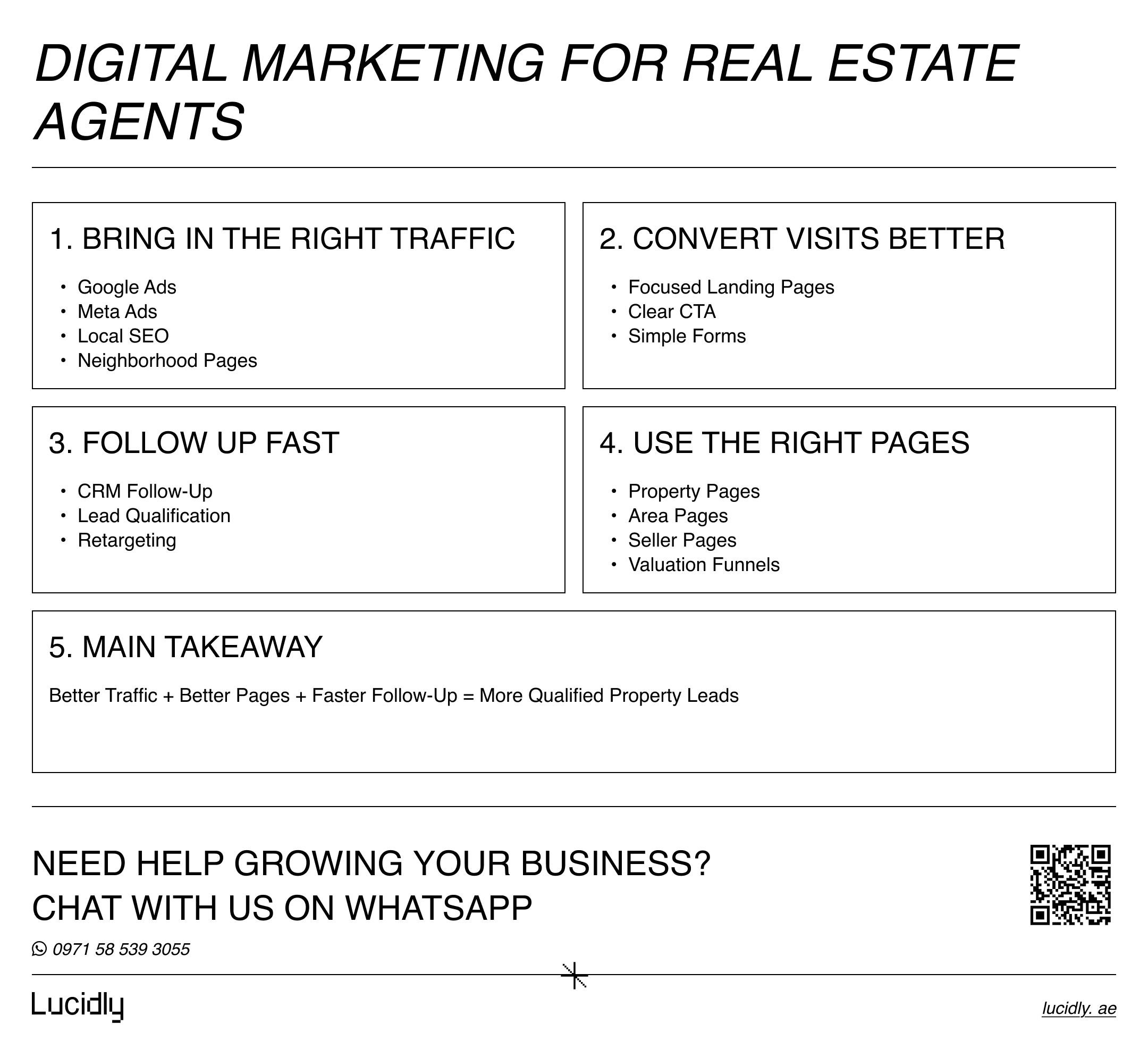
Digital marketing for real estate agents is no longer just about getting more views on listings. In 2026, the real goal is turning property traffic into qualified leads through clearer targeting, stronger listing promotion, better landing pages, and faster CRM follow-up.
Agents who combine local SEO, Google Ads, Meta ads, retargeting, and neighborhood pages are in a stronger position to generate steady enquiries instead of relying on inconsistent referrals or traffic that rarely converts into serious buyers or sellers.
Message Lucidly on WhatsApp for practical support with real estate lead generation, paid ads, SEO, and conversion-focused digital marketing.
How Digital Marketing for Real Estate Agents Turns Property Traffic Into Leads
Getting traffic is only useful when it leads to real inquiries.
A clear lead generation strategy helps agents connect each traffic source with the right page, offer, form, and follow-up process.
Attract the right traffic
More visits do not always mean better results. Digital marketing for real estate agents works better when it targets people with real intent, such as buyers searching on Google, investors comparing areas, or owners looking for valuation support.
Send visitors to the right page
Many leads are lost when campaigns send traffic to the homepage or a broad listings page. A focused page that matches the ad, property type, or area usually gives visitors a clearer next step.
Use landing pages that reduce friction
Strong landing pages help convert interest into action. The page should stay clear, relevant, and focused on one main action such as booking a viewing or requesting details.
Follow up quickly
Fast CRM follow-up is essential. A delayed reply can waste good property leads, while quick and simple follow-up improves the chance of conversion.
Use retargeting to recover missed opportunities
Most visitors will not enquire on the first visit. Retargeting helps bring them back after they leave, which can improve lead volume without relying only on new traffic.
What a Strong Real Estate Digital Marketing Strategy Looks Like in 2026
A practical real estate digital marketing strategy needs to connect traffic, conversion, and follow-up. Without that structure, agents often generate clicks but fail to create a steady lead flow.
The traffic layer
This is where visibility starts. Most agents will rely on a mix of:
Google Ads for high-intent searches.
Meta ads for audience targeting and listing promotion.
local SEO for long-term search visibility.
neighborhood pages for area-specific interest.
The conversion layer
Once traffic arrives, the next step is conversion. This usually depends on:
focused landing pages.
clear calls to action.
strong property presentation.
short forms.
trust signals such as agent details, reviews, or market knowledge.
The lead handling layer
This is where many campaigns fail. Real estate agent digital marketing performs better when there is a reliable process for:
responding quickly.
qualifying leads.
assigning priorities.
continuing follow-up.
re-engaging cold prospects.
The optimization layer
Good digital real estate marketing improves over time. Agents should review which channels create quality enquiries, which pages convert better, and which ads waste spend. Better tracking leads to better decisions.
Best Digital Channels for Real Estate Agents
Not every channel plays the same role. Some capture direct intent, while others create awareness or support retargeting.
Google Ads for high-intent searches
Google Ads works well when people are already searching for a property type, service, or location. This channel is especially useful when the goal is to capture buyers or sellers who already know what they want.
Google Ads is often strong for:
location-based searches.
urgent buyer intent.
seller service pages.
valuation or consultation offers.
Meta ads for audience targeting and listing promotion
Meta ads can be effective for visual property marketing, audience segmentation, and listing promotion. This is especially useful when the audience may not be searching actively yet but is still relevant based on interests, behavior, or location.
Meta ads is often useful for:
promoting new listings.
showcasing lifestyle appeal.
retargeting visitors.
building local awareness.
Local SEO for steady visibility
Local SEO helps agents appear when people search for services or properties in specific areas. It is especially valuable for long-term visibility because it keeps generating traffic beyond paid campaign windows.
Understanding the Role of SEO in real estate digital marketing helps agents build long-term visibility beyond paid campaign windows.
Neighborhood pages for area-based search intent
Well-written neighborhood pages can attract visitors looking for information about a specific community, district, or investment area. These pages support both SEO and conversion because they match the way real users search.
Google Ads vs Meta Ads for Real Estate Agents
Both channels can work well, but they support different parts of the funnel.
Channel | Best for | Main strength | Common limitation |
Google Ads | High-intent searches | Captures existing demand | Can be expensive in competitive locations |
Meta ads | Awareness, promotion, retargeting | Strong audience targeting and visual reach | Lower intent on first click |
Local SEO | Long-term organic visibility | Builds sustainable search presence | Takes time to grow |
Neighborhood pages | Area-specific traffic | Matches local search intent well | Requires useful, specific content |
For businesses looking for a clearer growth strategy, Lucidly’s digital marketing services offer practical support across SEO, paid ads, content, and lead generation.
The Pages and Funnels That Work Best in Digital Marketing for Real Estate Agents
In digital marketing for real estate agents, the best pages and funnels are usually the clearest ones.
Property landing pages
These pages work best when each one focuses on one property type, one area, or one offer, with one clear action such as booking a viewing or requesting details.
Area and neighborhood pages
These pages attract users comparing locations and often work well when they explain pricing, lifestyle, and local appeal clearly.
Seller pages
Some pages should target owners, not just buyers. These usually perform better when they focus on valuation, demand, and the next step.
Simple lead funnels
The best funnels usually guide visitors toward one action, such as:
requesting a viewing.
asking for details.
getting a property valuation.
booking a consultation.
How Real Estate Digital Marketing Services Support Growth
Some agents manage campaigns alone. Others need outside support once growth becomes more complex.
What real estate digital marketing services usually cover
Real estate digital marketing services often include campaign setup, SEO work, content support, landing page creation, retargeting, and performance tracking. This can help agents avoid fragmented execution.
When a real estate digital marketing agency makes sense
Businesses exploring outside support may also want to compare the top digital marketing companies in Dubai to see how different agencies approach strategy, execution, and growth.
Individual agents vs real estate companies
Digital marketing for real estate companies often needs broader structure, more pages, and clearer internal coordination. In contrast, digital marketing for real estate agents is usually more focused on personal brand visibility, local lead generation, and manageable follow-up volume.
Choosing between in-house work and external help
Some businesses compare internal execution with support from digital marketing companies for real estate, especially when they need to understand digital marketing cost in Dubai before choosing the right growth setup.
FAQs
What is the best digital marketing strategy for real estate agents?
The best strategy combines intent-driven traffic, focused pages, and fast lead handling. In practice, that often means using Google Ads, Meta ads, local SEO, neighborhood pages, retargeting, and CRM follow-up together rather than relying on one channel alone.
How do real estate agents generate qualified leads online?
They generate qualified leads online by attracting the right audience, using clearer landing pages, improving listing promotion, following up quickly, and aligning each campaign with a specific offer or location.
Should agents use Google Ads or social ads?
Most agents benefit from both. Google Ads is better for active search intent, while social ads are useful for awareness, audience targeting, and retargeting. The strongest setup often uses both with different roles.
What pages and funnels work best for real estate?
The most effective pages are usually property landing pages, neighborhood pages, seller pages, valuation pages, and simple enquiry funnels built around one action at a time.
Digital marketing for real estate agents works best when it is built around lead generation, not just listing visibility. Agents who combine better targeting, stronger landing pages, local SEO, paid ads, retargeting, and faster follow-up are more likely to turn property traffic into real enquiries. In 2026, the advantage comes from building a clearer journey from click to conversation.
What CRM setup helps real estate agents follow up with leads faster?
A simple CRM setup should organise enquiries, assign lead ownership, track follow-up status, and support faster replies. For property teams that need stronger automation and lead tracking, HubSpot for real estate can help connect marketing, sales, and follow-up in one system
For a clearer and more practical approach to real estate digital marketing, Message Lucidly on WhatsApp or use the phone numbers listed on the Contact Us page.
References
Google Ads Help. Generate leads with Google Ads. Available at: https://support.google.com/google-ads/answer/15795510
Meta Business Help Center. Getting Started Guide and Support for Meta Ads. Available at: https://www.facebook.com/business/help/www/225964344407874/
Google Business Profile Help. Get started with Google Business Profile. Available at: https://support.google.com/business/answer/7039811