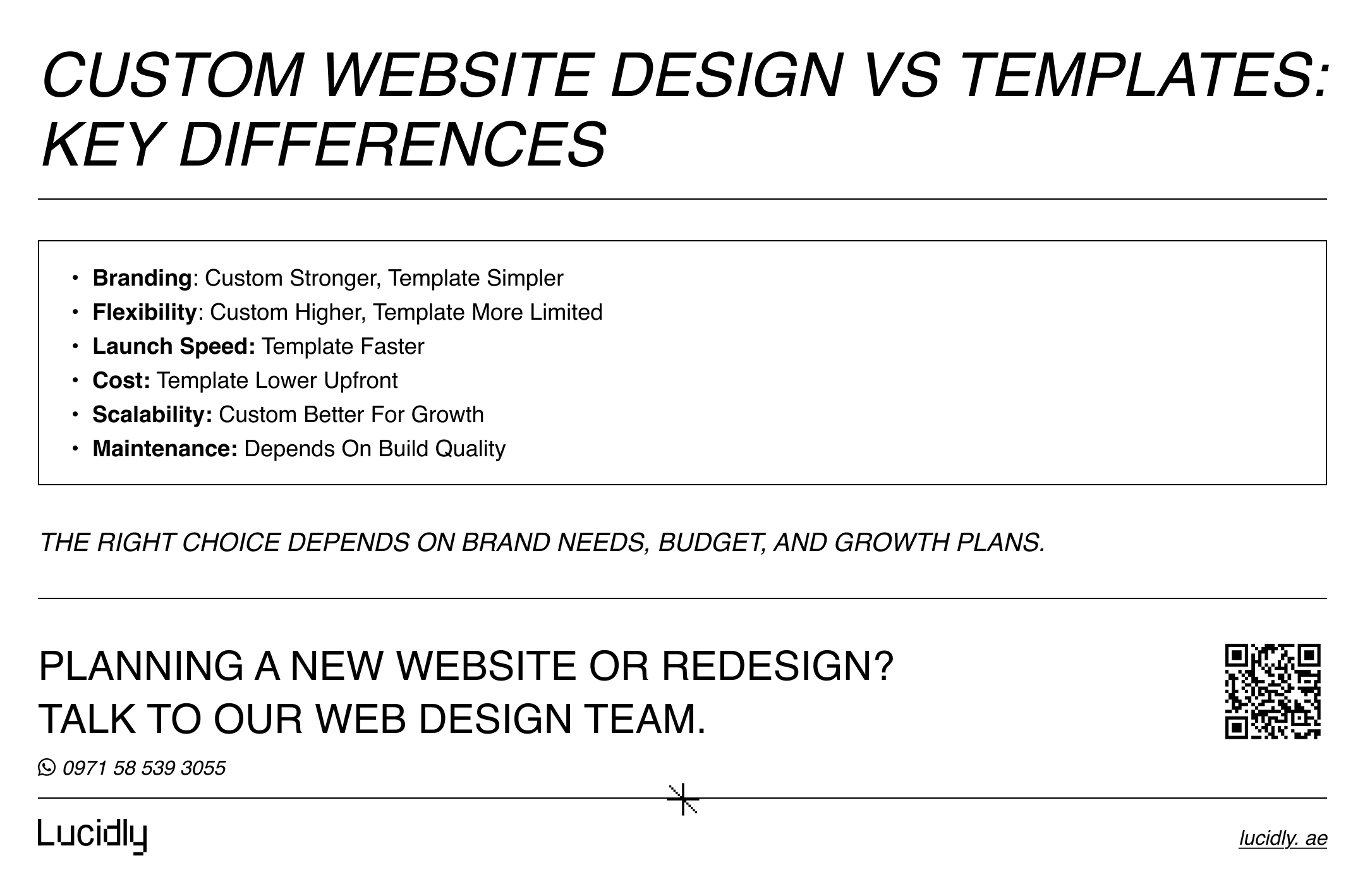
Custom website design vs templates is not just a design choice. It is a business decision that affects branding, flexibility, launch speed, cost, scalability, and long-term maintenance.
A template can be the right fit when the website is simple and speed matters most.
A custom website is often the better choice when the brand needs stronger differentiation, better control over user journeys, and more room to grow without rebuilding later.
Google’s guidance also reinforces that what matters is not whether a site is custom or template-based, but whether it is helpful, usable, well-structured, and built for real people.
If your brand is weighing templates against a more tailored website approach, Message Lucidly on WhatsApp.
Custom Website Design vs Templates: The Right Choice Depends on What Your Brand Actually Needs
The best option depends less on trends and more on what the website is expected to do. Some brands need a fast launch with a familiar structure.
Others need a site that reflects a stronger identity, supports more tailored journeys, and stays flexible as the business grows.
That is why custom website design vs templates should be evaluated through practical factors rather than preference alone.
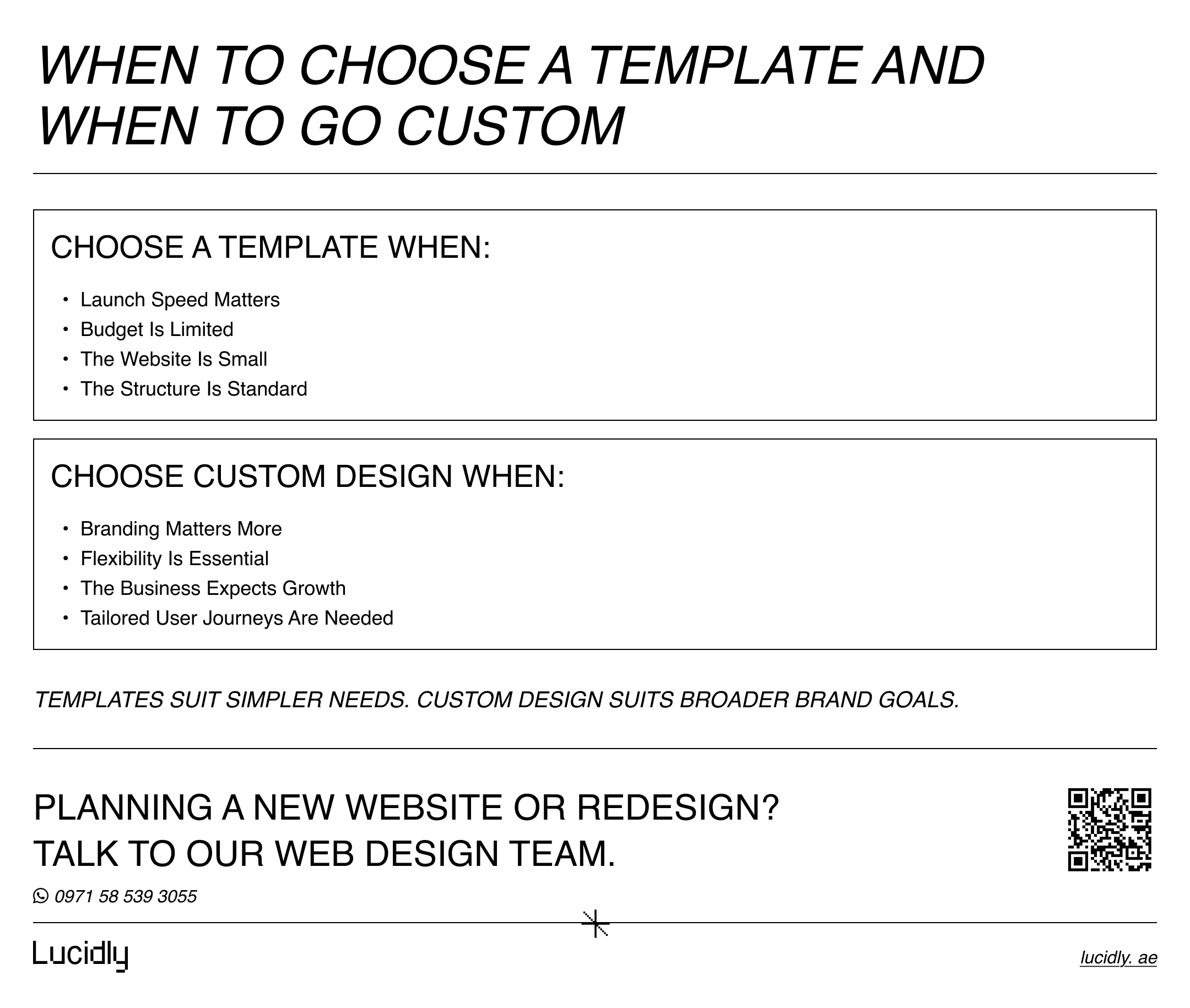
A template may be enough when the site is small, the structure is standard, and launch speed matters most.
Custom design is often better when the brand needs clearer differentiation, better flexibility, and more control over future changes.
The real decision usually comes down to:
branding.
flexibility.
cost.
launch speed.
scalability.
long-term maintenance.
If you want a clearer breakdown of how design impacts usability, trust, and performance, you can explore What Is Web Design? Why It Matters, What It Includes, and How It Affects Business Growth.
What a Template Website Does Well
Templates can be a smart business decision in the right context. They are not automatically weak, and they are not automatically “cheap-looking.” In many cases, they solve the right problem efficiently.
Faster launch speed for straightforward projects
A template-based website is often the faster route. When the structure is simple and the business needs to go live quickly, templates reduce planning time and shorten the build process.
Lower upfront cost
One of the clearest differences in template website vs custom website projects is cost. Templates are usually more budget-friendly upfront, which makes them attractive for smaller businesses, early-stage brands, or projects where speed and budget matter more than deep customisation.
Useful for brands with standard website needs
Templates often work well when the website only needs a familiar structure, such as:
homepage.
service pages.
about page.
contact page.
simple blog.
FAQ section.
WordPress itself supports themes as part of its ecosystem, and WordPress documentation makes clear that themes can control a site’s visual presentation and layout in flexible ways.
Where Template Websites Start to Feel Limiting
Templates usually become limiting not because templates are bad, but because the business begins asking for more than a standard structure can comfortably support.
Branding can feel constrained
A template can make it harder to create a site that feels distinct. The brand may end up adapting its message and layout to the template instead of building around its real priorities.
Flexibility is often restricted by the theme
This is where custom custom website design vs templates becomes a more useful question. A template can handle a standard setup well, but it may become restrictive when the business needs more control over layout, content hierarchy, conversion paths, or user flow.
That same limitation also explains why custom website vs theme is often not a technical debate only, but a strategic one.
Scalability may become harder over time
A template may work well at launch but become harder to scale as the site grows. New landing pages, service sections, conversion paths, or custom content structures may start to feel like workarounds instead of clean improvements.
Long-term maintenance can become messy in the wrong setup
A template-based site can also become harder to maintain when it depends on too many add-ons, layered customisations, or inflexible design decisions.
Long-term maintenance is not only about updates. It is also about how cleanly the site can evolve.
When Custom Website Design Is Worth the Investment
Custom design becomes worth the investment when the business needs more than a standard website can deliver.
Stronger brand differentiation
Bespoke website design is often the better fit when brand presence matters. If the business needs a website that feels closely aligned with its positioning, message, and visual identity, a custom approach gives more control.
Better control over user journeys and page structure
A custom site can be shaped around how users actually move through the website.
That makes it easier to support lead generation, service discovery, and stronger conversion paths without forcing the content into a pre-built layout.
More flexibility for future growth
This is where tailor made responsive web design vs template becomes a serious business question. If the site is expected to grow over time, custom design usually offers more flexibility.
It can be easier to expand sections, refine journeys, and support broader functionality without constantly working around theme limitations.
Better fit for brands with broader digital plans
A custom site often makes more sense when the website is expected to support:
stronger branding.
multiple services.
ongoing landing page growth.
content strategy.
more tailored UX decisions.
future scalability.
In practical terms, bespoke vs template website decisions usually come down to whether the brand wants a site that fits an existing framework or a site built around its actual needs.
Custom Website Design vs Templates: Which One Fits Your Brand Better?
The better choice is not always the cheaper one or the faster one. It is the option that fits the brand’s current needs and future direction more accurately.
Decision factor | Template website | Custom website design |
Branding | Good for simpler brand needs | Better for stronger differentiation |
Launch speed | Usually faster | Usually slower |
Cost | Lower upfront cost | Higher initial investment |
Flexibility | Limited by the template structure | Greater control over structure and UX |
Scalability | Fine for simpler growth | Better for broader growth plans |
Long-term maintenance | Can stay simple or become messy depending on setup | Often more consistent when built well |
Google’s Search Essentials and SEO guidance focus on technical quality, usability, and content value rather than whether a site is custom-built or template-based.
When a Template Is Enough and When It Is Not
A template is often enough when:
the website is small.
the structure is familiar.
the budget is limited.
speed matters more than uniqueness.
the business does not need complex user journeys.
Custom design is usually the better option when:
the brand needs a stronger identity online.
the site needs more tailored conversion paths.
flexibility matters more over time.
the business expects growth.
rebuilding later would be costly.
For some businesses, the next question is not just template or custom, but whether WordPress web design in Dubai offers the right balance between flexibility, scalability, and easier content management.
Are Templates Bad for Business Websites?
No. Templates are not bad by default. They are often useful for businesses that need a clean launch, a standard structure, and a manageable starting point.
The problem begins when a template is asked to carry a brand or website strategy that needs more control than the template can realistically provide.
In other words, templates are not the issue. Mismatch is the issue.
The Hidden Cost Question: Cheap to Launch vs Expensive to Outgrow
A template may cost less at the beginning, but that does not always make it the cheaper option over time.
If the business quickly outgrows the structure, needs repeated workarounds, or ends up rebuilding later, the real cost can rise.
A custom site usually costs more upfront, but it can make more sense when the business needs stronger branding, better flexibility, and long-term scalability from the start.
That is why cost should be evaluated alongside:
launch speed
flexibility
long-term maintenance
future growth
What Google and Real Users Actually Reward
Google does not reward a site for being custom just because it is custom. It also does not reward a site just because it uses a template well.
The stronger signal is whether the website serves people well.
That means:
helpful content
clear structure
strong page experience
useful navigation
accessible design
maintainable site quality
Google’s people-first content guidance and Search Essentials both emphasize usefulness, clarity, and technical soundness, while W3C accessibility principles emphasize that websites should be perceivable, operable, understandable, and robust for users.
Typography also plays a key role in readability and user experience. To understand this better, check Best Fonts for Web Design: How to Choose Fonts That Look Good and Improve Readability.
For brands weighing templates against a more tailored website approach, Lucidly’s web design services offer a useful point of reference.
FAQ
Should I choose a custom website or a template?
Choose a template when your website is straightforward, speed matters, and the structure is unlikely to become complex soon. Choose custom design when branding, flexibility, and future growth matter more.
Are templates bad for business websites?
No. Templates can work well for many business websites. They only become a weak choice when the business needs more control, differentiation, or scalability than the template can support.
When is custom design worth the investment?
Custom design is usually worth the investment when the website plays a bigger role in branding, lead generation, user experience, or long-term growth.
Which option is better for growth?
Custom design is usually better for broader growth because it offers more flexibility and fewer structural limitations over time. Templates can still be enough for simpler growth paths.
Choosing between a template and a custom website should come down to fit, not assumption. The right option is the one that supports your brand, your goals, and the way you expect the website to grow over time.
If you need clearer guidance on which direction fits your business best, Message Lucidly on WhatsApp. or use the phone numbers listed on the Contact Us page.
References
Google Search Central. Creating helpful, reliable, people-first content.
WordPress.org. Work with Themes.