Your website platform isn’t just a tech decision—it’s a growth decision.
The wrong choice can quietly drain results through slow pages, limited SEO control, costly changes, or messy maintenance.
That’s why Custom Code vs Website Builders vs WordPress needs a practical, business-first answer.
Most companies don’t need the “best” platform in theory—they need the one that fits their stage, team capacity, and acquisition plan, especially for organic search, content, and conversion-focused landing pages.
This guide gives you a clear way to choose.
Message Lucidly on WhatsApp for a clear, platform-agnostic website review—before you choose a builder, WordPress, or custom code.
The 60-Second Decision Rule
Before comparing features, you’ll get better results by clarifying three realities: how fast you need to ship, how much control you need, and who will maintain the site after launch.
In practice, these three questions will eliminate at least one option immediately.
Here are the questions that settle the decision quickly:
How quickly do you need a credible site live (days, weeks, or months)?
How important is SEO control, performance, and structured content for growth?
Who will own maintenance and improvements for the next 12–24 months?
If you need speed and minimal overhead, builders tend to win.
If you need a scalable content engine with strong SEO control, WordPress is often the best balance.
If your website is closer to a product—integrations, custom logic, unique UX—custom code can be the right long-term play.
Website Builders for Business: When They’re the Smart Choice
Website builders such as Wix, Squarespace, and other template-driven platforms are designed to remove friction.
They bundle hosting, security, templates, and visual editing into a controlled environment that prioritizes simplicity.
For many businesses, especially early-stage ones, this simplicity is not a compromise—it’s an advantage.
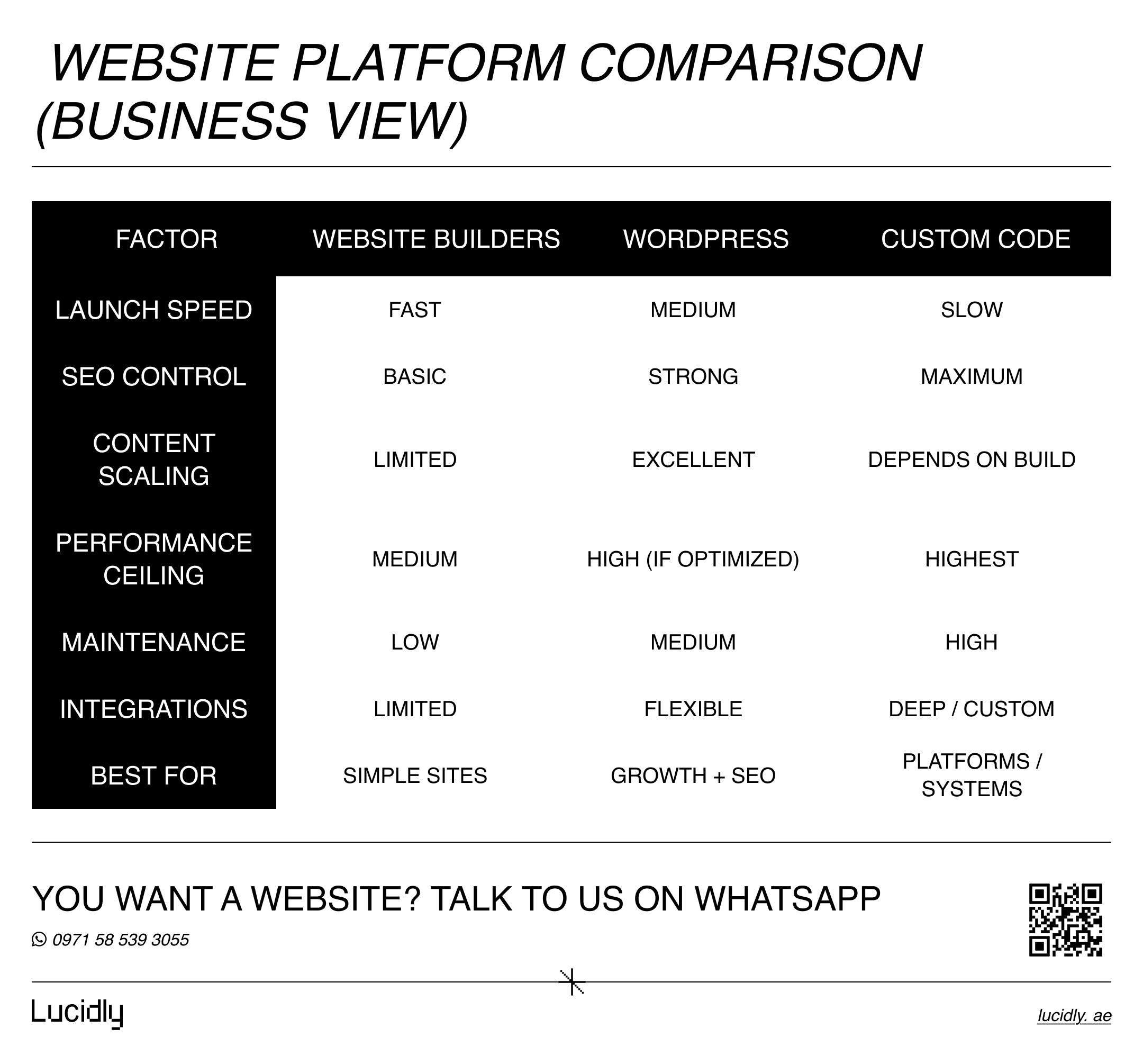
Best Use Cases for Website Builders
Website builders work best when your site functions primarily as a marketing presence rather than a complex system.
They are particularly effective when speed and ease of use matter more than customization depth.
Common scenarios where builders make sense include:
Launching a new business or service quickly
Creating a basic lead-generation or brochure-style site
Allowing non-technical teams to update content independently
SEO and Growth Limits to Watch
Modern builders handle basic SEO well, but they can be limiting as you scale. Advanced schema, complex internal linking, and performance tuning may be harder to control. Builders can still rank—especially for local searches—but they’re often best as short- to mid-term solutions if you plan to grow fast.
WordPress for Small Business: The Best Balance for SEO and Flexibility
WordPress sits between simplicity and control, which explains its widespread adoption. It offers a flexible content management system without requiring everything to be built from scratch.
For many businesses, WordPress is the most balanced option in terms of SEO and flexibility.
Why WordPress Wins for Content-Led Growth
WordPress excels when content plays a central role in customer acquisition. Its structure supports blogs, service pages, landing pages, and topic clusters that scale over time.
This makes it especially effective for businesses relying on organic search, educational content, and ongoing publishing rather than one-off pages.
WordPress SEO Control: What You Actually Own
One of WordPress’s strongest advantages is control. You can shape site architecture, manage internal links, customize metadata, and implement structured data using well-established tools.
This level of ownership allows SEO strategies to evolve without rebuilding the entire site. For many service-based and B2B businesses, this flexibility becomes decisive in the Custom Code vs Website Builders vs WordPress comparison.
The Real Trade-Off: Maintenance and Discipline
WordPress is not maintenance-free. Plugins, themes, and hosting choices directly affect performance and security.
However, with disciplined plugin selection, regular updates, and quality hosting, WordPress remains stable and scalable. The key is acknowledging maintenance as part of the cost of flexibility.
Custom Website Development: When Custom Code Is Worth the Investment
Custom-coded websites are built around specific business requirements rather than fitting those requirements into predefined templates. This approach offers unmatched control but demands greater investment and long-term commitment.
In the Custom Code vs Website Builders vs WordPress discussion, custom web development is rarely the default choice—but it can be the right one under specific conditions.
Ready to Build a High-Performance Website?
Turn strategy into results with Lucidly’s custom web development solutions — built for speed, SEO, and business growth.
👉 Book Your Web Development Consultation
When Custom Code Makes Business Sense
Custom code becomes valuable when a website functions as more than a marketing layer. This includes scenarios where the site behaves like a product, platform, or operational system.
Typical indicators include:
Complex integrations with internal systems
Custom user flows, portals, or dashboards
Strict performance budgets or advanced UX requirements
SEO Benefits of Custom Development (When Done Correctly)
When built properly, custom code allows precise control over HTML output, rendering strategy, and asset delivery.
This can support excellent performance and clean, crawlable structures.
However, these benefits only materialize with strong engineering practices.
A poorly built custom site can underperform simpler platforms, which is why execution matters more than the label in Custom Code vs Website Builders vs WordPress.
The Hidden Cost: Ongoing Engineering Dependency
Every improvement, fix, or experiment requires developer involvement. Without proper documentation and ownership, even small changes can become costly.
Custom development works best when engineering resources are stable and aligned with business goals.
SEO, Core Web Vitals, and Performance: What Actually Impacts Rankings
Search engines do not rank platforms—they rank pages that provide accessible content and strong user experiences. Platform choice only matters insofar as it supports or limits these outcomes.
Crawlability and Rendering Fundamentals
Pages must be easy to crawl and reliably rendered. Critical content and links should be accessible without fragile workarounds or excessive client-side dependencies.
Platforms that complicate rendering increase risk, especially as sites scale.
Core Web Vitals as a Practical Benchmark
Core Web Vitals reflect real-user experience rather than synthetic scores. Slow loading, layout shifts, and delayed interaction hurt conversions first and visibility second.
Any platform can meet acceptable thresholds, but some make optimization easier than others.
Site Structure That Scales Over Time
Clear hierarchies, logical internal linking, and consistent content structures help both users and search engines. Platforms that support these patterns naturally tend to age better as content grows.
learn How to Make Your Website SEO-Friendly from a Development Perspective
Total Cost of Ownership: Looking Beyond Launch Price
Launch cost is only one part of the equation. The more meaningful metric is what it costs to publish, optimize, and adapt the site over 12 to 24 months.
Website builders offer predictable pricing but limited flexibility. WordPress balances moderate costs with long-term adaptability. Custom code requires higher investment but offers the highest ceiling.
Security and Maintenance: Keeping Each Option Healthy
Security is not a platform feature—it’s an operational practice shaped by responsibility and process.
Website builders manage most infrastructure risks. WordPress requires active update routines and careful plugin selection. Custom code depends entirely on engineering discipline.
All three can be secure when maintained properly, and risky when neglected.
Which One Fits Your Business in the UAE?
In the UAE, the “right” platform depends on how fast you need to launch, how competitive your niche is (Dubai/Abu Dhabi/Sharjah), and whether you’ll rely on local SEO, bilingual pages (Arabic + English), and lead conversion (often via WhatsApp).
According to the UAE Government’s official digital business guidelines (u.ae), businesses are encouraged to adopt scalable, accessible, and user-friendly online platforms—making platform choice a strategic decision, not a technical one.
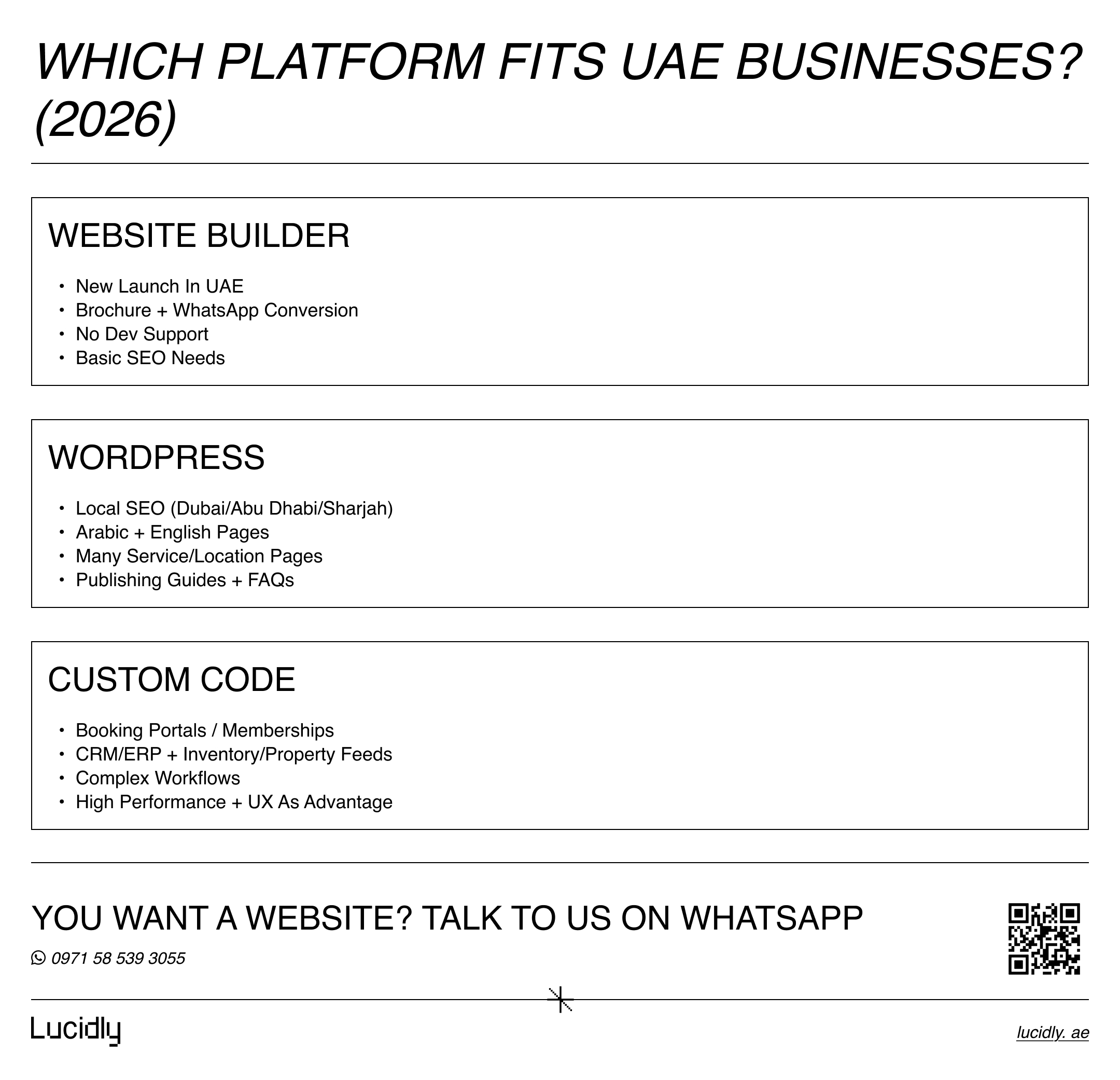
Choose a Website Builder in the UAE if…
You need a credible site live fast and want minimal maintenance.
Launching a new service or branch quickly
No developer support in-house
Mostly brochure pages + contact/WhatsApp
SEO needs are basic (not content-heavy)
Choose WordPress in the UAE if…
For many UAE service businesses, Custom Code vs Website Builders vs WordPress often lands on WordPress because it scales SEO and content without heavy engineering overhead.
Choose Custom Code in the UAE if…
Your website is closer to a product or operational system.
Advanced booking/portal workflows or membership areas
Deep integrations (CRM/ERP, inventory, property feeds)
Performance and UX are competitive differentiators
You have reliable engineering capacity for ongoing updates
learn more about: Choosing the Right Tech Stack: Languages, Frameworks, and CMS Options.
Migration and Vendor Lock-In: Planning for the Future
Early platform choices affect how easily you can move later. Content locked into proprietary widgets, unstable URLs, or undocumented systems increases migration cost.
Planning clean structures, stable URLs, and exportable content reduces lock-in risk regardless of platform.
The Biggest Mistake to Avoid
The biggest mistake isn’t picking the “wrong” platform—it’s picking one you can’t maintain. WordPress needs upkeep, builders can limit growth, and custom code needs a roadmap and ongoing dev support.
The real question is: which option can you maintain consistently as you grow?
FAQ
Is it better to code your own website or use WordPress?
WordPress is best for most businesses because it’s faster to launch, easier to update, and strong for SEO + content. Custom code is better only if you need unique features, deep integrations, or product-level performance—and you have ongoing developer support.
Which is better, WordPress or custom websites?
Neither is universally better. WordPress wins for marketing agility (pages, blog, SEO, quick changes). Custom wins for precision and complex requirements (portals, integrations, advanced UX)—but costs more and needs maintenance.
How much does it cost to build a website in UAE?
It varies by complexity. A basic business site is often a few thousand AED, CMS/ecommerce or custom builds can be tens of thousands AED or more. Don’t forget ongoing costs: hosting, updates, and improvements.
Is it better to build your own website or use a website builder?
If you’re non-technical and need speed, a website builder is usually better. Choose WordPress if you’ll publish content and grow SEO. Choose custom code only if the site is a core system and you can maintain it with developers.
There’s no single winner in Custom Code vs Website Builders vs WordPress—each fits a different stage.
Instead of debating platforms, define your key pages, conversion paths, required integrations, and publishing cadence.
Set a realistic performance goal, then choose the option that supports that plan with the least friction.
When you pick based on operational reality—not hype—your website becomes a long-term growth asset, not a constraint.
Contact us - or Message Lucidly on WhatsApp for a website planning review—we’ll map what you need before you choose a builder, WordPress, or custom code.
References
Google Search Central — Choosing the Right Website Platform
Google Search Central — JavaScript SEO Basics & Rendering
web.dev (Google) — Core Web Vitals and Page Experience
WordPress.org — WordPress Security and Maintenance Best Practices