The best digital marketing tools are the ones that help small businesses improve visibility, measure performance, manage leads, and simplify day-to-day marketing without adding unnecessary cost or complexity. Most businesses do not need dozens of platforms.
They need a practical mix of SEO tools, analytics tools, CRM, content tools, and reporting dashboards that match their goals and budget.
If your current setup is creating gaps in tracking, reporting, or follow-up, now is the time to fix it before more budget is wasted.
If your campaigns are running but you still cannot clearly see where results come from or where opportunities are being lost, message Lucidly on WhatsApp for a practical recommendation built around your business goals, budget, and growth stage.
What Are Digital Marketing Tools?
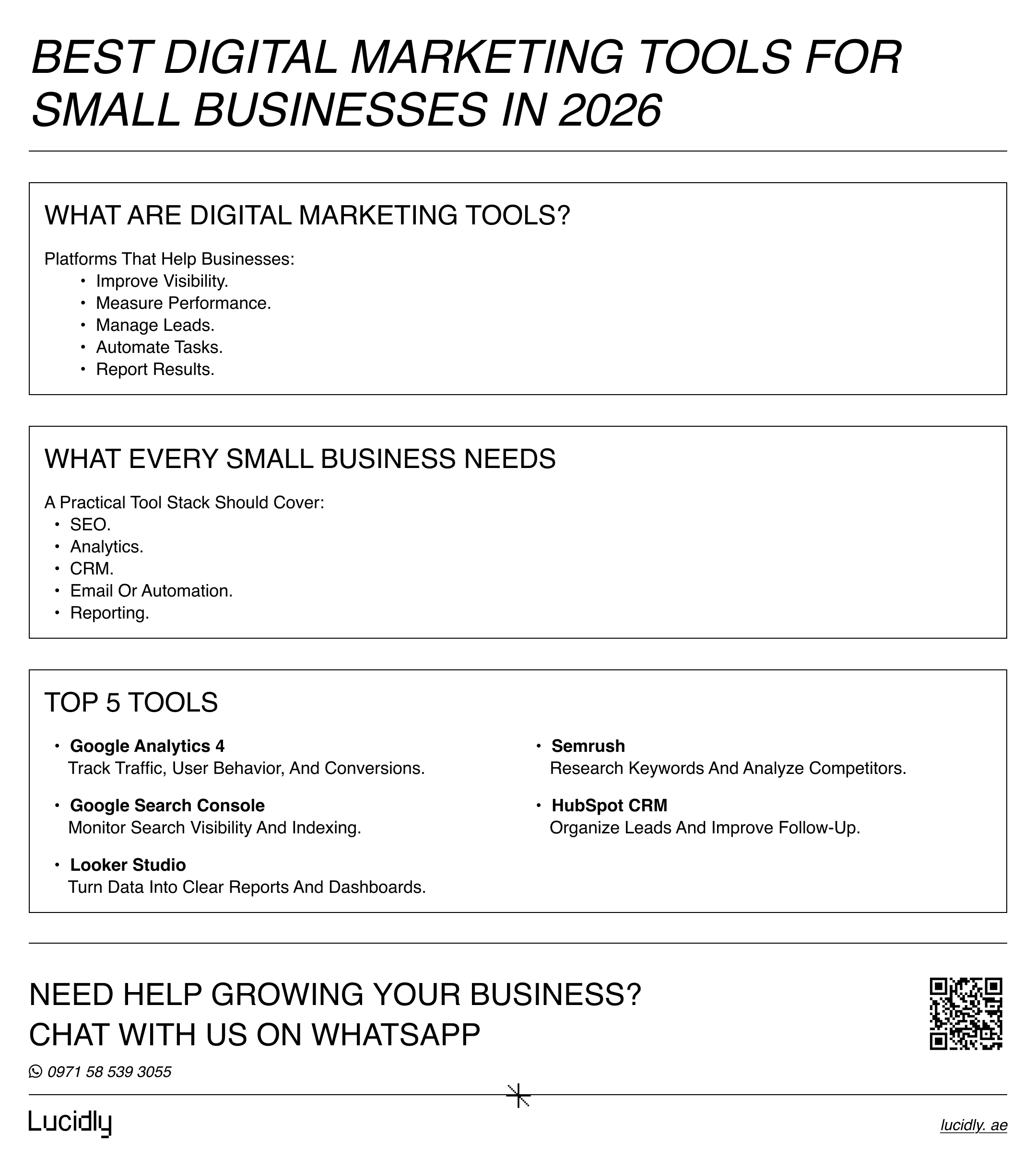
Digital marketing tools are the platforms businesses use to improve online visibility, track performance, manage leads, automate key tasks, and report on results more clearly.
Rather than working as isolated apps, the most useful tools help connect search, analytics, content, customer management, and campaign performance into a more practical marketing system.
In practical terms, digital marketing tools include the following categories:
SEO tools to improve search visibility and target the right keywords.
Analytics tools to measure traffic, user behavior, and conversions.
Keyword research tools to uncover demand and content opportunities.
CRM to organize leads, contacts, and pipeline activity.
Marketing automation to reduce manual work and improve lead nurturing.
Content tools to plan, optimize, and manage content.
Social media tools to schedule and manage publishing.
PPC tools to run and improve paid campaigns.
Reporting dashboards to bring data into one clear view.
The goal is not to build a bloated stack. It is to choose essential digital marketing tools that make marketing easier to manage and easier to measure.
Best Digital Marketing Tools in 2026
The best digital marketing tools in 2026 are the ones that help small businesses measure performance, improve visibility, manage leads, and report clearly without creating unnecessary complexity.
For most businesses, that means using a balanced tool stack rather than relying on one platform.
Goal | Recommended tool | Best for | Budget fit |
Website analytics | Google Analytics 4 | Traffic, events, and conversion tracking | Free |
Search visibility | Google Search Console | Organic performance and indexing insights | Free |
SEO and competitor research | Semrush or Ahrefs | SEO growth and keyword planning | Paid |
Lead management | HubSpot CRM | Contacts, pipeline, and follow-up | Free / Paid |
Email and automation | Mailchimp | Email campaigns and nurture flows | Low-cost / Paid |
Reporting dashboards | Looker Studio | Cross-channel reporting | Free |
5 Best Digital Marketing Tools to Grow Your Business in 2026
The 5 best digital marketing tools to grow your business in 2026 are the tools that improve visibility, measure performance, manage leads, and simplify reporting. For most small businesses, that means choosing a focused shortlist rather than using too many platforms.
Google Analytics 4
Google Analytics 4 is one of the best digital marketing tools for businesses that need clearer performance data.
Google continues to position Analytics around measurement, setup, and improving data collection, and has recently added features such as cross-channel budgeting in beta.
This tool is strongest when you need to understand:
Where traffic comes from.
What users do on the site.
Which actions turn into conversions.
Google Search Console
Google Search Console remains one of the most useful free digital marketing tools for small businesses.
Google describes it as a free service for monitoring, maintaining, and troubleshooting a site’s presence in Google Search.
This tool is especially useful when you want to:
See which queries drive impressions and clicks.
Identify indexing or visibility issues.
Improve organic search performance without paying for software first.
Semrush
Semrush is one of the best tools for digital marketers who need more than raw traffic data.
It belongs in the conversation when the business needs stronger keyword research, competitor research, and SEO planning.
For a clearer breakdown of Semrush Explained, this guide explains why marketers use it for keyword research, competitor analysis, and SEO planning.
This tool is strongest when the business needs:
Better topic targeting.
Better keyword research tools.
Better visibility into competitors.
HubSpot CRM
HubSpot CRM is one of the most practical essential digital marketing tools for small businesses that are starting to lose control of leads, follow-up, or pipeline visibility.
HubSpot promotes its CRM as a free system for startups and small businesses and emphasizes unified customer data, tracking, and growth support.
It is a strong fit when the business needs:
A structured lead database.
Better follow-up discipline.
Fewer spreadsheets and manual gaps.
Looker Studio
Looker Studio is one of the most useful digital marketing software tools for turning scattered performance data into clear reporting dashboards.
Google describes it as a free way to create interactive dashboards and shareable reports across many data sources.
It becomes especially useful when the business needs:
One view across multiple channels.
Cleaner reporting for internal teams or clients.
Faster decision-making from performance data.
Which Tools Do Small Businesses Need First?
The tools small businesses need first are the ones that help them measure performance, improve visibility, manage leads, and track results clearly.
Most do not need a long digital marketing tools list from the start. They need a simple, practical tool stack built in the right order.
Start with this sequence:
Add analytics tools so performance is measurable.
Add search visibility tools so organic results become clearer.
Add a CRM when lead tracking starts to matter.
Add email or marketing automation when follow-up needs more structure.
Add reporting dashboards when data is spread across several channels.
A practical starter stack usually looks like this:
Google Analytics 4.
Google Search Console.
HubSpot CRM.
Mailchimp.
Looker Studio.
This approach is usually stronger than buying too many tools too early because it reduces overlap and keeps the stack easier to manage.
How Budget Changes Your Choice
Budget is not a minor detail. It directly affects which tools make sense.
Free digital marketing tools are often enough when the priority is visibility, analytics, and reporting.
Low-cost tools become useful when the business needs better email, scheduling, or simpler workflow support.
Paid tools make more sense when the business is ready for deeper SEO research, stronger integrations, CRM workflows, or more advanced automation.
The best marketing software tools are not always the most advanced. They are the ones that fit the current business stage and budget.
When a business needs more than separate tools and is looking for a structured approach that supports visibility, lead generation, and performance improvement, digital marketing services may be the more suitable next step.
Best Digital Marketing Tools by Goal
The best digital marketing tools by goal are the ones that match what the business is trying to improve, whether that is search visibility, performance tracking, lead management, content publishing, or paid growth.
Choosing by goal makes it easier to build a tool stack that supports results without adding unnecessary complexity.
Goal | Best-fit tools | Why they fit |
Organic growth | SEO tools, keyword research tools, competitor research platforms | They improve visibility, support keyword targeting, and help uncover growth opportunities. |
Measurement and performance tracking | Analytics tools, reporting dashboards | They show where traffic comes from, how users behave, and what drives results. |
Lead management and follow-up | CRM, marketing automation | They organize leads, improve follow-up, and reduce missed opportunities. |
Content planning and publishing | Content tools, social media tools | They support planning, scheduling, and a more consistent workflow. |
Paid campaign growth | PPC tools, reporting integrations | They help manage spend and measure campaign performance more clearly. |
Best Digital Marketing Tools by Business Type
The best tools for a local service business are not always the same as the best tools for an eCommerce brand, a B2B company, or a digital marketing agency.
Business type | Main priorities | Best-fit tools or categories |
Local service business | Search visibility, lead tracking, clear reporting | SEO tools, CRM, reporting dashboards |
Small eCommerce business | Analytics, search visibility, email, conversion tracking | Analytics tools, SEO tools, email tools, reporting dashboards |
Small B2B business | CRM, lead tracking, follow-up visibility, stronger reporting | CRM, marketing automation, analytics tools, reporting dashboards |
Lean startup | Free tools first, then one or two paid tools when the process becomes clearer | Free digital marketing tools, basic CRM, core analytics tools |
Digital marketing agency | Collaboration, multi-client management, broader reporting | CRM, advanced reporting dashboards, collaboration tools |
This difference matters because the best tools for digital marketing agencies often prioritize multi-client workflows and broader reporting, while small businesses usually need simpler systems and tighter budget control.
How Do I Build a Digital Marketing Tech Stack?
The cleanest way to build a digital marketing tech stack is to start with the goal, not the software.
If the goal is visibility, start with Search Console.
If the goal is measurement, add Google Analytics 4.
If the goal is better follow-up, add a CRM.
If lead flow becomes consistent, add email or automation.
If performance data is spread across channels, add a reporting dashboard.
The common mistake is buying tools before the need is clear. A smaller stack that grows with the business is usually the better choice.
Once the core marketing stack is in place, many businesses start looking at [AI tools for digital marketing] that actually save time and improve execution.
Frequently Asked Questions
What are the best digital marketing tools in 2026?
For most small businesses, the best digital marketing tools in 2026 include Google Analytics 4, Google Search Console, HubSpot CRM, Mailchimp, and Looker Studio because they cover measurement, visibility, lead management, and reporting.
Which tools do small businesses need first?
Most small businesses need analytics, search visibility, CRM, and a basic follow-up tool before they need a larger stack.
What is the best free digital marketing tool?
There is no single answer. Google Search Console is one of the strongest free tools for search visibility, Google Analytics 4 is one of the strongest for measurement, and Looker Studio is a strong free option for reporting.
Which tools help with SEO, content, and analytics?
A practical setup includes Search Console, Google Analytics 4, one SEO or keyword platform such as Ahrefs vs Semrush vs Moz, and a reporting dashboard such as Looker Studio.
How do I build a digital marketing tech stack?
Start with the goal, then add visibility, analytics, CRM, automation, and reporting only when each layer is actually needed.
The best digital marketing tools are not the most popular tools or the longest digital marketing tools list. They are the tools that match the goal, fit the budget, and make marketing easier to measure and manage. For most small businesses, a smaller set of essential digital marketing tools creates more value than a large stack of overlapping platforms.
If your current setup feels fragmented, expensive, or unclear, message Lucidly on WhatsApp for a practical recommendation built around your goals, budget, and growth stage.
or use the phone numbers listed on the Contact Us page.
References
Google Cloud. Looker Studio: Business Insights Visualizations. Retrieved April 21, 2026, from https://cloud.google.com/looker-studio
Google Support. About Search Console. Retrieved April 21, 2026, from https://support.google.com/webmasters/answer/9128668?hl=en
Google Support. Google Analytics Help Center. Retrieved April 21, 2026, from https://support.google.com/analytics/?hl=en