AI tools for digital marketing are no longer optional. In 2026, they are part of how marketing teams reduce manual work, improve targeting, and make faster decisions. But the real value does not come from using more tools.
It comes from using the right tools in the right place. Businesses that understand how to apply AI across content, ads, data, and automation are the ones that see real improvements in performance, not just efficiency.
For practical guidance on using AI in digital marketing more effectively, Message Lucidly on WhatsApp.
What Are AI Tools for Digital Marketing and Why They Matter
AI tools for digital marketing are not just about speed. They are about improving how marketing works across planning, execution, and analysis.
Instead of relying on guesswork, businesses can use ai tools for digital marketing to analyse patterns, support decisions, and reduce repetitive work.
This is where ai in digital marketing becomes useful. It helps teams move from manual processes to more structured and data-driven systems.
At the same time, ai for digital marketing does not replace strategy. It strengthens execution.
The real value comes from combining human judgment with digital marketing ai tools to improve consistency, accuracy, and performance over time.
What Are the Best AI Tools for Digital Marketing?
The best digital marketing tools are usually the ones that solve clear problems. Businesses benefit most when they choose tools based on function, not hype.
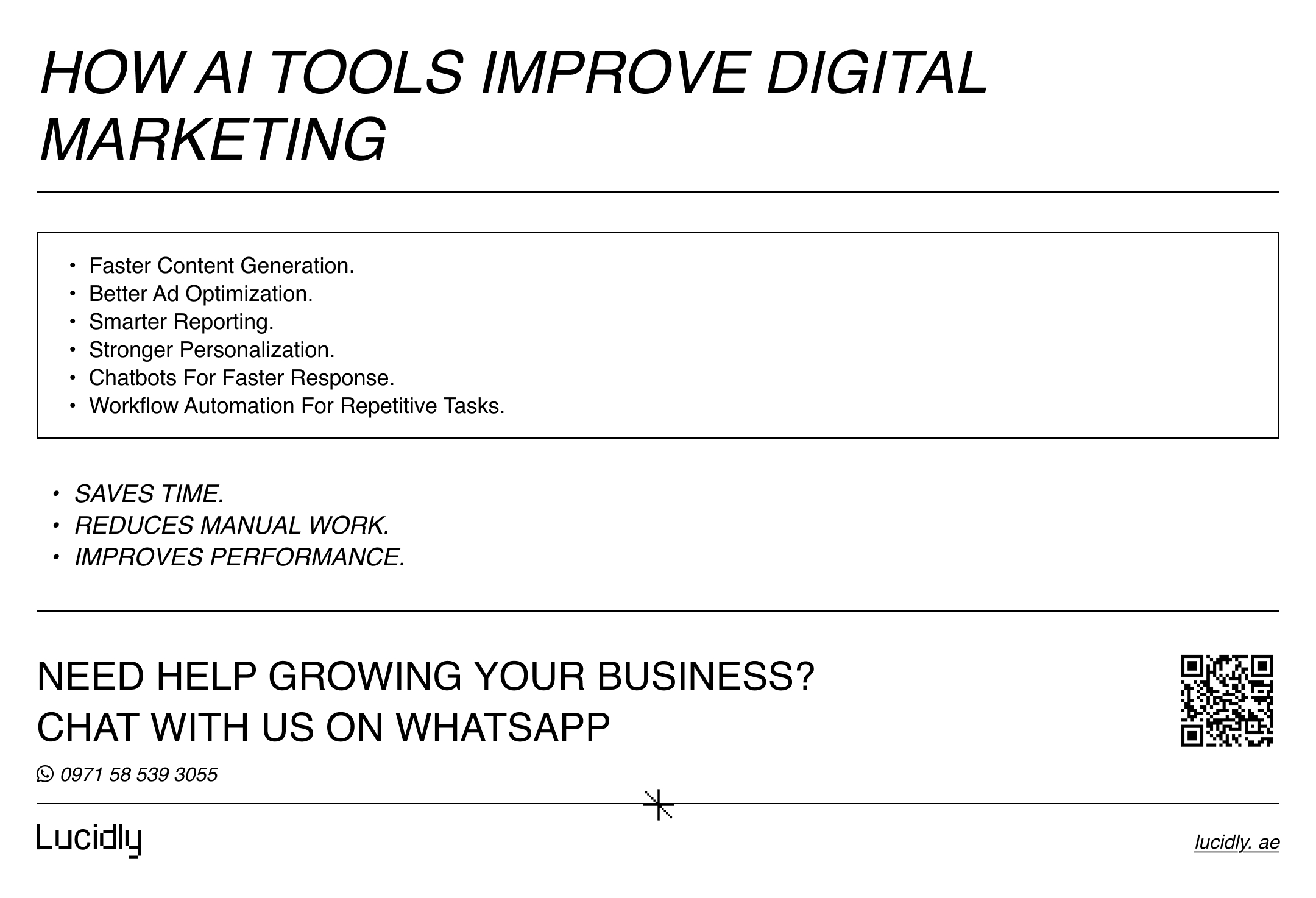
Content and content generation tools
Content is one of the fastest areas where AI can save time. It helps marketers move faster while keeping structure and testing options.
Support faster content generation for blogs, ads, and emails.
Help create multiple versions for testing.
Improve drafting speed and message consistency.
Reduce time spent on repetitive content tasks.
Advertising and ad optimization tools
Paid media is another area where AI creates practical value. It helps improve targeting, bidding, and performance decisions.
Support ad optimization through automated adjustments.
Improve audience targeting and segmentation.
Assist with creative testing at scale.
Help reduce wasted spend across campaigns.
Data, reporting, and predictive analytics tools
Good decisions depend on good visibility. AI improves how teams analyse results and identify trends.
Tools like Semrush can also help marketers connect AI-supported reporting with keyword research, competitor analysis, and SEO performance tracking.
Use predictive analytics to spot likely patterns and outcomes.
Improve reporting speed and clarity.
Help identify high-performing channels.
Reduce time spent on manual analysis.
Automation and workflow tools
This is where much of the direct time saving happens. Automation tools reduce friction in execution.
Support digital marketing automation across repetitive tasks.
Improve workflow automation between platforms and teams.
Reduce manual updates and repetitive actions.
Help keep campaigns moving more consistently.
Personalization and chatbot tools
AI is also useful for improving user experience. It helps make communication more relevant and timely.
Enable real-time personalization across websites and emails.
Use chatbots for lead capture and first-response support.
Improve user journeys with better message relevance.
Support faster engagement without constant manual input.
A strong mix of AI-powered marketing tools should make work more efficient while also improving output quality.
How Can AI Improve Digital Marketing Performance?
The real value of ai tools for digital marketing appears in measurable improvements. AI is most useful when it improves how quickly and accurately teams can act.
Speeds up campaign setup and adjustments.
Improves audience targeting.
Supports better testing and optimisation.
Helps increase conversion rate through better relevance.
Reduces wasted spend and weak execution.
Improves reporting quality and performance visibility.
When used properly, AI in marketing helps businesses make faster and better decisions rather than just automating activity.
Which Marketing Tasks Should Be Automated First?
Not every task should be automated immediately. The best place to start with ai tools for digital marketing is repetitive work that consumes time but does not require deep strategic thinking.
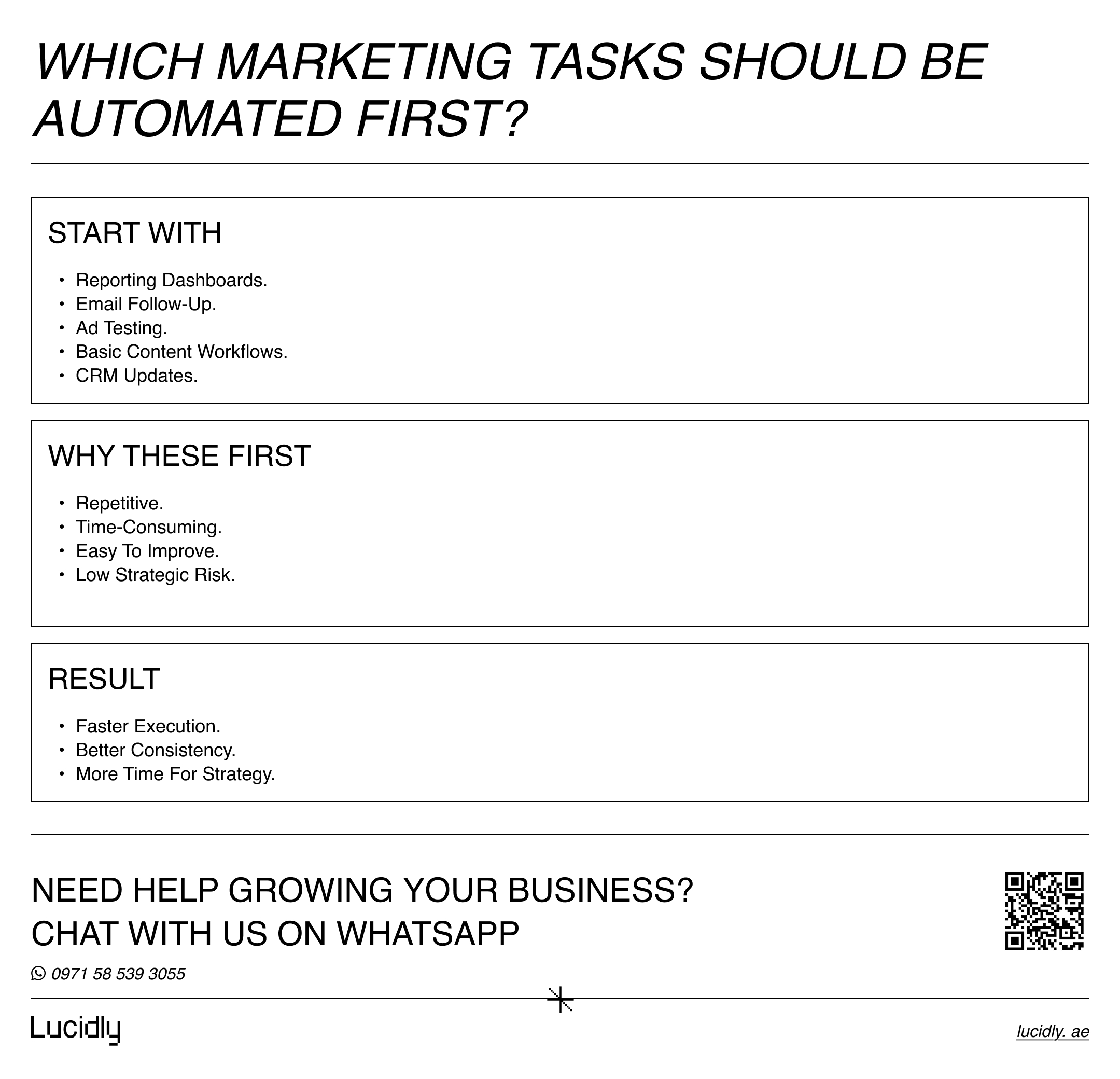
Reporting and dashboards
Reporting is often one of the easiest wins. It saves time and gives teams clearer performance visibility.
Automate recurring dashboards.
Reduce manual reporting tasks.
Surface performance trends faster.
Improve consistency in reporting cycles.
Email sequences and follow-up
Follow-up tasks are often repetitive but important. Automation helps teams respond faster and more consistently.
Automate nurture flows.
Trigger follow-up emails based on user actions.
Improve response timing.
Support lead progression more efficiently.
Ad testing and optimisation
Paid campaigns benefit from faster adjustments. AI can improve this without removing human oversight.
Test ad variations faster.
Adjust bidding more efficiently.
Improve targeting based on performance signals.
Support quicker optimisation cycles.
Basic content workflows
Content production often includes repetitive tasks that can be sped up with AI support.
Draft outlines and first versions faster.
Generate headline or subject line options.
Repurpose content into multiple formats.
Reduce time spent on repetitive writing tasks.
CRM updates and workflow tasks
Administrative work is another practical place to automate first. It frees up time for more valuable activities.
For real estate businesses, HubSpot for real estate can support lead tracking, follow-up automation, and stronger CRM workflows.
Update records automatically.
Route leads more quickly.
Trigger internal notifications.
Reduce manual process gaps.
These are some of the best use cases for digital marketing automation tools because they save time without weakening strategic quality.
Where AI Actually Saves Time and Where It Does Not
AI can be very helpful, but only in the right places. Businesses usually get the best results when they use it selectively.
Where AI saves time
AI works best when the task is repetitive, data-heavy, or operational.
Content drafts and variations.
Campaign analysis.
Reporting workflows.
Ad testing support.
Workflow automation tasks.
Where AI should not replace human input
Some areas still need human thinking, business judgment, and creative control.
Strategy and positioning.
Brand voice decisions.
Offer creation.
Funnel design.
Final quality control.
This is the difference between using ai for digital marketing intelligently and relying on it too heavily.
Can AI Replace a Digital Marketer or Just Support One?
This is one of the most common questions around ai tools for digital marketing. The practical answer is that AI supports marketers far more effectively than it replaces them.
AI can improve speed, reduce manual work, and strengthen decision support. It helps marketers analyse faster, test more efficiently, and automate repetitive tasks. But it does not understand business nuance, positioning, or strategic trade-offs in the same way a skilled marketer does.
The strongest results usually come from combining human thinking with artificial intelligence and digital marketing tools. AI improves execution. Human input guides priorities, messaging, and commercial direction.
AI and CRO: Improving Conversion, Not Just Traffic
One of the most valuable uses of ai tools for digital marketing is conversion improvement. Many teams focus on traffic growth, but AI is often more useful when applied to conversion and performance refinement.
Better landing page analysis
AI can help identify weak points in pages and user journeys. This makes it useful for conversion-focused work.
Spot friction points in landing pages.
Highlight message mismatches.
Support page improvement decisions.
Help identify likely drop-off areas.
Smarter testing and optimisation
CRO improves when teams can test faster and learn faster. AI supports this process.
Speed up A/B testing workflows.
Identify performance patterns more quickly.
Improve targeting and message relevance.
Support stronger conversion decisions.
Stronger personalization
More relevant experiences often improve conversion without increasing traffic. This is where AI becomes commercially useful.
Adapt messages based on user behaviour.
Improve page and email relevance.
Support segmented user journeys.
Reduce drop-off across the funnel.
This is where marketing automation tools and AI create direct business value. They do not just increase activity. They improve the chances that existing traffic converts.
What AI Tools Help a Senior Digital Marketing Agency Work More Effectively?
As AI becomes more useful in daily execution, many businesses also want to know how experienced teams actually apply it in real marketing workflows. A senior agency does not use AI simply to produce more output. It uses it to improve speed, reduce repetitive work, support better reporting, and strengthen optimisation without losing strategic control.
Content and workflow support
These tools are often most useful when they help teams move faster across repetitive tasks.
Faster content generation for drafts, outlines, and variations.
Smarter workflow automation across reporting and campaign tasks.
Better internal efficiency without reducing quality control.
Reporting and performance analysis
This is where AI often adds practical value behind the scenes.
Faster reporting preparation and clearer performance visibility.
Better pattern recognition across campaigns and channels.
Stronger support for optimisation decisions.
Ad and conversion support
AI is also useful when improving campaign efficiency and conversion performance.
Ad optimization through faster testing and adjustment.
Personalization that improves relevance across user journeys.
Stronger support for CRO and landing page refinement.
Businesses looking for a more structured and performance-focused approach can explore Lucidly’s digital marketing services.
FAQs
What are the best AI tools for digital marketing?
The best AI tools for digital marketing are usually those that improve content generation, ad optimization, reporting, workflow automation, and personalization.
How can AI improve digital marketing performance?
AI improves performance by speeding up execution, improving targeting, supporting optimisation, reducing wasted effort, and making reporting more useful.
Which marketing tasks should be automated first?
Start with repetitive tasks such as reporting, email follow-up, CRM updates, ad t esting support, and basic content workflows.
Can AI replace a digital marketer or just support one?
AI mainly supports marketers. It improves efficiency and execution, but strategy, judgment, and positioning still require human input.
The best use of ai tools for digital marketing is practical, selective, and performance-focused. Businesses usually see the strongest results when they use AI to improve content workflows, automate repetitive tasks, support ad optimisation, and strengthen reporting. Used well, AI reduces wasted time and helps teams work more efficiently without replacing strategic thinking.
For a clearer approach to using AI tools for digital marketing in a way that saves time and improves results, Message Lucidly on WhatsApp or use the phone numbers listed on the Contact Us page.
References:
HubSpot – AI in Marketing Guide
https://blog.hubspot.com/marketing/ai-marketingMcKinsey – The Value of AI in Marketing
https://www.mckinsey.com/capabilities/quantumblack/our-insights/the-state-of-aiSalesforce – AI for Marketing Overview
https://www.salesforce.com/products/marketing-cloud/what-is-ai-marketing/