Choosing between Ahrefs, Semrush, and Moz is not about finding one universal winner. It is about choosing the platform that fits your team, your workflow, and the kind of SEO work you actually do every week.
If you are comparing these tools for keyword databases, backlink index quality, site explorer workflows, traffic estimates, content research, SERP features, and reporting, the right choice depends less on reputation and more on how your team actually works.
Still unsure which SEO tool is right for your business? Message Lucidly on WhatsApp for a practical recommendation based on your goals, budget, and growth stage.
Ahrefs vs Semrush vs Moz: Quick Answer Before You Choose
All three tools cover the core SEO jobs: keyword research, backlink analysis, rank tracking, site audits, domain research, and competitor analysis.
The real difference is in depth, workflow design, reporting strength, and how well each platform fits different business needs.
Ahrefs remains especially strong for research-heavy SEO and backlink-led analysis, while Semrush is broader and more operations-oriented across reporting, content, and visibility workflows.
Moz stays relevant as the simpler option for teams that want easier adoption and less day-to-day complexity.
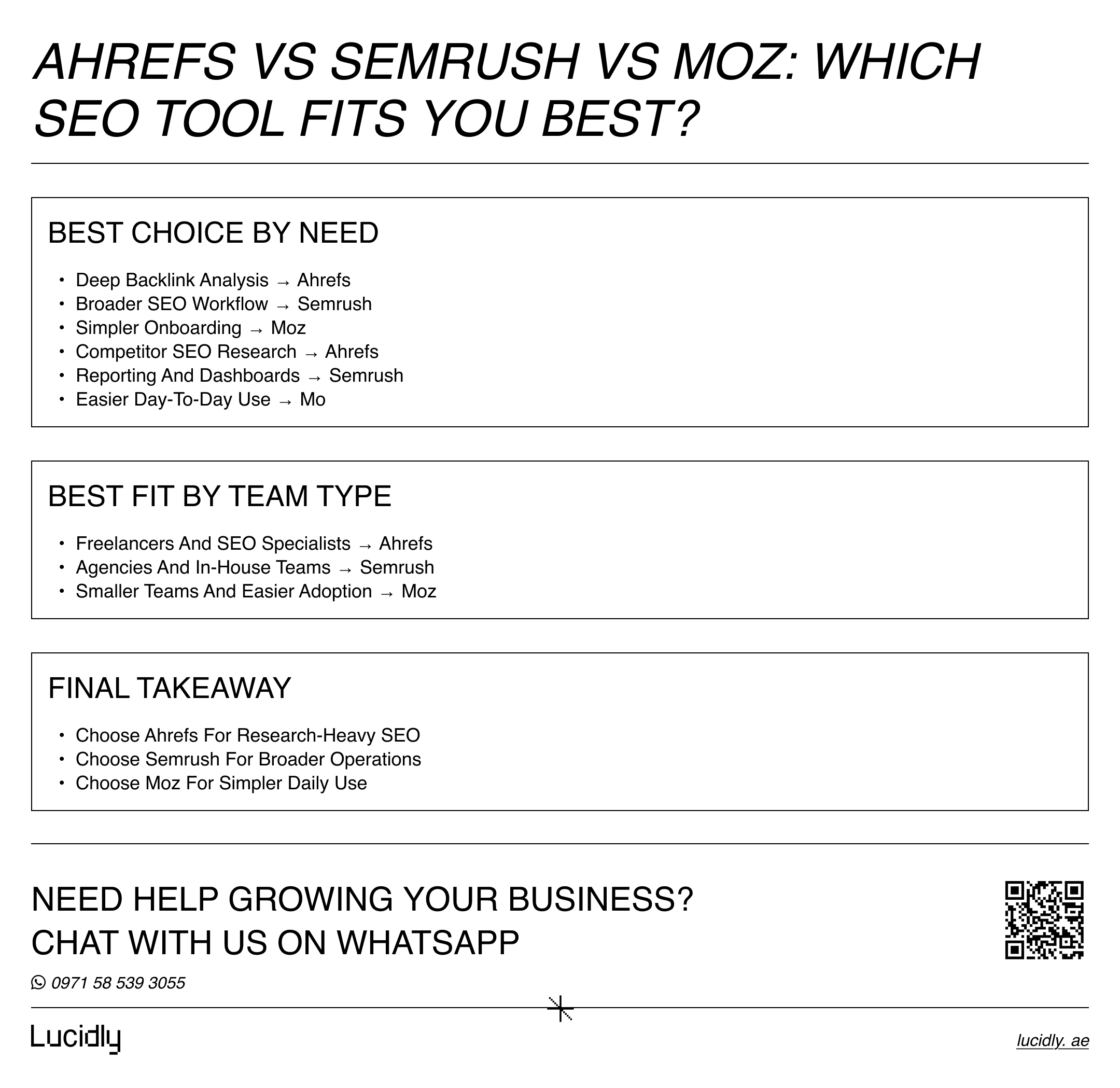
For most teams, the fastest way to decide is this:
Choose Ahrefs if backlink analysis, competitor SEO research, and search-first workflows matter most.
Choose Semrush if you need broader workflow support, stronger reporting, and a more connected SEO operations stack.
Choose Moz if you want a simpler platform with an easier learning curve and lighter setup.
That is the core answer to Semrush vs Ahrefs as well. Ahrefs is usually the better fit for deep SEO research, while Semrush is usually the better fit for broader workflow management and reporting.
Moz enters the conversation when simplicity matters more than maximum depth.
If you need | Best choice |
Deep backlink analysis | Ahrefs |
Broad SEO workflow and reporting | Semrush |
Simpler onboarding | Moz |
Strong Site Explorer-style research | Ahrefs |
Wider competitive visibility stack | Semrush |
Easier day-to-day usage | Moz |
What Really Matters in an SEO Tools Comparison
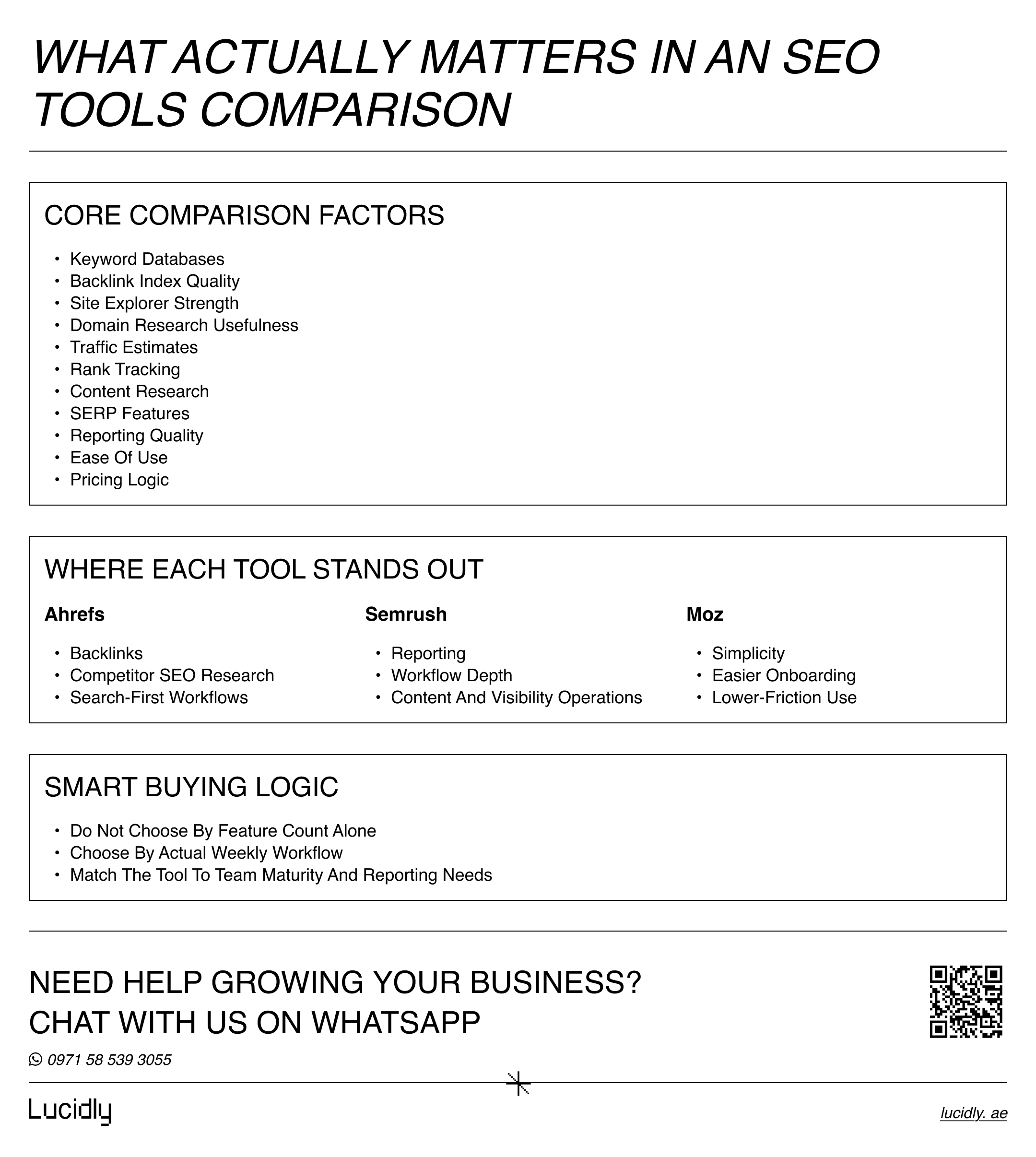
A useful SEO tools comparison should not start with brand popularity. It should start with the real decision criteria and how each platform fits into a broader digital marketing workflow.
The criteria that actually shape the decision.
When businesses compare Ahrefs vs Semrush vs Moz seriously, these are the factors that matter most:
keyword databases and how useful they are for planning and expansion
backlink index depth and quality
site explorer and competitor investigation strength
domain research usefulness
traffic estimates and market direction insight
rank tracking accuracy and usability
content research support
SERP features visibility
reporting quality for internal teams or clients
ease of use, workflow depth, and pricing logic
A platform can look impressive on paper and still be the wrong fit for your team. The better choice is the one that supports your actual SEO work clearly, consistently, and profitably.
To understand how SEO tools fit into the bigger marketing picture, review the role of SEO in digital marketing before choosing between Ahrefs, Semrush, and Moz.
Ahrefs vs Semrush vs Moz: Feature Comparison
The clearest way to compare these platforms is by function, not by brand narrative.
Keyword Research and Keyword Databases
Keyword research is one of the biggest reasons businesses compare Ahrefs vs Semrush vs Moz. All three tools support keyword research, but they do not offer the same depth or workflow value.
Ahrefs is especially strong for search-first research, competitor keyword discovery, content gap analysis, and opportunity mapping.
Independent reviews in 2026 still position Ahrefs as one of the strongest keyword research tools for data depth and advanced search metrics.
Semrush is also strong for keyword research, but it becomes more attractive when keyword discovery needs to connect directly with rank tracking, reporting, site auditing, and broader workflow execution.
Semrush is generally positioned as a broader SEO platform rather than a narrow keyword research tool.
Moz remains useful for keyword research, but it is usually chosen more for accessibility and ease of use than for maximum research depth.
External comparison sources still tend to position Moz as the easier option for smaller teams and less advanced users.
Quick takeaway
Choose Ahrefs for deeper keyword research and competitor discovery.
Choose Semrush for keyword research tied to broader SEO workflows.
Choose Moz for simpler adoption and lighter day-to-day use.
google keyword planner vs semrush
This is a useful side comparison, but it should not be misunderstood.
Google Keyword Planner is a practical free tool for ad-focused keyword discovery and volume direction, and recent reviews still describe it as a good free starting point.
But it is not a replacement for Semrush as a full SEO platform because it does not offer the same level of competitor analysis, site auditing, reporting, or broader search workflow support.
Google Keyword Planner is better for PPC-oriented keyword planning.
Semrush is better for broader SEO workflows.
Semrush adds competitor analysis, audits, tracking, and reporting structure.
Backlink Index and Site Explorer
This is one of the clearest areas where Ahrefs usually stands out.
Ahrefs continues to be widely recognized for strong backlink analysis, a large backlink index, and powerful Site Explorer workflows.
Recent reviews still position it as a premier option for backlink tracking, competitor link analysis, and deep SEO investigation.
Semrush still supports backlink analysis well, but the product identity is broader.
For many teams, that is useful because backlinks are only one part of a wider operational workflow. Moz can still support link analysis, but it is less commonly the first choice for backlink-first SEO.
Ahrefs alternative to Semrush
Some users searching for an Ahrefs alternative to Semrush are not looking for a weaker tool. They are looking for a more SEO-focused one.
In that case, Ahrefs is often the strongest Semrush alternative for teams that care most about backlinks, Site Explorer research, and competitor search visibility rather than broader reporting and operational features.
Ahrefs is strongest for backlink-first workflows.
Semrush is stronger when backlinks are one part of a larger SEO system.
Moz is more suitable when simplicity matters more than maximum depth.
Domain Research and Traffic Estimates
Domain research is not just about seeing a competitor’s ranking keywords. It is about understanding market direction, traffic trends, opportunity gaps, and where SEO visibility is actually moving.
Ahrefs is strong when the focus is organic search visibility, competitor overlap, and search-led domain analysis.
Semrush is broader when the team wants domain research plus extra layers around reporting, content, and operational visibility. Moz is usually less central in this exact lane.
similarweb vs semrush
The comparison between similarweb vs semrush matters because the tools are built for different priorities.
Similarweb is more naturally aligned with traffic intelligence, market trends, and audience-level analysis. Semrush is broader for SEO execution, keyword research, audits, rank tracking, and search visibility management.
That means Similarweb is often the more natural choice for market-level traffic intelligence, while Semrush is the better choice when SEO execution is the main job.
This is also consistent with how Semrush positions its own platform around workflow and visibility rather than pure traffic intelligence alone.
Choose Similarweb when traffic intelligence is the main job.
Choose Semrush when SEO execution is the main job.
Choose Ahrefs when deep search research matters more than market-level modeling.
Rank Tracking, Reporting, and Workflow Depth
This is where Semrush often becomes more attractive, especially for agencies and growing in-house teams.
Many businesses do not just need data. They need dashboards, recurring reporting, structured visibility, and a platform that makes ongoing SEO operations easier to manage. Semrush’s pricing and product structure reflect that broader positioning, with SEO Toolkit and Semrush One clearly framed as larger workflow products rather than simple standalone SEO utilities.
Ahrefs supports rank tracking well, but its overall feel is more research-driven. Moz remains the lighter option.
Semrush is strong for reporting and workflow structure.
Ahrefs is strong for search research and tracking insight.
Moz is easier for simpler reporting needs.
semrush vs google analytics
This is not a real one-to-one replacement comparison.
Google Analytics is first-party analytics focused on user behavior and on-site performance. Semrush is a third-party SEO and visibility platform focused on search, competitors, keyword opportunity, and reporting. They do different jobs.
Google Analytics shows user and website activity.
Semrush adds competitive insight, keyword workflows, and reporting structure.
Most teams benefit from using both.
search console vs semrush
This is another comparison that is often framed the wrong way.
Google Search Console gives first-party Google Search data such as clicks, impressions, CTR, and average position.
Semrush adds third-party competitive insight, site audits, keyword tracking, and broader workflow value.
Search Console should still be used even if you subscribe to Semrush, because first-party and third-party tools do not replace each other.
External 2026 best-tool roundups still place Google Search Console alongside premium SEO suites rather than beneath them as a substitute.
Search Console shows first-party search performance data.
Semrush adds competitor tracking, audits, and broader analysis.
Search Console should still be used even if you subscribe to Semrush.
Content Research and SERP Features
Content planning is now part of almost every serious SEO workflow, which is why content research and SERP features deserve their own comparison section.
Semrush is often stronger for teams that want content planning connected directly to keyword research, reporting, and SEO execution.
Ahrefs is still strong for opportunity discovery, content gaps, and search-led content planning. Moz is usually not the first choice when content operations become more advanced.
buzzsumo vs semrush
buzzsumo vs semrush is useful because the platforms serve different jobs.
BuzzSumo is more specialized in content discovery, trend spotting, and media resonance. Semrush is broader and better suited for SEO execution across content, keyword planning, and performance workflows.
Choose BuzzSumo for content discovery and trend research.
Choose Semrush for broader SEO content workflows.
Choose Ahrefs when search-led content opportunities matter most.
Pricing Comparison in 2026
In an ahrefs vs semrush vs moz comparison, pricing matters, but the lowest starting price does not always mean the best value.
What matters more is what each plan actually gives your team in day-to-day SEO work.
Tool | Current pricing direction | Best fit by budget logic |
Ahrefs | Starter at $29/month; higher tiers include Lite, Standard, Advanced, and Enterprise | Good if you want a low entry point or deep SEO research, but plan limits matter a lot |
Semrush | SEO Toolkit starts at $139.95/month; higher tiers increase with capability; Semrush One is positioned above this as a flagship solution | Better when you need broader workflows and are willing to pay more for them |
Moz | Commonly seen as more approachable than Semrush in market reviews, but current pricing should be verified on the live official page before purchase | Better for simpler needs if pricing and complexity are both concerns |
How to read the pricing properly
Ahrefs can look attractive at entry level, but the real fit depends on usage, data depth, and plan limits.
Semrush starts higher, but that higher price often makes more commercial sense for agencies and teams that need broader reporting, stakeholder visibility, and structured workflow support.
Moz can be more appealing when the team wants a simpler tool and does not need the deepest or widest stack.
The smartest way to read the price section is to ask which platform gives the best value for the work your team actually does every week.
Best Use Cases: Who Should Use Each Tool?
The right platform depends heavily on the type of user. That is why best-use-case analysis is usually more useful than declaring one generic winner.
Best for freelancers and solo SEO work
Freelancers usually need clarity, speed, and high-value insight without unnecessary tool sprawl.
Ahrefs is often the better fit for solo SEO professionals focused on backlinks, competitor research, and keyword opportunity discovery.
Moz is often better for easier adoption and lighter workflows.
Semrush makes more sense when freelance work includes broader reporting, stakeholder updates, or wider visibility tasks.
Best for small businesses and lean teams
Small businesses usually benefit more from practical fit than from feature overload.
Choose Ahrefs if organic growth and competitor SEO are top priorities.
Choose Semrush if the team needs broader reporting and a more connected workflow.
Choose Moz if the team wants less friction and simpler day-to-day use.
If your business is still comparing software options more broadly, it may also help to review the best digital marketing tools for small business before choosing a full SEO platform.
Best for agencies
Agencies usually need stronger reporting, repeatable workflows, and clearer client communication.
Semrush is often better for agencies with multiple workflows and stakeholders.
Ahrefs is excellent for agencies that are highly SEO-focused and backlink-led.
Moz is usually less common as a first choice for more advanced agency operations.
Best for backlink-led SEO
Some teams care more about link analysis than anything else.
Ahrefs is usually the strongest fit.
Semrush is still useful, but less specialized in this lane.
Moz is not usually the first choice here.
Best for broader search and visibility workflows
Some teams want more than SEO. They want a wider platform for visibility, tracking, and connected operations.
Semrush is usually the better choice here.
Ahrefs remains excellent for research.
Moz remains better for lighter use cases.
If you need more context on the platform itself before comparing it with other tools, see Semrush Explained: What It Does and Why Marketers Use It.
Best for simpler SEO adoption
Not every team wants the deepest platform. Some want the clearest one.
Moz is usually the most sensible choice for easier onboarding.
Ahrefs is better for users already comfortable with deeper SEO research.
Semrush is better when the team is ready for more moving parts.
Pros and Cons of Each Tool
A clean comparison table makes this section easier to scan. It reinforces the decision without repeating the full article.
Tool | Pros | Cons | Best fit |
Ahrefs | Strong backlink analysis, powerful Site Explorer, excellent competitor SEO research, strong fit for research-heavy workflows | Less broad than Semrush in wider operational workflows, plan limits may matter more than the entry price suggests | SEO-focused users who need deep research, backlink analysis, and competitor discovery |
Semrush | Broad SEO and visibility workflow support, strong reporting, good for teams and agencies, stronger fit for connected operations | Higher starting cost, can feel heavier than necessary for simple use cases | Agencies, in-house teams, and businesses that need broader workflows and structured reporting |
Moz | Easier learning curve, cleaner setup for smaller teams, lower-friction workflow | Less likely to be the best choice for deep backlink-first SEO, less broad than Semrush for wider visibility operations | Smaller teams and users who want a simpler SEO platform with easier adoption |
Which Tool Makes the Most Sense for UAE Businesses?
For UAE businesses comparing Ahrefs vs Semrush vs Moz, practical fit matters more than brand size.
A smaller service business in Dubai or Abu Dhabi may get more direct value from Ahrefs if the main goal is competitor SEO, backlink opportunities, and organic search growth.
A growing in-house marketing team may get more value from Semrush if reporting, cross-functional visibility, stakeholder communication, and broader marketing operations matter more.
A smaller company with limited SEO maturity may find Moz easier to adopt, especially if the team wants a lighter tool and quicker internal uptake.
If you want to evaluate SEO tools within a broader growth strategy, Lucidly’s digital marketing services page offers a useful next step.
UAE-specific buying logic
If the business is focused mainly on:
organic rankings and competitor SEO, Ahrefs is often the cleaner choice
reporting, stakeholder visibility, and structured operations, Semrush is often the stronger choice
lighter adoption with less internal friction, Moz is often the simpler choice
FAQ
Which is better: Ahrefs or Semrush?
Ahrefs is usually better for backlink analysis, Site Explorer workflows, and deep search-focused competitor research. Semrush is usually better for broader SEO operations, reporting, and connected workflow needs.
When should I use Moz instead?
Use Moz when you want a simpler tool, a lighter workflow, and an easier learning curve. It is often a better fit for smaller teams and less advanced SEO setups. That is where Moz remains most relevant in an SEO tools comparison.
Is Similarweb better for traffic data than Semrush?
For traffic intelligence and market-level analysis, Similarweb is often more naturally focused on that job. Semrush is broader when the goal is SEO execution plus tracking and reporting. So yes, Similarweb can be the better choice for pure traffic intelligence, but not for all-around SEO workflow.
Can Google Keyword Planner replace Semrush?
No. Google Keyword Planner is useful for ad-focused keyword discovery, but it does not replace Semrush for competitor analysis, audits, backlinks, reporting, and broader SEO workflow needs.
Do I still need Search Console if I use Semrush?
Yes. Search Console provides first-party Google Search data, while Semrush adds competitive insight, tracking, audits, and broader workflow value. Most teams should use both.
Choose Ahrefs if backlinks, competitor research, and search-first analysis matter most. Choose Semrush if you need broader workflows, stronger reporting, and wider visibility operations. Choose Moz if simplicity, easier onboarding, and a lighter workflow matter more.
The best answer to Ahrefs vs Semrush vs Moz is not one winner for everyone. It is the tool that best fits your team, your budget, and your weekly SEO workflow.
If you are still unsure which SEO tool best fits your business, message Lucidly on WhatsApp for a practical recommendation based on your goals, budget, and growth stage, or use the phone numbers listed on the Contact Us page.